


Water is fundamental to our lives, integral to the food we eat, the energy we use, and the environments we cherish. However, across Europe, water supplies face increasing pressures. Climate change is exacerbating droughts, floods, and pollution, threatening the cleanliness, availability, and long-term sustainability of this vital resource. Recognizing the urgency of this challenge, the European Economic and Social Committee (EESC) launched the “EU Blue Deal” in 2023 to guide Europe’s efforts toward sustainable water management.
The EU Blue Deal aims to address Europe’s water challenges by promoting sustainable and responsible water use across agriculture, industry, and urban development. Currently in the advocacy and consultation phase, the Blue Deal reflects Europe’s commitment to water security through collaborative, cross-sectoral strategies. Here’s an in-depth look at its guiding principles, goals, and proposed actions.
Need the Gist? Check out the infographic below for a quick, visual summary of the key points!
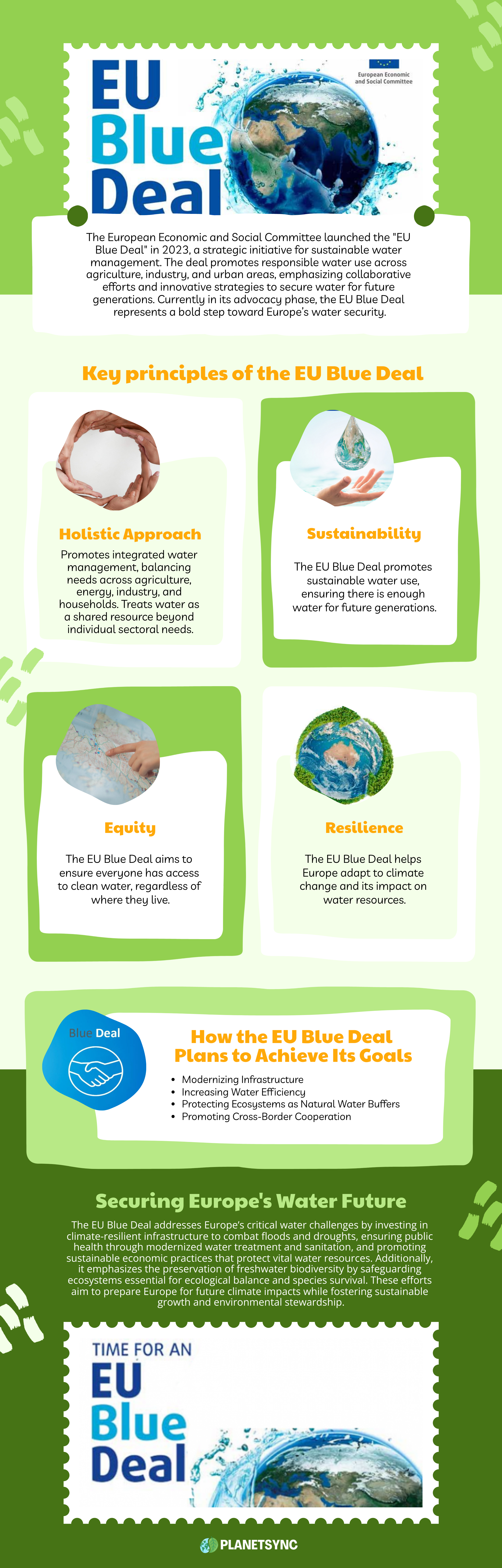
Key principles of the Blue Deal:
- Holistic Approach: the EU Blue Deal advocates an integrated approach to water management, aiming for a balanced allocation across sectors like agriculture, energy, industry, and households. It complements existing frameworks—particularly the EU Water Framework Directive—by encouraging member states to prioritize water security as a core element of sustainable development. This integrated approach aligns with the European Commission’s objective to treat water as a shared, essential resource transcending individual sectoral needs.
- Sustainability: at the core of the EU Blue Deal is sustainable water use to address challenges like depleted rivers and aquifers due to over-extraction. The EESC’s framework promotes efficient water practices, including precision irrigation in agriculture and closed-loop water systems in industry, to meet today’s needs while safeguarding resources for future generations.
- Equity: access to clean water is a fundamental right, yet disparities persist in rural and economically disadvantaged areas across Europe. The EU Blue Deal seeks to reduce these inequities by advocating for modernized infrastructure that provides reliable access to clean water for all EU citizens. This emphasis on equitable water access aligns with the EU’s broader goals of social sustainability.
- Resilience: climate change presents a severe risk to Europe’s water resources, with increased droughts, floods, and extreme weather events. Building resilience is central to the EU Blue Deal, which supports investments in climate-adaptive infrastructure, such as flood defenses and drought-preparedness systems. These measures aim to protect Europe’s water systems from future climate impacts, highlighting resilience as both an environmental and economic imperative.
How the Blue Deal Plans to Achieve Its Goals
Although the EU Blue Deal is still in its development phase, it outlines several key strategies to support sustainable water management across member states:
- Modernizing Infrastructure: Europe’s water infrastructure—such as treatment plants and wastewater systems—was largely constructed decades ago and requires updates to meet current environmental and health standards. The EU Blue Deal encourages modernization efforts to improve water quality, reduce waste, and increase efficiency in resource use.
- Increasing Water Efficiency: agriculture, which consumes a large share of Europe’s water, is a primary focus for efficiency improvements. Technologies such as precision irrigation and closed-loop systems in industrial settings are highlighted as effective ways to reduce water usage. The EU Blue Deal advocates for these approaches to make sustainable water use feasible across the continent.
- Protecting Ecosystems as Natural Water Buffers: wetlands, forests, and other ecosystems act as natural reservoirs, storing water during wet periods and releasing it during dry times. The EU Blue Deal prioritizes the protection of these ecosystems as a cost-effective way to stabilize the water cycle and maintain water quality. By supporting these natural buffers, the European Environment Agency underscores the critical role ecosystems play in filtering pollutants and preventing floods.
- Promoting Cross-Border Cooperation: recognizing that Europe’s rivers and lakes often span multiple countries, the EU Blue Deal encourages shared water management strategies, particularly for transboundary rivers like the Danube and Rhine. Collaborative, cross-border approaches align with existing EU policies, enabling coordinated governance to address pollution and water-sharing challenges equitably.
Why the Blue Deal Matters?
The EU Blue Deal has several key goals to address the significant water-related challenges Europe faces:
- Building Climate Resilience: Investments in flood defenses, drought preparation, and climate-resilient infrastructure are essential for adapting to climate impacts on water systems. By advocating for these initiatives, the EU Blue Deal aims to mitigate future costs associated with extreme weather, preparing Europe for climate challenges.
- Protecting Public Health: Access to clean water and sanitation is essential for public health. By supporting the modernization of water treatment facilities and sanitation systems, the EU Blue Deal seeks to reduce pollution and prevent waterborne diseases, especially in areas with outdated infrastructure.
- Supporting a Sustainable Economy: Industries like agriculture and tourism rely heavily on clean, reliable water supplies. By emphasizing water efficiency and conservation, the EU Blue Deal aims to foster a sustainable economic model that encourages growth while preserving vital resources. This initiative also supports job creation and economic stability in water-dependent sectors.
- Preserving Biodiversity and Ecosystem Health: Freshwater ecosystems are among the most biodiverse, supporting species ranging from fish to bird habitats. The EU Blue Deal’s commitment to ecosystem protection aims to maintain ecological balance and safeguard biodiversity.


 planetsync.blog
Leave a comment