

In my previous article, we explored the updated EU Drinking Water Directive (DWD) and its key improvements designed to tackle modern water challenges. But how does the EU make sure these ambitious standards are met, ensuring safe drinking water for millions of citizens? What challenges do countries face in implementing these new standards, and how can everyday people get involved in water management? In this article, we’ll dive into these critical points.
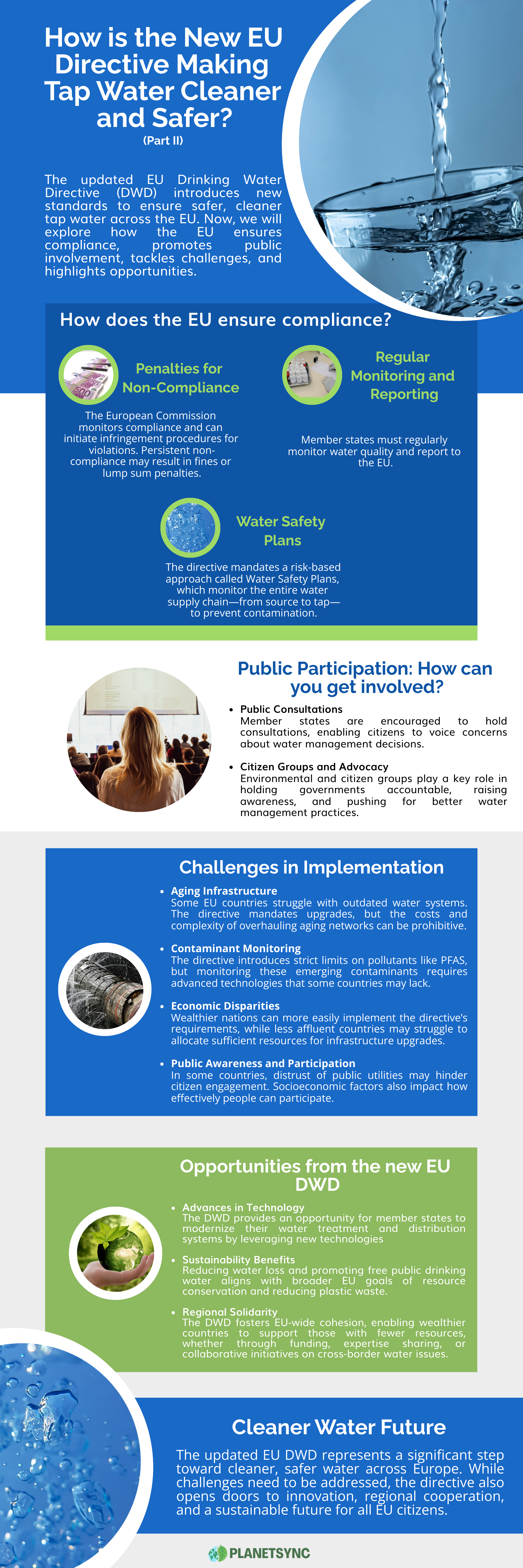
Need the Gist? Check out the infographic below for a quick, visual summary of the key points!
How does the EU ensure compliance?
The EU doesn’t just leave it up to each country to figure out how to meet the new water standards—it closely monitors and enforces compliance to ensure everyone has access to clean, safe drinking water.
Penalties for Non-Compliance
If a member state doesn’t meet the new water standards, there are consequences. The European Commission monitors compliance with EU law. When a member state fails to comply with the directive, the Commission can initiate infringement procedures. Persistent non-compliance may lead to fines or lump sum penalties imposed by the European Court of Justice. These penalties aren’t just about punishment—they’re about making sure countries take action to improve water quality.
Regular Monitoring and Reporting
Member states are required to regularly monitor water quality and report their findings to the EU. If a country is falling behind, the EU can step in to provide support or push for stronger measures. This monitoring also helps identify where problems exist, such as aging infrastructure or high levels of pollutants like PFAS, which are harmful chemicals that the directive targets.
Water Safety Plans
As part of the updated DWD, a risk-based approach is mandatory. This includes monitoring the entire water supply chain—an approach known as Water Safety Plans (WSPs) recommended by the WHO—which focuses on preventing contamination at every stage, from source to tap.
Why is it not so easy to implement the EU DWD?
Aging Infrastructure
One of the most significant challenges in implementing the DWD is the state of water distribution infrastructure across Europe. Some countries, particularly in Eastern Europe, still rely on aging pipelines that are prone to leaks and contamination. For instance, in countries like Bulgaria and Romania, infrastructure is outdated, leading to high water loss and potential contamination. The DWD mandates improvements, but the costs and logistics of overhauling entire water networks can be prohibitive, requiring substantial investment and coordination between local, national, and EU-level authorities.
Contaminant Monitoring and Regulation
The new DWD introduces stringent limits on contaminants like PFAS. However, monitoring for these emerging pollutants requires advanced technology and expertise that some member states lack. Building the necessary infrastructure to monitor and regulate such chemicals presents a significant challenge, particularly in countries with limited resources.
Economic Disparities Between Member States
The EU’s commitment to ensuring equitable access to clean water for all, including marginalized and vulnerable populations, is a central feature of the directive. However, the economic disparities between wealthier member states like Germany and the Netherlands and less affluent nations such as Greece or Latvia create challenges in achieving this goal. Wealthier countries may more easily implement the directive’s provisions, while poorer nations might struggle to allocate the necessary funding to upgrade water infrastructure and ensure broad access to safe drinking water.
Public Awareness and Participation
The directive emphasizes public participation, transparency, and local consultation in water management, but public awareness and engagement with water safety issues vary significantly across the EU. In countries like Italy and Spain, where trust in public utilities has sometimes been low, engaging citizens and ensuring they understand and contribute to water safety decisions could prove difficult. Moreover, socioeconomic factors, and access to information play a role in limiting public involvement in some regions.
What opportunities does the implementation of the new EU DWD offer?
Advancement in water safety technology
The DWD provides a unique opportunity for member states to modernize their water treatment and distribution systems by leveraging new technologies. Advanced sensors, for example, can be used to detect contamination in real-time, and smart water management systems can help reduce water loss by identifying leaks quickly. In countries like the Netherlands, where there is already substantial investment in water infrastructure, these advancements could serve as a model for other member states.
Sustainability benefits
The directive’s emphasis on reducing water loss and providing free public drinking water aligns with the EU’s sustainability goals, contributing to resource conservation and the reduction of plastic waste.
Strengthened regional cohesion and solidarity
The directive reinforces the EU’s commitment to cohesion, ensuring that water safety is not only a local responsibility but a shared goal across the entire Union. By setting common standards, wealthier states can support those with fewer resources, either through direct funding, expertise sharing, or EU-level support mechanisms. This creates opportunities for regional solidarity, especially in tackling water issues that don’t stop at borders, such as the contamination of shared water bodies.
Public Participation: How can you get involved?
One of the most significant shifts in the updated directive is the emphasis on public participation. Water management isn’t just a government responsibility anymore—everyone has a role to play. The DWD encourages public involvement in several ways:
Public Consultations
The EU encourages member states to hold public consultations on water management decisions. This allows citizens to voice their concerns and contribute to how their local water systems are managed. You don’t need to be an expert to get involved—your experiences and input matter.
Citizen groups and advocacy
Many environmental and citizen groups actively participate in shaping water policy, and the updated directive encourages this involvement. These groups can hold governments accountable, raise awareness, and push for better water management practices.
Towards a Cleaner, Healthier Water Future for All
The updated EU DWD represents both an ambitious regulatory step forward and a test of the EU’s ability to address modern environmental and public health challenges. While implementing the DWD requires overcoming significant hurdles, from infrastructure upgrades to economic disparities, it also opens the door to innovation, cooperation, and a healthier, more sustainable future for all EU citizens. By focusing on emerging risks, vulnerable populations, and transparency, the directive not only ensures cleaner water but also promotes a broader vision of environmental equity across Europe.
References & Resources
- Infringement procedure
- Improving access to drinking water for all
- Directive (EU) 2020/2184 of the European Parliament and of the Council of 16 December 2020 on the quality of water intended for human consumption (recast)
- Zero pollution: Improved quality and access to drinking water
- Implementation of the Chemicals Strategy


 planetsync.blog
Leave a comment