


As climate change accelerates, finding effective solutions has never been more urgent. One promising technology that makes waves is Direct Air Capture (DAC), which uses carbon mineralization. This advanced approach not only captures carbon dioxide directly from the air but also stores it permanently. But what exactly does this mean, and why is this important? Let’s dive into how capturing carbon from the air could be a game-changer in our fight against climate change.
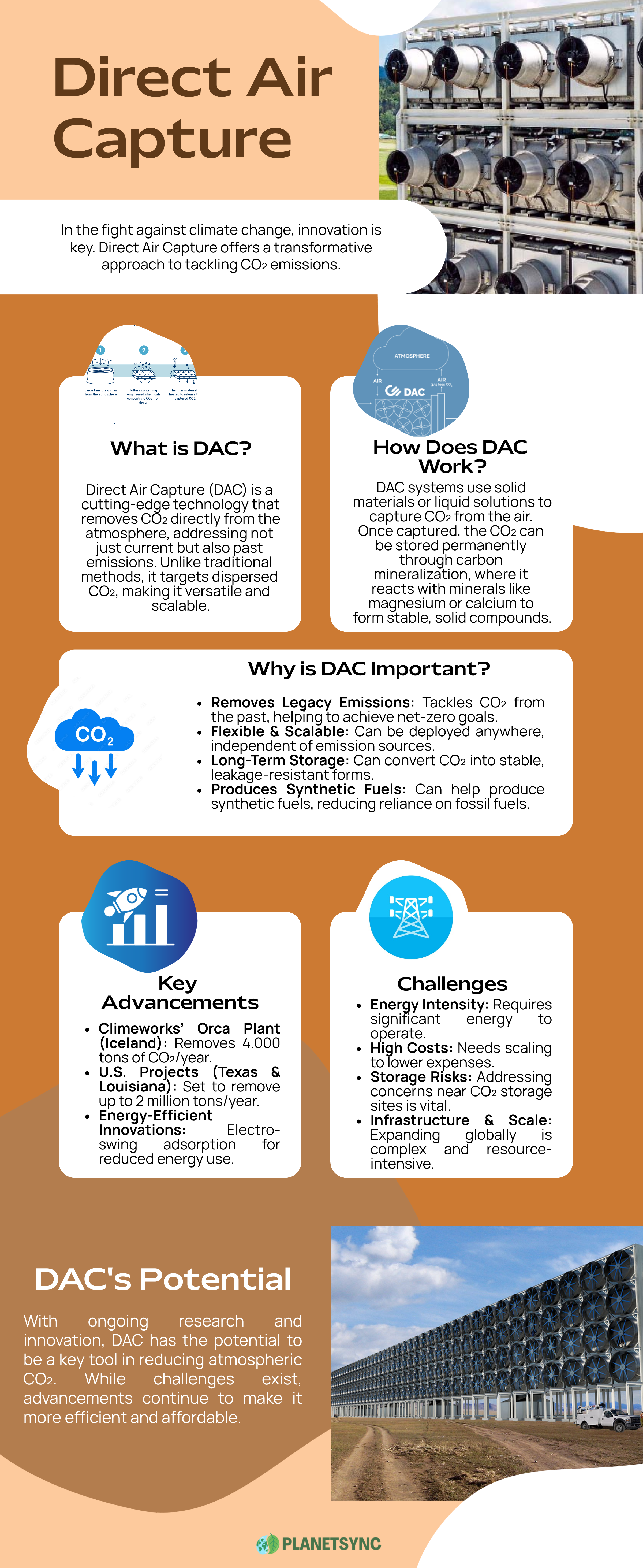
Need the Gist? Check out the infographic below for a quick, visual summary of the key points!
What is DAC?
Direct Air Capture (DAC) is a technology designed to remove carbon dioxide (CO₂) directly from the atmosphere. Unlike traditional carbon capture methods that focus on capturing CO₂ at the source of emissions (like power plants), DAC systems target CO₂ already present in the air. This makes it a versatile tool for addressing the massive amounts of CO₂ that have accumulated over time.
How Does DAC Work?
DAC is designed to capture CO₂ using two primary technologies:
- Solid DAC (S-DAC): This method uses solid adsorbents, which absorb CO₂ from the air. When heated, these materials release the captured CO₂, which is then stored or utilized.
- Liquid DAC (L-DAC): This method involves using liquid solutions such as potassium hydroxide to chemically bind CO₂. The CO₂ is then separated and stored after treatment.
Once captured, the CO₂ can be permanently stored through a process called carbon mineralization. Here, the CO₂ reacts with minerals like magnesium or calcium to form stable carbonates. This method ensures that the CO₂ remains securely stored for centuries, reducing the risk of leakage.
Why Is This Important?
- Addressing Legacy Emissions: DAC can help remove CO₂ from the atmosphere that was emitted long ago. This is crucial for achieving net-zero emissions and mitigating past pollution.
- Flexibility and Scalability: Unlike traditional point-source carbon capture technologies, DAC can be deployed almost anywhere, as it is not tied to specific emission sources. This flexibility allows it to address dispersed CO₂ emissions.
- Long-Term Storage: The mineralization process provides long-term carbon storage, converting CO₂ into stable carbonates, which reduces the risk of leakage and ensures that captured CO₂ remains sequestered for centuries.
- Potential to Produce Synthetic Fuels: DAC can also contribute to the production of synthetic clean fuels, reducing reliance on fossil fuels and further lowering greenhouse gas emissions.
Recent Advancements and Developments
- Climeworks’ Orca Plant: Located in Iceland, this facility captures and stores CO₂ underground, removing around 4.000 tons annually. It’s a significant step toward scaling up DAC technology.
- New Projects in the U.S.: two new DAC projects in Texas and Louisiana are slated for completion by 2024 and 2025. These plants aim to collectively remove up to 2 million metric tons of CO₂ per year.
- Research is advancing on reducing the energy intensity of DAC systems, with innovations like electro-swing adsorption (ESA), which uses electrochemical cells to capture CO₂ more efficiently.
Challenges to Overcome
Despite its potential, DAC faces several challenges:
- Energy Intensity: DAC is highly energy-intensive, particularly when compared to traditional carbon capture methods.
- Cost: Current DAC plants operate on a small scale, and the technology is still expensive. Scaling up operations and reducing costs through innovation will be crucial for widespread adoption.
- Environmental and Social Concerns: There are concerns about the potential risks associated with underground CO₂ storage, particularly for communities near storage sites. Addressing these risks through thorough environmental assessments and regulatory frameworks will be essential.
- Scalability: Expanding DAC operations to a global scale presents its own set of challenges, from infrastructure requirements to ensuring an adequate energy supply for large-scale deployment.
The Road Ahead
Direct Air Capture with carbon mineralization represents a promising approach for reducing atmospheric CO₂ levels. While there are hurdles to overcome, ongoing research and development are crucial to making this technology more efficient and affordable. As we continue to explore and invest in DAC, it could become a key tool in our climate action toolkit.
Keep an eye on this technology—it might just be the breakthrough we need in the fight against climate change.pacts remain.


 planetsync.blog
Leave a comment