


Our planet’s most pressing challenges demand innovation fueled by diverse perspectives. In environmental science, where issues like climate change, biodiversity loss, and escalating pollution continually reshape our world, the insights and expertise of a diverse spectrum of talent are indispensable. Women’s unique viewpoints not only enrich scientific inquiry but also help craft solutions that are effective, equitable, and represent a vital pathway to a sustainable future.
Need the Gist? Swipe through the visuals below for a quick summary!


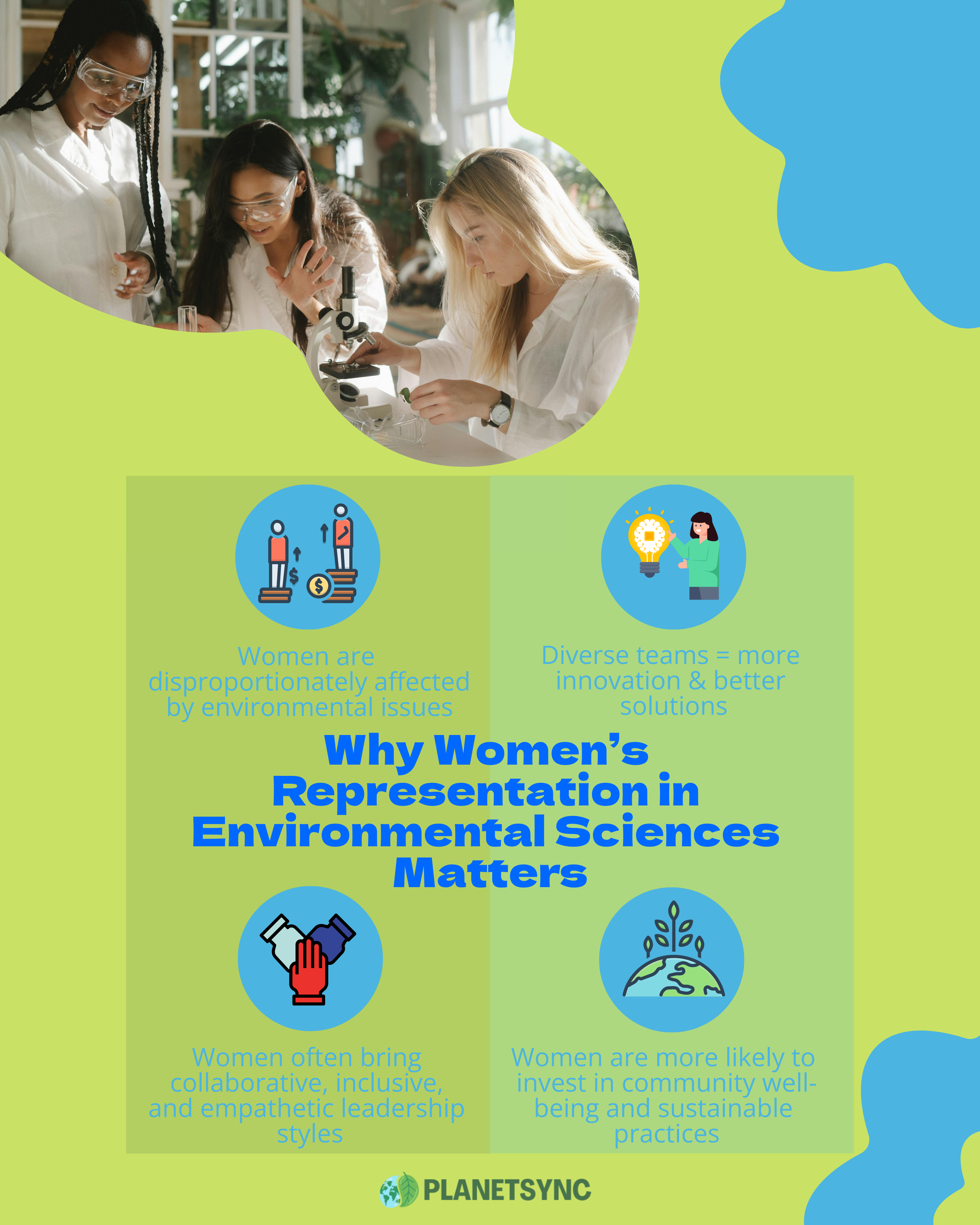


Why Women’s Representation in Environmental Sciences Matters
Some may worry that advocating for women’s representation means lowering standards or giving special treatment. In reality, it’s about ensuring that the most capable individuals, regardless of gender, have an equal opportunity to compete, contribute and succeed based on their skills, knowledge, and expertise. A true meritocracy isn’t about exclusion, favoritism or given women an unfair advantage; it’s about fostering an environment where the best minds rise to the top.
This principle applies across all fields, including STEM, where innovation thrives on diverse perspectives. Environmental sciences are no exception. So why does women’s representation in environmental sciences matter?
Diversity Drives Innovation
As we face complex global challenges, the need for a broad range of perspective has never been greater. Women bring unique viewpoints, experiences, and problem-solving approaches that complement those of their male counterparts. Research consistently shows that diverse teams are more innovative and produce better outcomes. In environmental science, diversity of thought can lead to more creative and effective solutions.
Women Are Disproportionately Affected by Environmental Issues
Women, particularly in developing countries, are often more vulnerable to the impacts of environmental degradation. They are frequently responsible for securing water, food, and fuel for their families, making them directly affected by challenges like deforestation, water scarcity, and climate change. According to the United Nations, women and girls in some regions spend a combined 200 million hours every day collecting water, and they make up 80% of those displaced by climate-related disasters. If environmental science is to address real-world problems, it must include the perspectives of those most affected.
Women’s Leadership Strengthens the Field
Women often bring collaborative, inclusive, and empathetic leadership styles, which are critical for addressing global environmental challenges that require cooperation across disciplines and borders. Studies show that women leaders are more likely to prioritize sustainability and foster teamwork. Their leadership can bridge gaps between science, policy, and community action, ensuring that solutions are both scientifically sound and socially effective.
Economic and Social Benefits of Inclusion
Increasing women’s representation in environmental science isn’t just good for science, it’s good for society. Women are more likely to invest in community well-being and sustainable practices, which can lead to greater social stability and economic growth. The World Bank has found that gender equality in STEM fields boosts productivity and improves development outcomes. Environmental science is deeply connected to social and economic systems, and women’s involvement ensures that solutions are holistic and benefit everyone.
Barriers Preventing Women from Advancing in Sciences
Despite their potential, women in environmental science, like women in other STEM fields, face a range of barriers that limit their participation and advancement. The most significant obstacles include:
Gender Stereotypes and Bias
From an early age, girls are often subtly steered away from STEM fields due to societal stereotypes about gender roles. This can lead to fewer opportunities to engage with science-related activities and a lack of confidence in pursuing these paths.
Workplace Discrimination and Bias
Women often face bias in hiring, promotions, and access to resources. Implicit bias can also affect how their work is evaluated, making it harder for them to gain recognition for their contributions.
Lack of Role Models and Mentorship
With fewer women in senior positions, aspiring female scientists and professionals often struggle to find mentors who can guide them through academic and career challenges. Mentorship is crucial in any field, but in STEM, where women are still underrepresented in leadership, this gap can create additional hurdles. Without visible role models, young women may find it harder to envision themselves thriving in these careers, reinforcing the perception that success is out of reach. Access to experienced female leaders who can offer guidance, share strategies for overcoming obstacles, and advocate for equitable opportunities is essential for fostering confidence and career growth.
Rigid Work Environments
STEM career structures often fail to support a healthy work-life balance, especially for women who take maternity leave. The traditional model of scientific careers is built around uninterrupted research trajectories, making it challenging for those who step away for caregiving responsibilities to re-enter and advance. As a result, many talented professionals face setbacks not due to a lack of ability, but because the system isn’t designed to accommodate different life paths.
Funding Disparities
Studies have shown that women in STEM often receive less research funding than their male counterparts. This disparity can limit their ability to conduct research, publish their findings, and advance their careers.
The Barriers Are Real, But the Fixes Are Simple
Fortunately, there are straightforward ways to change the trajectory:
Early Engagement and Education
Encouraging an interest in environmental science from an early age helps expand the talent pool. Providing young girls with exposure to STEM opportunities, hands-on experiences, and visible role models can inspire their long-term interest and confidence in pursuing careers in the field.
Stronger Networks and Mentorship
Formal mentorship programs, especially those that connect early-career professionals with experienced leaders, help equip women with the guidance and support needed to navigate challenges and advance in their careers. When those in leadership roles actively mentor the next generation, they foster a cycle of inclusion and opportunity.
Recognizing Talent, Not Gender
The focus should be on ensuring the best ideas get funded and supported, regardless of who presents them. This requires fair and unbiased evaluation processes in areas such as grant funding, promotions, and awards. A system that prioritizes excellence over preconceived biases ultimately strengthens the entire field.
Equitable Funding Practices
Funding bodies should implement mechanisms to ensure transparent, structured review processes, bias-awareness training for reviewers, and accountability measures ensures that funding decisions are made based on merit and impact rather than unconscious biases.
Reentry Programs for Career Breaks
Many professionals, both men and women, take career breaks for caregiving or other responsibilities. Structured reentry programs help ensure that individuals returning to STEM careers can continue to contribute their expertise without unnecessary barriers. These programs prevent skill erosion and allow organizations to retain valuable talent in the workforce.
Changing Perceptions Through Public Awareness
Media and educational institutions play a vital role in shaping societal perceptions. By highlighting the achievements of women in environmental science, we normalize female leadership in STEM and challenge outdated stereotypes. Showcasing diverse role models benefits not only young girls but also the broader public by reinforcing that innovation and expertise are not bound by gender.
Inspiring Examples of Women in Environmental Sciences
Throughout history, women have made groundbreaking contributions to environmental science, often overcoming significant barriers to do so. These women didn’t succeed despite being women, they succeeded because they were brilliant, dedicated, and passionate about their work. Their achievements serve as proof that when talent is recognized and supported, innovation thrives. Some notable examples include:
Rachel Carson
A marine biologist and writer, Carson is widely credited with launching the modern environmental movement. Her groundbreaking book, Silent Spring, exposed the harmful effects of pesticides, particularly DDT, on the environment and human health. Her work spurred public awareness and led to stricter regulations on pesticide use.
Katharine Hayhoe
A climate scientist and communicator. Hayhoe is a professor at Texas Tech University and the chief scientist for The Nature Conservancy. She is known for her research on climate change impacts and her efforts to communicate climate science to a broad audience, including those with diverse political views.
Jane Lubchenco
A marine ecologist and former administrator of the National Oceanic and Atmospheric Administration (NOAA). Lubchenco is known for her work on marine ecosystems, climate change, and science policy. She has emphasized the importance of using scientific knowledge to inform environmental decision-making.
Wangari Maathai
A Kenyan environmentalist, political activist, and Nobel Peace Prize laureate. Maathai founded the Green Belt Movement, an organization that has planted millions of trees across Kenya, empowering women and promoting sustainable development. She was a vocal advocate for environmental conservation, social justice, and peace.
Science Wins When We Stop Leaving Talent on the Table
When we exclude or overlook talented individuals, whether intentionally or unintentionally, we all lose out. The challenges we face are too complex to be solved by only half the population. By ensuring women have equal opportunities to contribute, we don’t just make environmental science fairer, we make it better.
Let’s commit to breaking down barriers, celebrating achievements, and creating a future where everyone, regardless of gender, can contribute to solving the world’s greatest challenges.
References & Resources
- Feminist climate justice: A framework for action. 2023. UN Women – Headquarters
- Gender and climate action. 2023. UNEP – UN Environment Programme
- Gender, climate and security: Sustaining inclusive peace on the frontlines of climate change. (2020, November 4). UN Women – Headquarters
- Dee, T., & Gershenson, S. (2017, August). Unconscious Bias in the Classroom: Evidence and Opportunities. Google’s Computer Science Education Research
- SALAMON, H. (2022). The effect of women’s parliamentary participation on renewable energy policy outcomes. European Journal of Political Research, 62(1), 174–196.
- European Commission: Directorate-General for Education, Youth, Sport and Culture, Evagorou, M., Puig, B., Bayram, D., & Janeckova, H. (2024). Addressing the gender gap in STEM education across educational levels : analytical report, Publications Office of the European Union.
- Empowering women in science: How the EU is driving change for gender equality in R&I. (2025, February 7). European Research Executive Agency.
- Women’s leadership in environmental action. (2022, April 29). OECD
- Five Reasons Why Climate Action Needs Women. (2023, March 8). UNFCC
- Harrington, S. (2019, September 12). Countries with more female politicians pass more ambitious climate policies, study suggests. Yale Climate Connections
- Lesi, S. (2023, July 28). To fight climate change, more female leaders are fundamental. European Investment Bank
- Decision-making in environment and climate change: women woefully under-represented in the EU Member States. (2021, November 15). European Institute for Gender Equality
- Why women are key to climate action. United Nations.
- Our sustainable future depends on gender equality. (2022, March). UNEP-WCMC
- New guidance from UN Women and UNEP FI – Advancing Gender Equality and Women’s Empowerment. (2021). UNEP FI
- The STEM Gap: Women and Girls in Science, Technology, Engineering and Mathematics. AAUW
- Fast Facts: Early Barriers to Girls & Women in STEM. AAUW


 planetsync.blog
Leave a comment