


April 22, 2025, marks the 55th anniversary of Earth Day. This year’s theme, “Our Power, Our Planet,” puts a spotlight on a critical challenge of our time: tripling renewable energy by 2030.
But what does that actually mean, and why does it matter so much? Let’s break it down!
Need the Gist? Swipe through the visuals below for a quick summary!




The Problem: Burning Fossil Fuels Heats Up the Planet
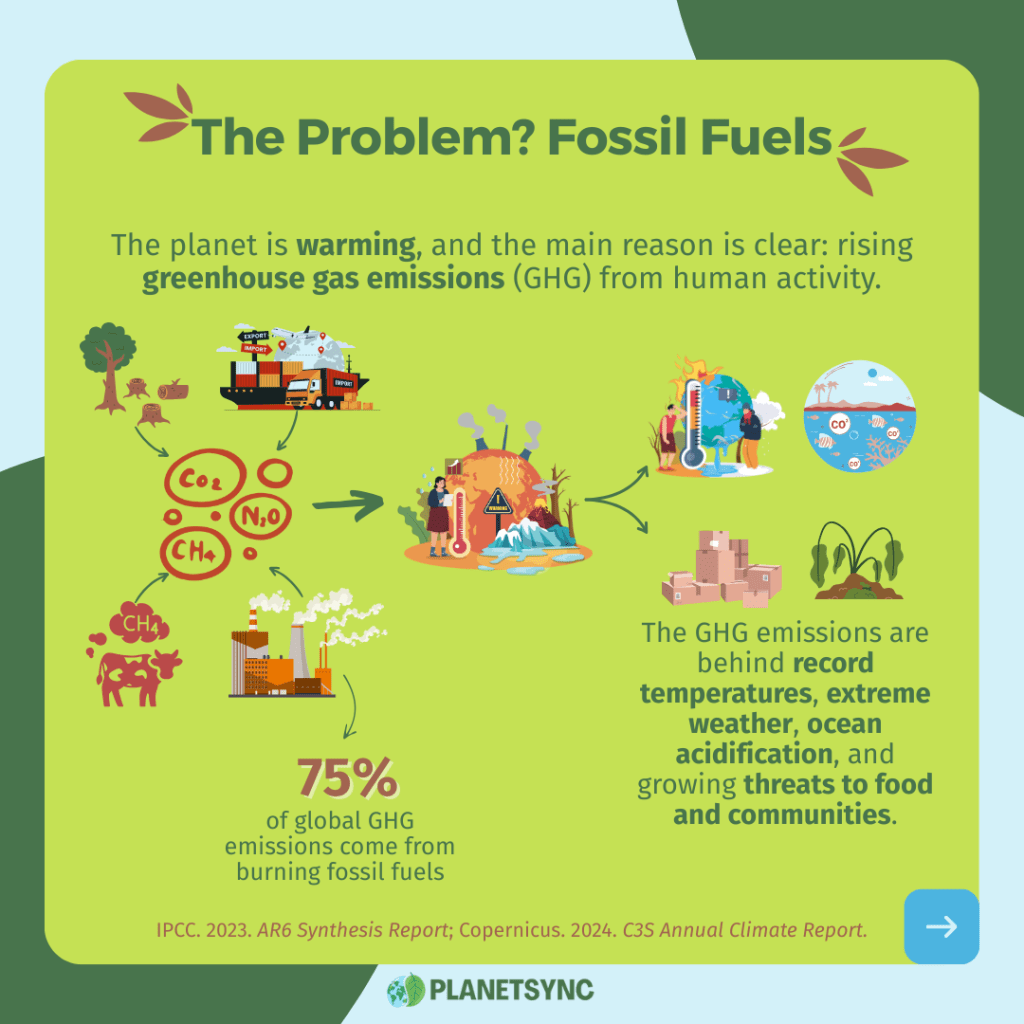
The Intergovernmental Panel on Climate Change (IPCC), the United Nations’ leading authority on climate science, has concluded that human activity is warming the planet. This warming is primarily driven by the continued increase in global greenhouse gas (GHG) emissions, stemming from unsustainable energy use (especially fossil fuels), land use practices, and consumption and production patterns.
Notably, the burning of fossil fuels (coal, oil, and gas) for electricity, heat, and transportation is the largest source of human-caused CO₂ emissions, accounting for roughly 75% of all global GHG. This process releases carbon dioxide (CO₂) and methane (CH₄) that trap heat in the atmosphere (the greenhouse effect), causing:
- Record-breaking global temperatures. 2024 was the warmest year ever recorded, with monthly global average temperatures exceeding 1.5°C above pre-industrial levels for 11 months
- More intense and frequent extreme weather events
- Ocean acidification and coral reef loss
- Displacement of communities and rising food insecurity
One Key Solution: Expansion of Renewable Energy
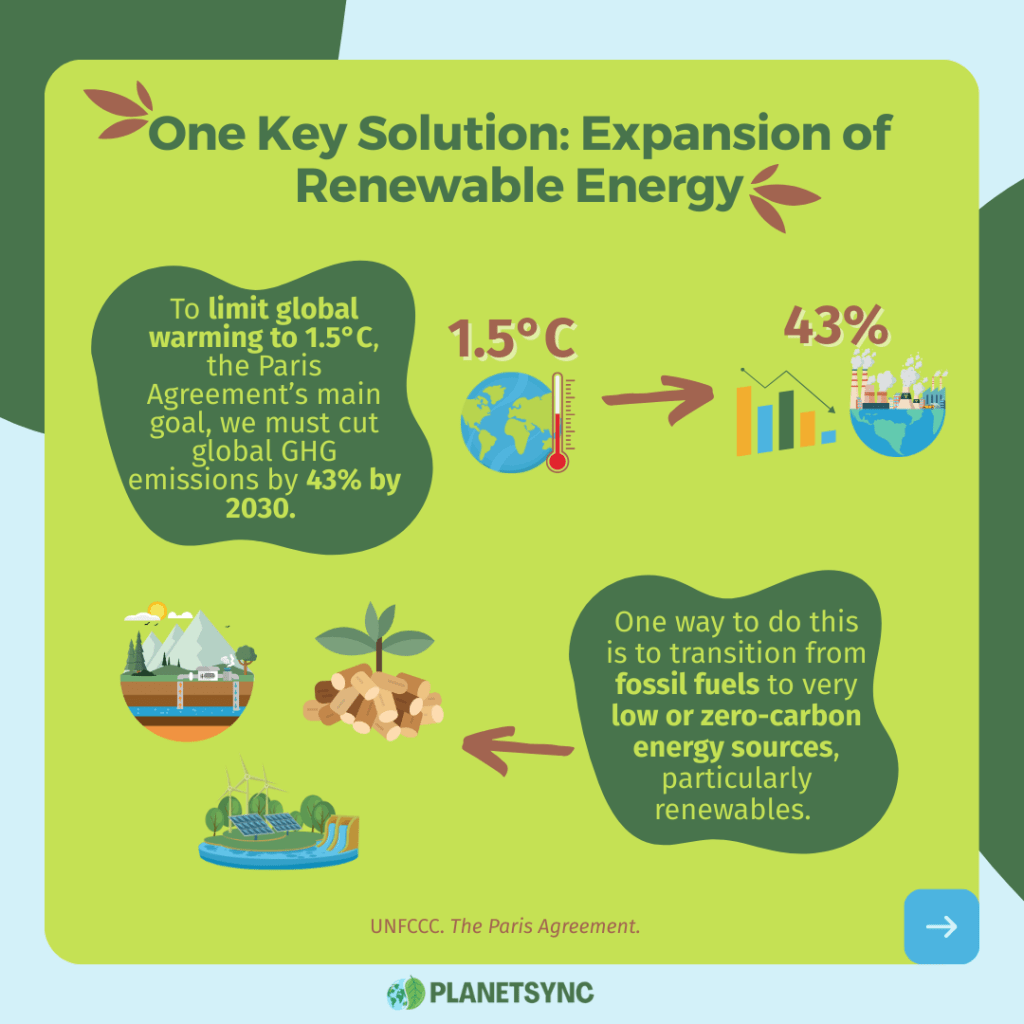
To limit global warming to 1.5°C above pre-industrial levels, the core target of the Paris Agreement, global greenhouse gas emissions must fall by 43% by 2030. One way to do this is transitioning from fossil fuels to very low or zero-carbon energy sources, particularly renewables. This includes solar power, wind power, hydropower, geothermal energy, and sustainably sourced biomass.
So, What Does “Tripling Renewable Energy” Actually Mean?
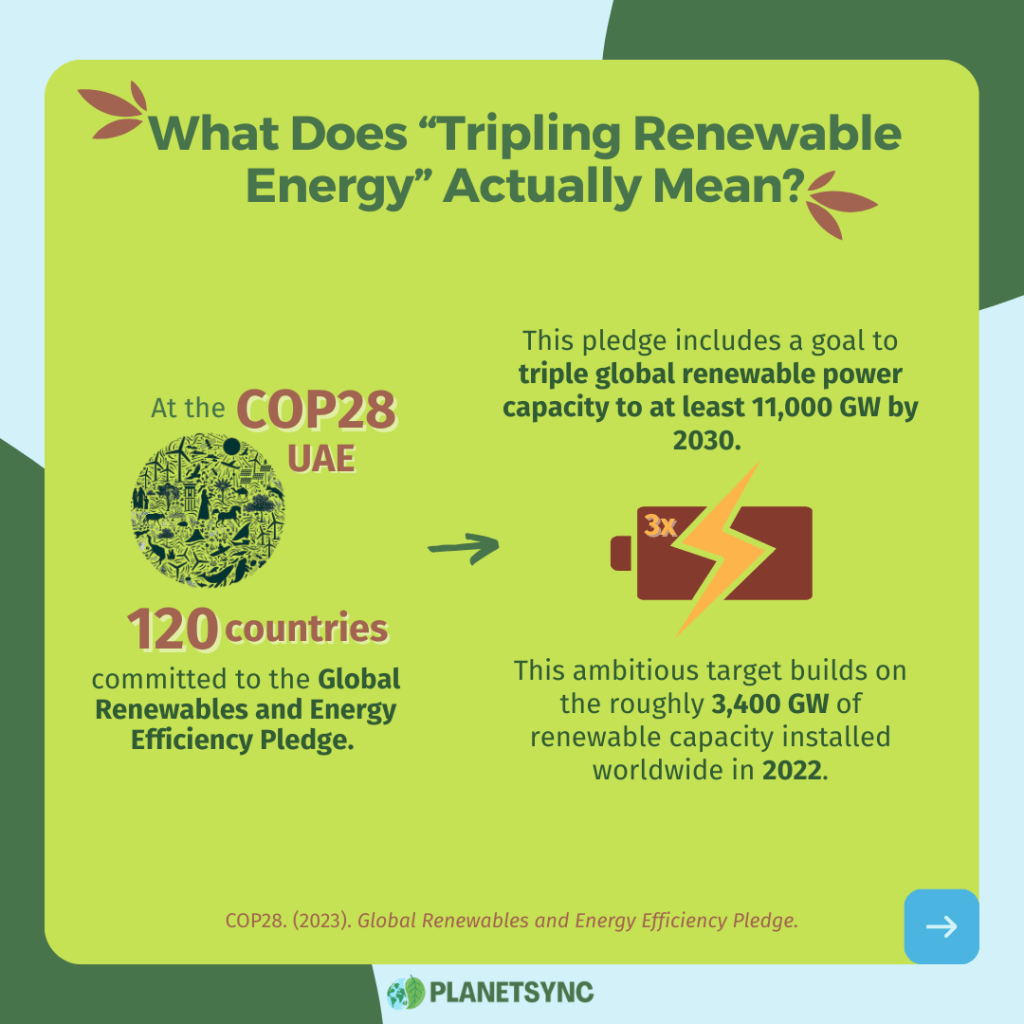
At the COP28 climate summit in Dubai, nearly 120 countries committed to the Global Renewables and Energy Efficiency Pledge, aiming to triple global renewable power capacity to at least 11,000 gigawatts (GW) by 2030. This ambitious target builds on the roughly 3,400 GW of renewable capacity installed worldwide in 2022.
This isn’t an arbitrary figure. According to the International Renewable Energy Agency (IRENA) and the International Energy Agency (IEA), tripling renewable energy capacity by 2030 is the minimum scale required to keep global warming below 1.5°C, in line with the Paris Agreement. Reaching this level would make it possible to phase out coal and gas more rapidly, electrify key sectors like transportation and heating, and expand energy access in low-income countries, all while significantly reducing global emissions.
Is It Doable? The Numbers Say We’re Getting Closer
As of the end of 2024, global renewable power capacity reached 4,448 GW, representing a record annual increase. Solar energy accounted for the largest share of the global total. Renewable hydropower and wind energy accounted for most of the remainder.
However, despite this progress, the current growth trajectory remains well below what is needed to meet the 2030 target. IRENA warns that if we continue at the same pace seen in 2024, the world will reach only 10,400 GW by 2030, falling 800 GW (7.2%) short of the goal.
So, is the 2030 target achievable? The short answer is yes, but only if we significantly accelerate the current pace of renewable energy deployment, potentially more than doubling annual additions over the next 5 years and scaling up supporting infrastructure, investment, and policy action at the same time.
Do We Have the Technology to Make Energy Transition Happen?
Yes, we do, and it’s already being deployed at scale.
The core technologies needed to shift away from fossil fuels are not experimental or hypothetical. They’re mature, commercially available, and increasingly cost-competitive. Solar and wind are now the cheapest sources of new electricity generation in some countries. In fact, according to the IEA, solar and wind are expected to make up 95% of all new renewable energy capacity through 2030, precisely because they’re now cheaper than fossil fuels in some parts of the world.
Just as importantly, we have the tools to address one of the biggest challenges renewables face: variability. Advances in battery storage technology, along with smarter energy grids and digital management systems, are making it possible to store electricity when the sun isn’t shining or the wind isn’t blowing. These systems are already being integrated into national power grids, improving reliability and flexibility.
While innovation will continue, the foundation is already here. The technology to drive a large-scale, global energy transition needs to be scaled up, supported, and deployed more widely.
What Can You Do?
While governments, industries, and institutions must drive the large-scale changes needed, individual choices still matter, and collectively, they add up. You can play a part in supporting the clean energy transition by:
- Switching to a green energy plan powered by renewables, if your energy provider offers it
- Using energy-efficient appliances and lighting to reduce consumption and lower emissions
- Choosing lower-impact ways of getting around whenever possible. Walking or biking are great options when feasible. Public transport, while not always fossil-free, is generally far more efficient than driving alone. And when driving is necessary, carpooling with friends or colleagues can still cut emissions by sharing the ride
- Supporting leaders and policies that prioritize clean energy and climate action
- Sharing trusted, science-based information. In a world full of misinformation, being a source of accurate facts can help shift public understanding and build momentum for change
Our Power, Our Planet: A Future We Can Build Together
Earth Day reminds us that the power to protect the planet is in our hands. The call to triple renewable energy by 2030 is technically achievable, economically sound, and essential for meeting climate objectives. It will require urgent and systemic policy action and commitment from us.
Let’s make this Earth Day not just a day of reflection, but a day of action!


 planetsync.blog
Leave a comment