


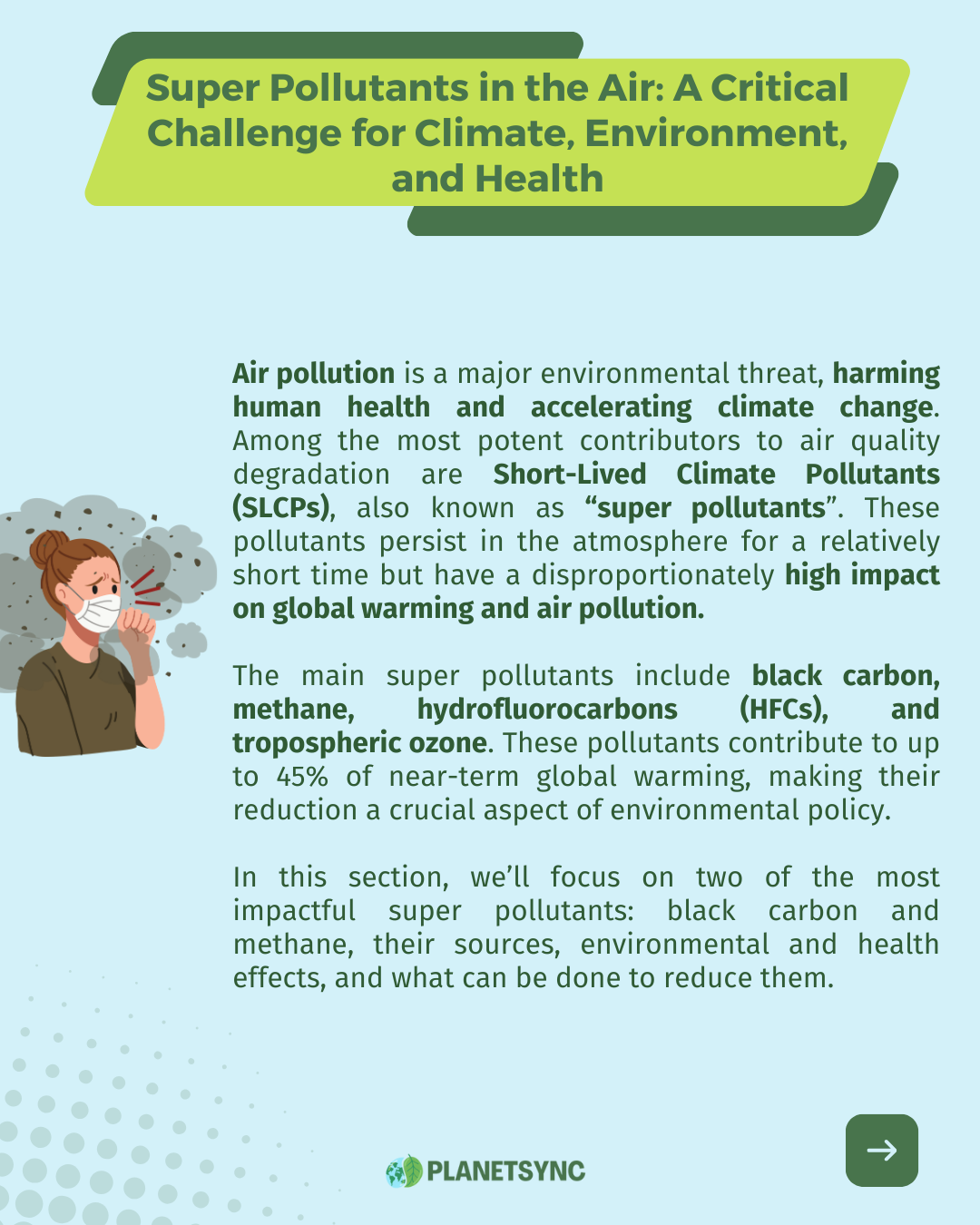
Air pollution is a major environmental threat, harming human health and accelerating climate change. Among the most potent contributors to air quality degradation are Short-Lived Climate Pollutants (SLCPs), also known as “super pollutants”. These pollutants persist in the atmosphere for a relatively short time but have a disproportionately high impact on global warming and air pollution.
The main super pollutants include black carbon, methane, hydrofluorocarbons (HFCs), and tropospheric ozone. These pollutants contribute to up to 45% of near-term global warming, making their reduction a crucial aspect of environmental policy.
In this section, we’ll focus on two of the most impactful super pollutants: black carbon and methane, their sources, environmental and health effects, and what can be done to reduce them.
Need the Gist? Swipe through the visuals below for a quick summary!



Black Carbon
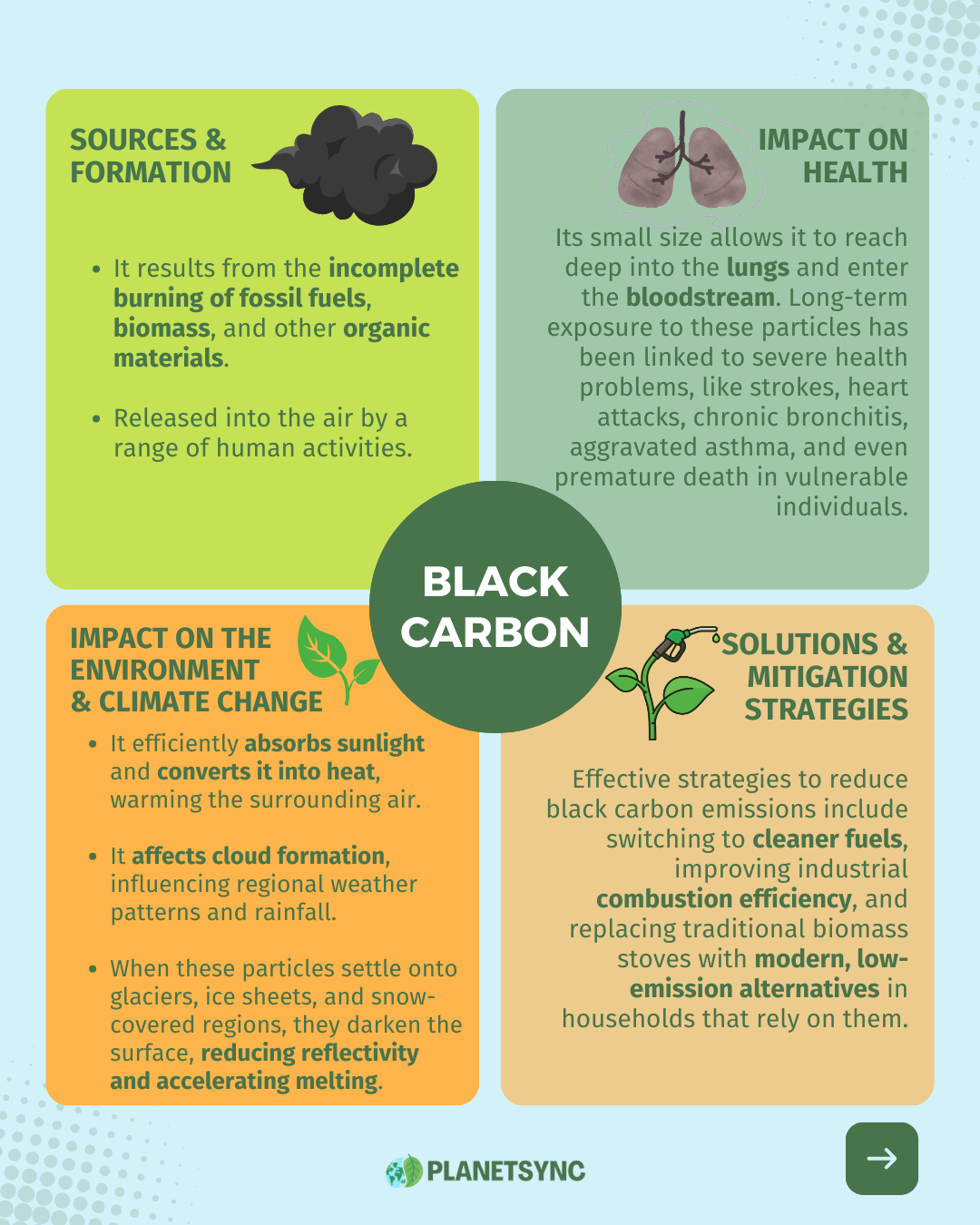
Sources & Formation
Black carbon, commonly known as soot, consists of tiny black particles that result from the incomplete burning of fossil fuels, biomass, and other organic materials. It is released into the air by a range of human activities, including vehicle emissions, forestry machinery, ships, and household stoves that burn coal or wood. Another major source is the burning of biomass in open environments, such as forest fires and the deliberate burning of agricultural waste.
Impact on the Environment & Climate Change
Black carbon is a powerful contributor to climate change. It is highly efficient at directly absorbing sunlight and converting it into heat, warming the surrounding air. However, because its concentration varies widely across different regions and at different times of the year, its impact is not uniform on a global scale.
Black carbon also affects cloud formation, which in turn influences regional weather patterns and rainfall.
One of the most alarming consequences of black carbon pollution is its impact on ice and snow. When these particles settle onto glaciers, ice sheets, and snow-covered regions, they darken the surface, reducing its ability to reflect sunlight, a property known as albedo. The darker surface absorbs more heat, accelerating melting. This effect is particularly concerning in the Arctic and high-altitude glaciated regions like the Himalayas, where the loss of ice has serious implications for sea level rise and water availability for millions of people who depend on glacier-fed rivers.
Impact on Health
Black carbon is a major component of PM2.5, a category of fine particulate matter that is many times smaller than a grain of table salt. Because of its tiny size, PM2.5 can penetrate deep into the lungs, carrying toxic compounds directly into the bloodstream. Long-term exposure to these particles has been linked to severe health problems, including strokes, heart attacks, chronic bronchitis, aggravated asthma, and even premature death in individuals with existing heart and lung conditions.
Solutions & Mitigation Strategies
Black carbon has a relatively short atmospheric lifetime, typically lasting between 4 and 12 days, making it a prime target for immediate climate action. Because of its short lifespan, reducing emissions today can yield rapid benefits. Effective strategies to reduce black carbon emissions include switching to cleaner fuels, improving industrial combustion efficiency, and replacing traditional biomass stoves with modern, low-emission alternatives in households that rely on them.
Methane (CH₄)
Sources & Formation
Methane is the second most abundant human-caused greenhouse gas (GHG) after carbon dioxide (CO₂), accounting for around 11% of global emissions. Human activities are the primary drivers of methane emissions. Fossil fuel production, including oil, gas, and coal extraction, releases significant amounts of methane into the air. Agriculture, particularly livestock farming, is another major contributor, as cows and other ruminant animals produce methane during digestion. Rice paddies also release methane due to the waterlogged conditions that foster its production. Waste management, including landfills and wastewater treatment, adds to the problem as organic waste decomposes and releases methane into the air. Altogether, these human-driven sources account for about 60% of global methane emissions.
Impact on Environment & Climate Change
While methane exists in much lower concentrations in the atmosphere than CO₂, it is far more potent. Over a 100-year period, it has about 28 times the global warming potential of CO₂. However, in the shorter term, within just 20 years, its warming impact is even more extreme, roughly 84 times that of CO₂. Scientists estimate that methane has been responsible for over 40% of recent global warming, making it a critical target for climate action.
Additionally, when methane is released into the atmosphere, it undergoes chemical reactions with other gases, forming tropospheric ozone, which contributes to global air pollution.
Impact on Health
Methane is not typically classified as an air pollutant, as this term is usually reserved for substances that have direct harmful effects on human health when inhaled. However, it contributes to the formation of tropospheric ozone, a harmful pollutant linked to respiratory diseases such as asthma and chronic lung conditions.
Solutions & Mitigation Strategies
Methane has a lifespan of about 12 years before breaking down into other compounds. This relatively short atmospheric lifetime, combined with methane’s high global warming potential, means cutting methane today will immediately slow the pace of climate change to complement longer term action, while providing long-lasting human health co-benefits.
Recognizing the necessity of methane reduction, an international effort known as the Global Methane Pledge (GMP) has been established. This voluntary initiative, supported by 159 countries, aims to cut methane emissions by at least 30% below 2020 levels by 2030. If successful, this reduction could lower global warming by at least 0.2°C by 2050. To reduce methane emissions under the GMP, countries are targeting key sources such as fossil fuels, agriculture, and waste. In the energy sector, this involves detecting and fixing leaks in oil and gas infrastructure, as well as minimizing flaring, where excess gas is burned off. In agriculture, efforts focus on changing livestock diets to reduce methane produced during digestion, improving manure management, and adopting more sustainable rice farming practices. Waste-related strategies include capturing methane from landfills and reducing the amount of organic waste through composting and recycling. These actions, supported by technological innovation, policy changes, and international cooperation, aim to significantly curb methane emissions by 2030.
What Comes Next
So far, we have explored black carbon and methane, two major contributors to air pollution and their harmful effects on human health, climate change, and the environment. However, they are not the only “super pollutants” threatening the planet.
Continue reading the next article to learn about the HFCs, tropospheric ozone, and the path to cleaner air!
References & Resources
- Bessagnet, B., Belis, C., Crippa, M., Dentener, F., Van, D. R., & Thunis, P. (2024). Trends of methane emissions and their impact on ozone concentrations at the European and Global levels. JRC Publications Repository. https://doi.org/10.2760/376659
- Climate-friendly alternatives to HFCs. (n.d.). European Commission.
- Cutting methane emissions key to fighting climate change and harmful ozone. (2024). European Commission.
- Europe’s air quality status 2023. (2023.). European Environment Agency.
- Global Methane Pledge. (n.d.). Climate and Clean Air Coalition (CCAC).
- Global Risks Report 2025. (n.d.). World Economic Forum.
- Gul, C., Mahapatra, P. S., Kang, S., Singh, P. K., Wu, X., He, C., Kumar, R., Rai, M., Xu, Y., & Puppala, S. P. (2021). Black carbon concentration in the central Himalayas: Impact on glacier melt and potential source contribution. Environmental Pollution, 275, 116544. https://doi.org/10.1016/j.envpol.2021.116544
- State of Global Air 2024. Special Report. (2024). Health Effects Institute.
- Hydrofluorocarbons (HFCs). (n.d.). Swedish Pollutant Release and Transfer Register.
- Hydrofluorocarbons (HFCs). (n.d.). Climate and Clean Air Coalition (CCAC).
- Kang, S., Zhang, Y., Qian, Y., & Wang, H. (2020). A review of black carbon in snow and ice and its impact on the cryosphere. Earth-Science Reviews, 210, 103346. https://doi.org/10.1016/j.earscirev.2020.103346
- Scientific Assessment of Ozone Depletion 2022: Executive Summary. (n.d.). Chemical Sciences Laboratory (CSL).
- Li, C., Bosch, C., Kang, S., Andersson, A., Chen, P., Zhang, Q., Cong, Z., Chen, B., Qin, D., & Gustafsson, Ö. (2016). Sources of black carbon to the Himalayan–Tibetan Plateau glaciers. Nature Communications, 7(1), 12574. https://doi.org/10.1038/ncomms12574
- Liu, Z., Doherty, R. M., Wild, O., O’Connor, F. M., & Turnock, S. T. (2022). Tropospheric ozone changes and ozone sensitivity from the present day to the future under shared socio-economic pathways. Atmospheric Chemistry and Physics, 22(2), 1209–1227. https://doi.org/10.5194/acp-22-1209-2022
- Lu, X., Zhang, L., & Shen, L. (2021). Chapter 2—Tropospheric ozone interacts with weather and climate. In M. Gao, Z. Wang, & G. Carmichael (Eds.), Air Pollution, Climate, and Health (pp. 15–46). Elsevier. https://doi.org/10.1016/B978-0-12-820123-7.00006-1
- Mar, K. A., Unger, C., Walderdorff, L., & Butler, T. (2022). Beyond CO2 equivalence: The impacts of methane on climate, ecosystems, and health. Environmental Science & Policy, 134, 127–136. https://doi.org/10.1016/j.envsci.2022.03.027
- Methane. (n.d.). Climate & Clean Air Coalition.
- Methane & Health. (n.d.). The Global Climate and Health Alliance.
- Methane emissions. (n.d.). European Commission.
- Prather, M. J., & Zhu, X. (2024). Lifetimes and timescales of tropospheric ozone. Elementa: Science of the Anthropocene, 12(1), 00112. https://doi.org/10.1525/elementa.2023.00112
- Schraufnagel, D. E., Balmes, J. R., Cowl, C. T., De Matteis, S., Jung, S.-H., Mortimer, K., Perez-Padilla, R., Rice, M. B., Riojas-Rodriguez, H., Sood, A., Thurston, G. D., To, T., Vanker, A., & Wuebbles, D. J. (2019). Air Pollution and Noncommunicable Diseases. Chest, 155(2), 417–426. https://doi.org/10.1016/j.chest.2018.10.041
- The latest EU Background News on Black Carbon. (n.d.). Arctic Monitoring and Assessment Programme Working Group (AMAP).
- Toxic blaze: The true cost of crop burning. (2021, August 16). United Nations Environment Programme (UNEP).
- Ground-level Ozone Pollution. US EPA.
- Importance of Methane [Overviews and Factsheets]. US EPA.
- Why measuring black carbon is key to climate change mitigation. (2025, February 25). World Economic Forum.
- Xie, X., Zhao, Z., Li, S., Lu, Z., Chen, L., & Cai, J. (2024). Spatiotemporal variations of atmospheric black carbon concentration and its correlation with meteorological and environmental factors in Xinjiang, China, from 2010 to 2022. PeerJ, 12, e18187. https://doi.org/10.7717/peerj.18187
- Zhang, Y., Zhang, Q., Cheng, Y., Su, H., Li, H., Li, M., Zhang, X., Ding, A., & He, K. (2018). Amplification of light absorption of black carbon associated with air pollution. Atmospheric Chemistry and Physics, 18, 9879–9896. https://doi.org/10.5194/acp-18-9879-2018


 planetsync.blog
Leave a comment