


Take a moment to look around. Chances are, something plastic is within arm’s reach: your phone case, a pen, a snack wrapper, clothes, etc. Plastic has become so embedded in daily life that it’s easy to forget it hasn’t been around all that long. Yet in just over 118 years, it has revolutionized everything from food preservation to modern medicine and quietly become one of the most widespread pollutants on Earth.
This World Environment Day, celebrated on June 5, 2025, the spotlight is on plastic pollution. It’s a global crisis with planetary consequences, and now, as research increasingly shows, it’s a human health issue, too.
What’s at stake? What can still be done? And how are you part of the solution? Keep reading to find out.
Need the Gist? Swipe through the visuals below for a quick summary!


From Convenience to Crisis
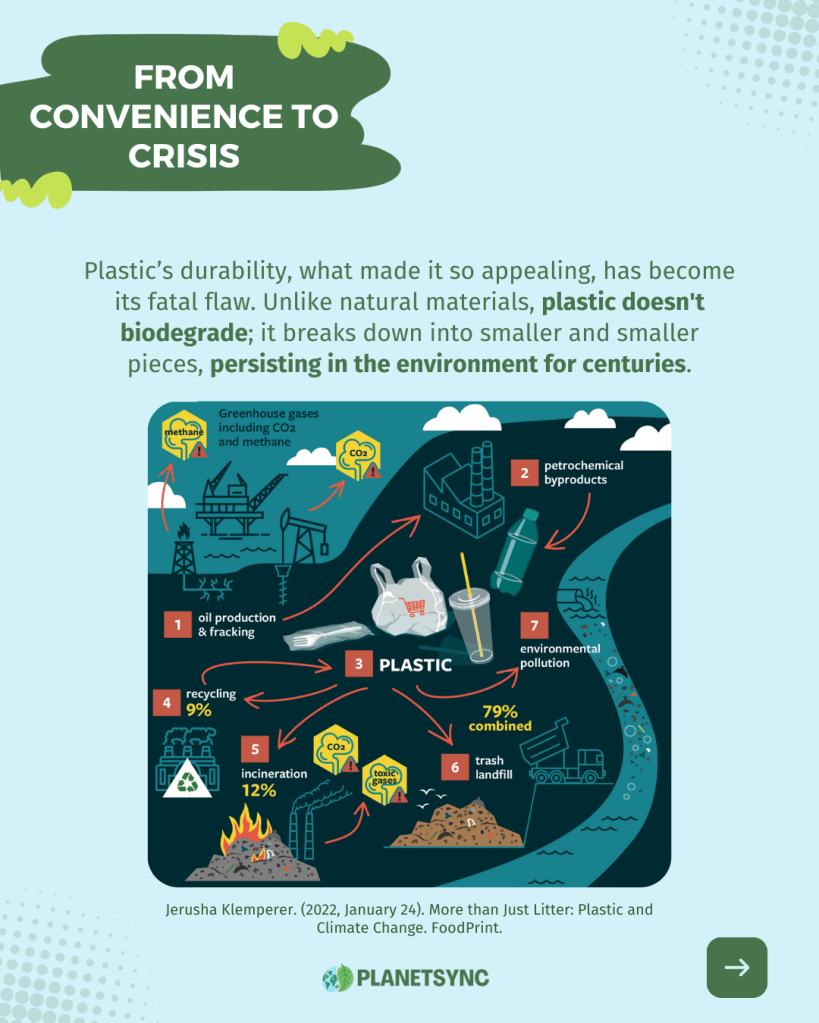
Plastic’s durability, what made it so appealing, has become its fatal flaw. Unlike natural materials, plastic doesn’t biodegrade; it breaks down into smaller and smaller pieces, persisting in the environment for centuries. A plastic bottle tossed today may still be polluting the planet in the year 2500.
We’re seeing the effects everywhere: from swirling gyres of floating waste in the Pacific Ocean to microplastic particles embedded in Arctic Sea ice, on Himalayan peaks, and in the deepest parts of the ocean.
Even more alarming, plastic is now showing up in places it was never meant to be: inside our bodies.
When plastic breaks down, it forms microplastics (particles smaller than 5 millimeters) and nanoplastics (less than one micrometer). These fragments make their way into drinking water, food, and even the air we breathe. A 2022 study published in Environment International found microplastics in human blood, suggesting these particles can circulate through the body. Other studies have discovered them in lung tissue, placentas, and breast milk.
While scientists are still studying the long-term health effects, early concerns are serious: microplastics may cause chronic inflammation, disrupt hormones, or carry toxic chemical additives like phthalates and bisphenol A (BPA), which are known endocrine disruptors.
And we’re not alone in this exposure. Wildlife across the planet is suffering. Turtles mistake plastic bags for jellyfish. Seabirds feed colorful fragments to their chicks. Whales and dolphins are washing ashore with stomachs full of plastic debris. A joint report by the World Economic Forum and the Ellen MacArthur Foundation, warned that if current trends continue, plastic could outweigh fish in the ocean by 2050.
A Global Response: The Plastics Treaty
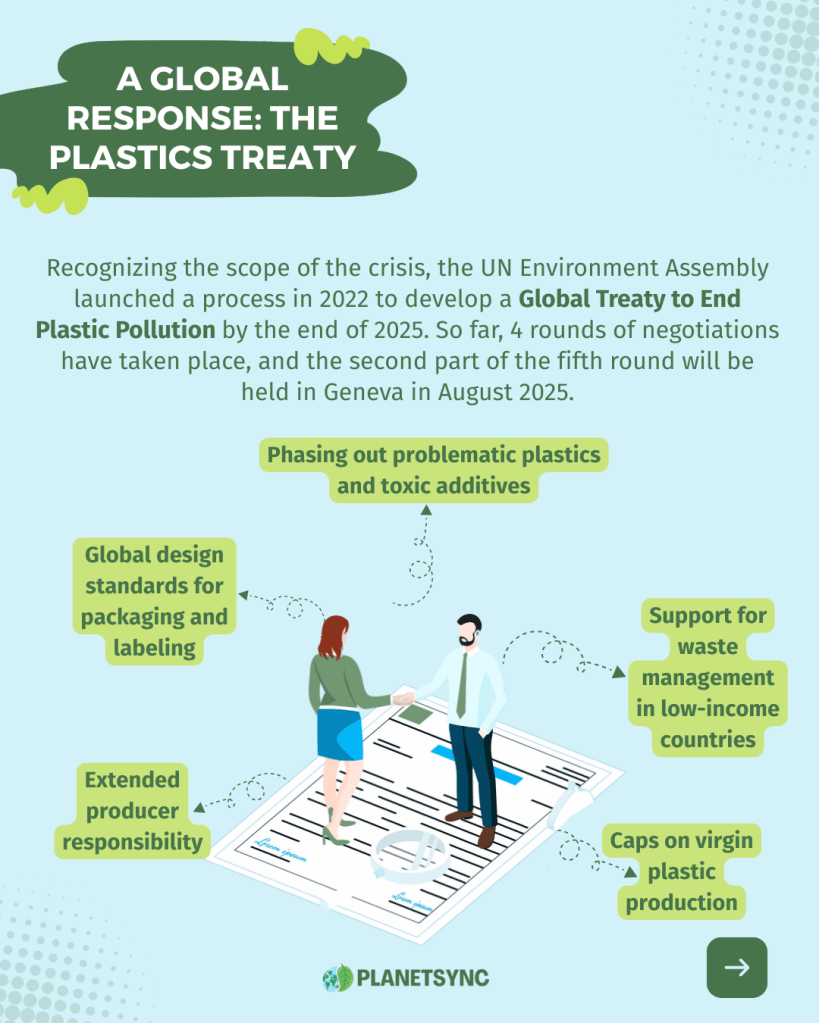
Recognizing the scope of the crisis, the UN Environment Assembly (UNEA) launched a process in 2022 to develop a Global Treaty to End Plastic Pollution by the end of 2025.
So far, four rounds of negotiations have taken place, and the second part of the fifth and likely final round, known as INC-5.2, will be held in Geneva from August 5 to 14, 2025.
Key components under negotiation include:
- Caps on virgin plastic production
- Global design standards for packaging and labeling
- Phasing out problematic plastics and toxic additives
- Support for waste management in low-income countries
- Extended producer responsibility (EPR), which holds manufacturers accountable for the full life cycle of their products
Environmental scientists and health experts argue that voluntary measures are no longer sufficient. Binding global rules are essential to reduce plastic pollution at the source, not just to clean up the mess afterward.
What You Can Do
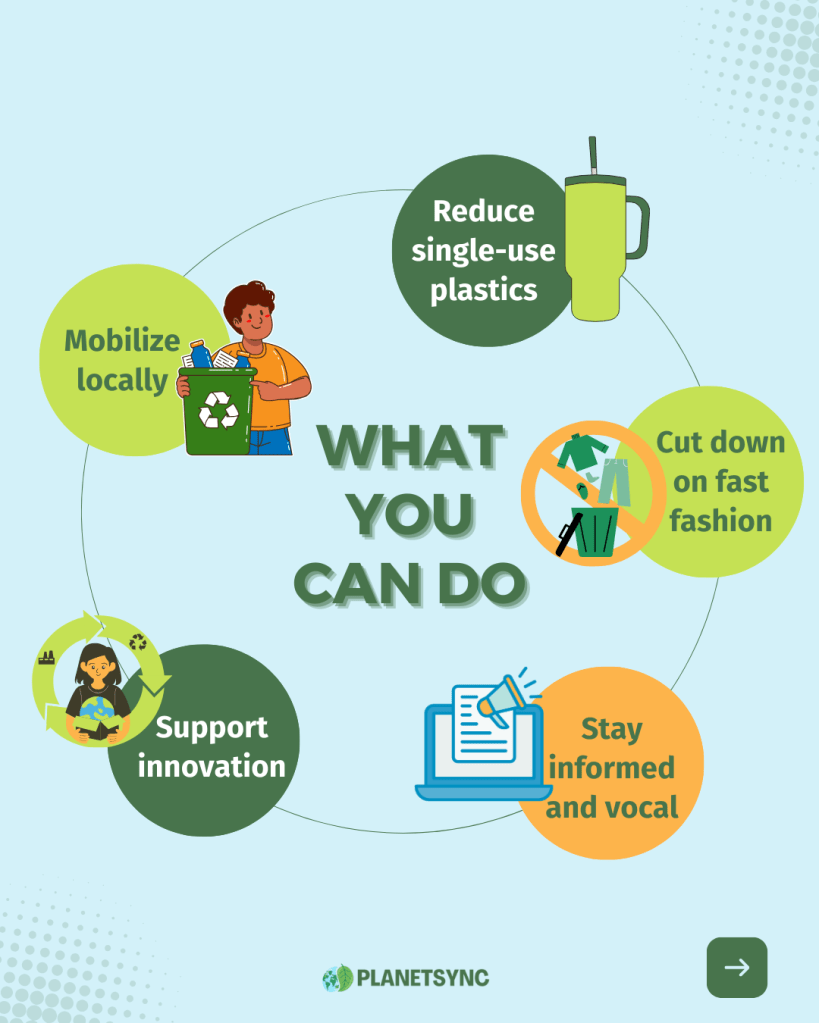
While systemic change is essential, individual and community actions matter more than ever, especially when they influence market demand, political pressure, and cultural norms. Here’s how you can take part:
- Reduce single-use plastics: Switch to reusable alternatives like a stainless-steel water bottle instead of disposable plastic, a glass or metal food container instead of a plastic one, a cloth shopping bag instead of plastic bags.
- Cut down on fast fashion: The clothing industry is a major source of microplastic pollution, nearly 60% of textiles are made from synthetic fibers like polyester and nylon, which shed tiny plastic particles during washing and wear. Buy fewer, higher quality items, support natural fiber options like organic cotton, hemp, or wool.
- Stay informed and vocal: Let elected officials know you support bold action. Policy shifts often begin with public demand.
- Support innovation: Choose brands that embrace plastic-free design or circular economy practices. Consumer choices influence supply chains.
- Mobilize locally: Join cleanup events, support school campaigns, or advocate for local plastic bans. Small-scale efforts create momentum that scales up.
The Time for Half-Measures Is Over
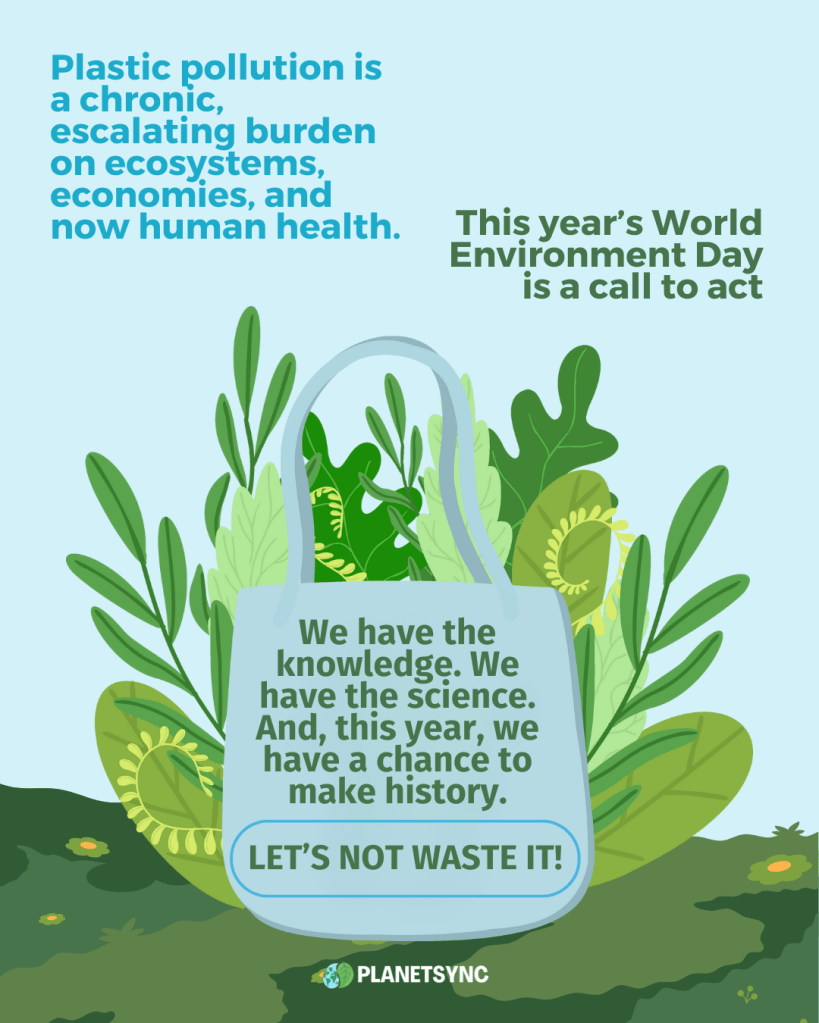
Plastic pollution is a chronic, escalating burden on ecosystems, economies, and now human health. It took decades to reach this tipping point, but with collective action, we can begin to turn the tide.
This year’s World Environment Day is a call to act, just two months before world leaders gather in Geneva to shape what could be the most important environmental agreement of the decade.
We have the knowledge. We have the science. And, this year, we have a chance to make history. Let’s not waste it!
References & Resources
- Bergmann, M., Allen, S., Krumpen, T., & Allen, D. (2023). High Levels of Microplastics in the Arctic Sea Ice Alga Melosira arctica, a Vector to Ice-Associated and Benthic Food Webs. Environmental Science & Technology, 57(17), 6799–6807. https://doi.org/10.1021/acs.est.2c08010
- European Environment Agency. (2021, January 28). Plastic in textiles: Towards a circular economy for synthetic textiles in Europe.
- Jamieson, A. J., Brooks, L. S. R., Reid, W. D. K., Piertney, S. B., Narayanaswamy, B. E., & Linley, T. D. (2019). Microplastics and synthetic particles ingested by deep-sea amphipods in six of the deepest marine ecosystems on Earth. Royal Society Open Science, 6(2), 180667. https://doi.org/10.1098/rsos.180667
- Jiao, H., Ali, S. S., Alsharbaty, M. H. M., Elsamahy, T., Abdelkarim, E., Schagerl, M., Al-Tohamy, R., & Sun, J. (2024). A critical review on plastic waste life cycle assessment and management: Challenges, research gaps, and future perspectives. Ecotoxicology and Environmental Safety, 271, 115942. https://doi.org/10.1016/j.ecoenv.2024.115942
- Leslie, H. A., van Velzen, M. J. M., Brandsma, S. H., Vethaak, A. D., Garcia-Vallejo, J. J., & Lamoree, M. H. (2022). Discovery and quantification of plastic particle pollution in human blood. Environment International, 163, 107199. https://doi.org/10.1016/j.envint.2022.107199
- National Geographic. (n.d.). Great Pacific Garbage Patch.
- Peeken, I., Primpke, S., Beyer, B., Gütermann, J., Katlein, C., Krumpen, T., Bergmann, M., Hehemann, L., & Gerdts, G. (2018). Arctic sea ice is an important temporal sink and means of transport for microplastic. Nature Communications, 9(1), 1505. https://doi.org/10.1038/s41467-018-03825-5
- Plastics for Change. (2025, March 20). Global Plastics Treaty INC-5.2: Key Business Impacts & How Companies Can Lead the Circular Economy.
- Ragusa, A., Svelato, A., Santacroce, C., Catalano, P., Notarstefano, V., Carnevali, O., Papa, F., Rongioletti, M. C. A., Baiocco, F., Draghi, S., D’Amore, E., Rinaldo, D., Matta, M., & Giorgini, E. (2021). Plasticenta: First evidence of microplastics in human placenta. Environment International, 146, 106274. https://doi.org/10.1016/j.envint.2020.106274
- Science Museum. (n.d.). The Age of Plastic: From Parkesine to pollution.
- Talukdar, A., Bhattacharya, S., Bandyopadhyay, A., & Dey, A. (2023). Microplastic pollution in the Himalayas: Occurrence, distribution, accumulation and environmental impacts. Science of The Total Environment, 874, 162495. https://doi.org/10.1016/j.scitotenv.2023.162495
- Interreg Baltic Sea Region. (2024, April 30). The Global Plastics Treaty Explained.
- World Economic Forum. (2016, January 19). The New Plastics Economy: Rethinking the future of plastics.
- UN Environment Programme. (n.d.). Intergovernmental Negotiating Committee on Plastic Pollution.
- UNEP. (n.d.). World Environment Day 2025.
- Williams, A. T., & Rangel-Buitrago, N. (2022). The past, present, and future of plastic pollution. Marine Pollution Bulletin, 176, 113429. https://doi.org/10.1016/j.marpolbul.2022.113429
- Zhao, S., Kvale, K. F., Zhu, L., Zettler, E. R., Egger, M., Mincer, T. J., Amaral-Zettler, L. A., Lebreton, L., Niemann, H., Nakajima, R., Thiel, M., Bos, R. P., Galgani, L., & Stubbins, A. (2025). The distribution of subsurface microplastics in the ocean. Nature, 641(8061), 51–61. https://doi.org/10.1038/s41586-025-08818-1


 planetsync.blog
Leave a comment