


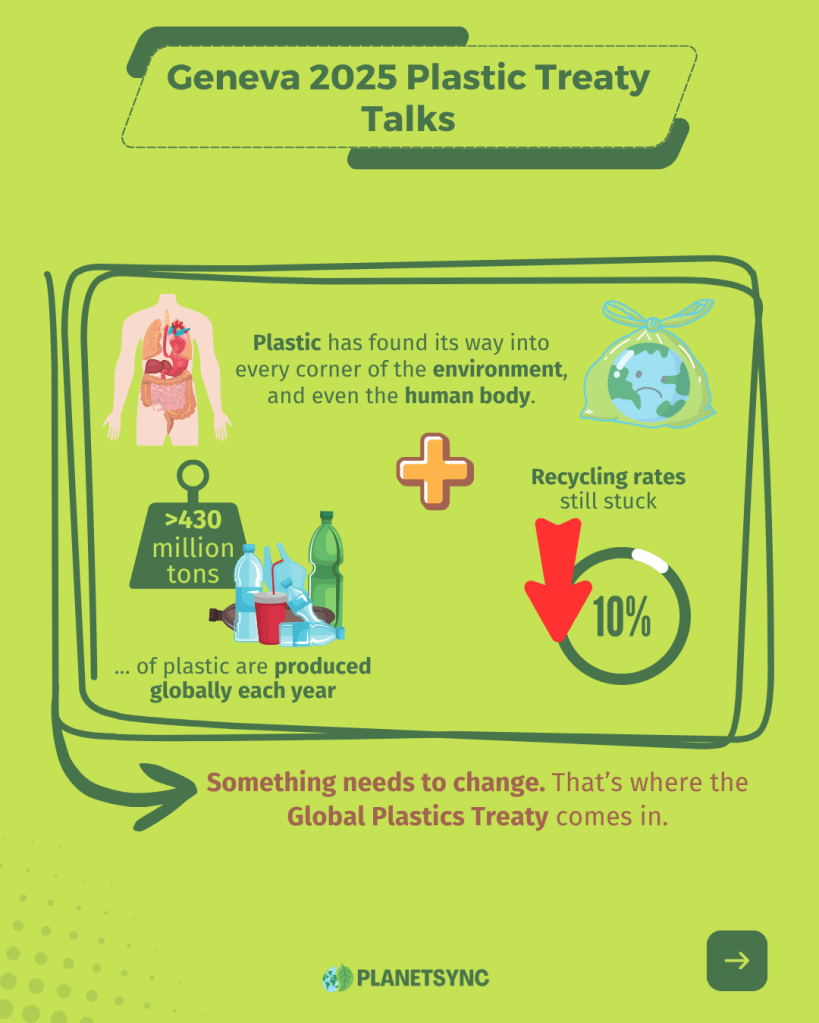
As explained in previous articles, plastic has found its way into every corner of the environment, and even the human body. With more than 430 million tons produced globally each year, much of it single-use, and recycling rates still stuck below 10%, the situation is clear: something needs to change. That’s where the Global Plastics Treaty comes in.
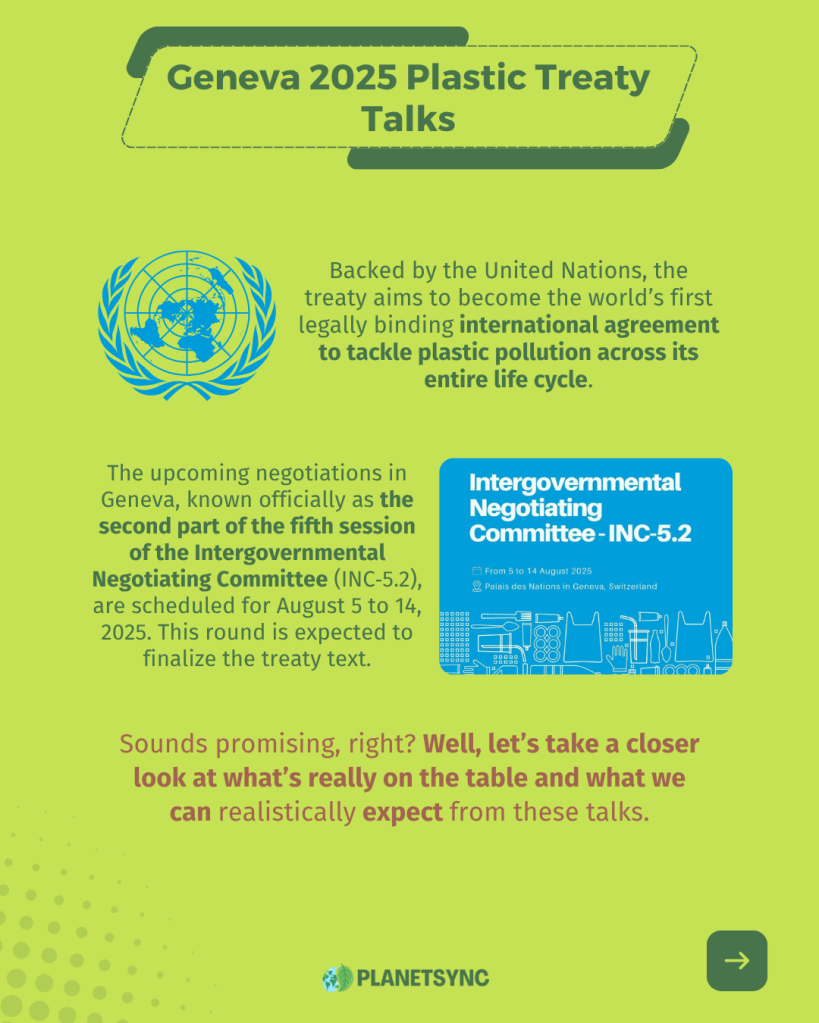
Backed by the United Nations, the treaty aims to become the world’s first legally binding international agreement to tackle plastic pollution across its entire life cycle, from production and design to disposal. The upcoming negotiations in Geneva, known officially as the second part of the fifth session of the Intergovernmental Negotiating Committee (INC‑5.2), are scheduled for August 5 to 14, 2025. This round is expected to finalize the treaty text.
Sounds promising, right? Well, let’s take a closer look at what’s really on the table and what we can realistically expect from these talks.
Need the Gist? Swipe through the visuals below for a quick summary!
What’s Being Negotiated
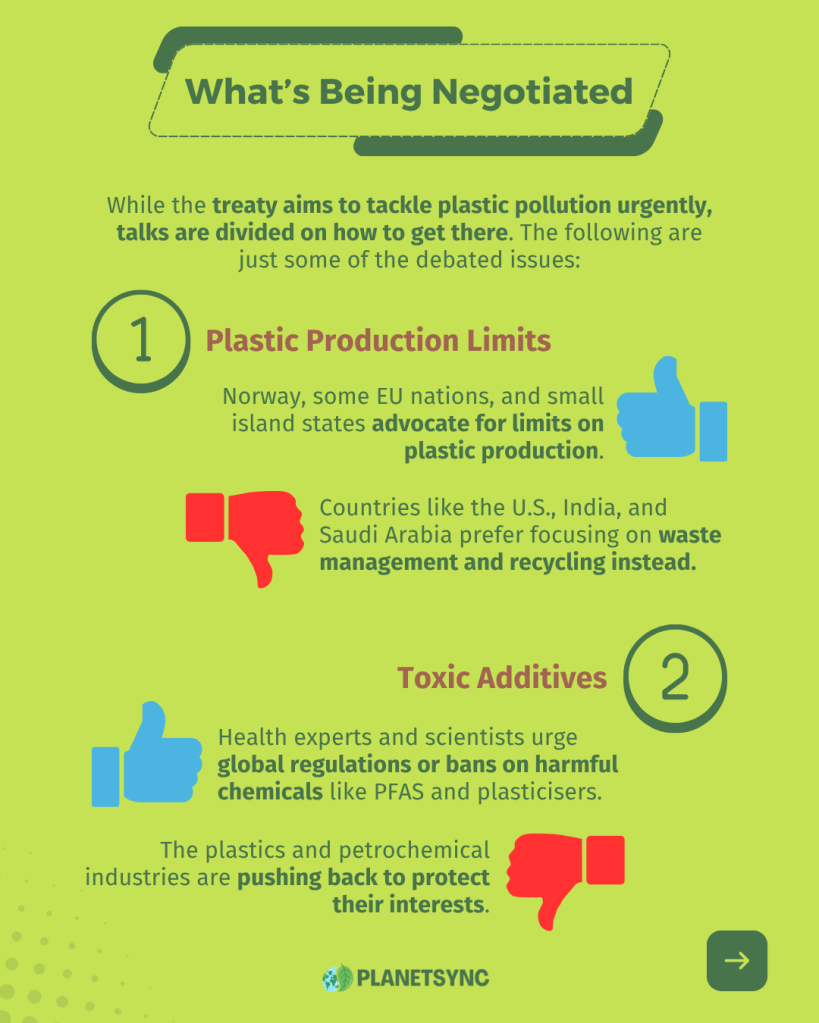
While the treaty is framed as bold and urgent, the reality inside negotiation rooms is far more complex. One of the most contentious issues is whether to impose limits on plastic production itself. Countries like Norway, several EU members, and small island nations are pushing for caps, arguing that the only way to reduce pollution is to reduce how much plastic is made in the first place. But major fossil fuel producers, including the United States, India, and Saudi Arabia, strongly oppose this, insisting the focus should be on improving waste management and recycling systems instead.
There is also serious disagreement over how to handle toxic additives, such as PFAS and plasticisers, which are linked to a range of health and environmental harms. Public health experts and scientists are calling for global regulation or bans, but the plastics and petrochemical industries are fiercely resisting any such moves.
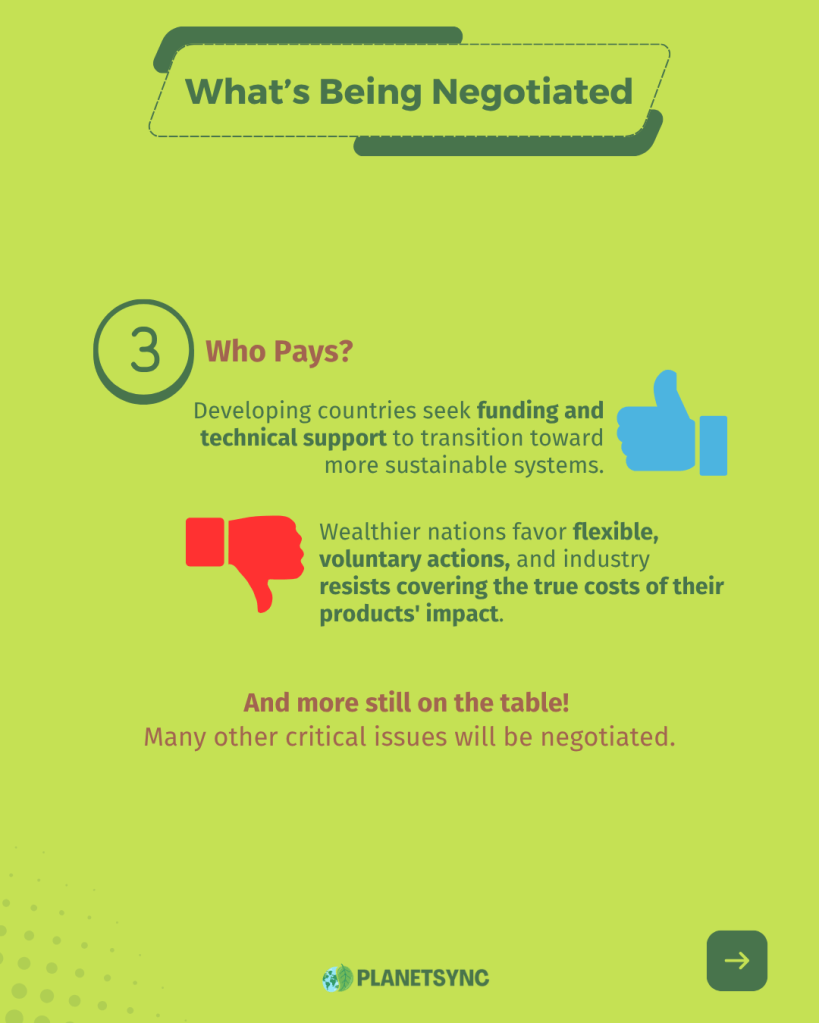
Then comes a financial question: who will pay for the changes the treaty demands? Developing countries are asking for financial guarantees and technical support to transition toward more sustainable systems. Wealthier nations often want flexible, voluntary commitments. And industry groups are lobbying to avoid paying the true costs of their products’ impact. So far, no one agrees on who should foot the bill.
What the Final Treaty Might Actually Look Like
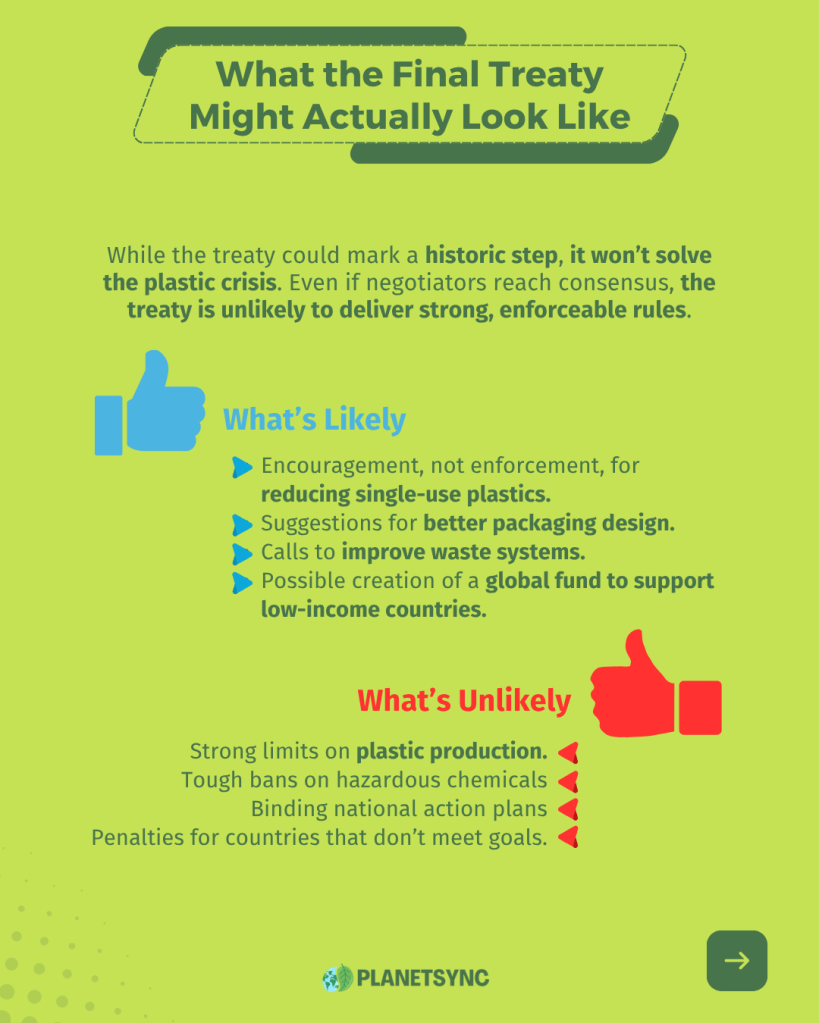
Here’s the honest take: the Geneva talks won’t solve the plastic crisis. Even if negotiators reach consensus, the treaty is unlikely to deliver strong, enforceable rules. What we’re more likely to see is a framework filled with broad language: encouragement to reduce single-use plastics, suggestions to consider design changes (like making packaging easier to reuse or recycle), calls to improve waste systems, and perhaps a global fund to support lower-income countries.
Caps on production or bans on hazardous chemicals may be mentioned, but likely with enough loopholes to keep producers comfortable. Countries might be required to report progress or submit national action plans, but maybe without binding penalties for falling short, these measures could end up as little more than paperwork. It would be a historic milestone, but one that may ultimately feel hollow if it lacks legal muscle and enough pressure to drive meaningful change.
A First Step… But Maybe Just That
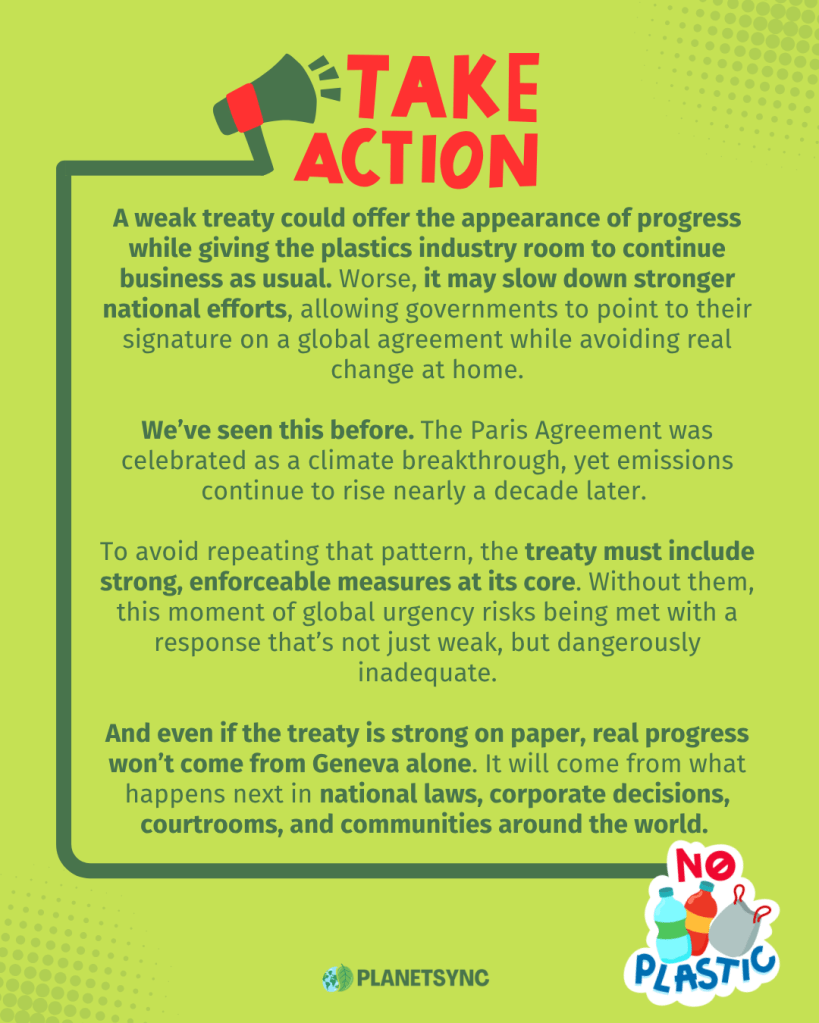
Unfortunately, a weak treaty isn’t “better than nothing.” It risks offering the illusion of action while allowing the plastics industry to continue business as usual. It could delay stronger national policies and give governments cover to say, “we signed the treaty,” while doing next to nothing at home.
We’ve seen this before. The Paris Agreement was celebrated as a major breakthrough on climate, but nearly a decade later, emissions are still rising. Plastic pollution could follow the same path: big promises, flashy headlines, and a quiet retreat into status quo.
Hopefully, I’m wrong. Hopefully, negotiators in Geneva will deliver a bold, binding agreement that prioritizes public health, environmental justice, and climate stability over corporate convenience. But unless the final text includes real limits on plastic production, restrictions on toxic chemicals, and clear accountability for waste exports, this treaty risks becoming just another feel-good press release, one that falls far short of what the moment demands.
And even if the treaty is strong on paper, real change won’t come from Geneva alone. It will depend on what happens next in national legislatures, corporate boardrooms, courtrooms, and communities.
References & Resources
- Anderson, S. (2024, December 3). UN Plastic Pollution Treaty Derailed As Fossil Fuel Nations Block Production Limits—Health Policy Watch. https://healthpolicy-watch.news/global-plastics-treaty-talks-derailed-as-fossil-fuel-nations-block-production-limits/
- Bob Duffer. (n.d.). Global Plastic Pollution Treaty Talks Collapse as Nations Remain Divided. https://www.chemanalyst.com/NewsAndDeals/NewsDetails/global-plastic-pollution-treaty-talks-collapse-as-nations-remain-divided-31851
- Dauvergne, P., Allan, J. I., Beaudoin, S., Carney Almroth, B., Clapp, J., Cowan, E., de Groot, B., Farrelly, T., Grilli, N. de M., Mah, A., Mendenhall, E., Paik, R., Ralston, R., Stoett, P., Stöfen-O’Brien, A., Taggart, J., Tiller, R., Villarrubia-Gómez, P., & Vince, J. (2025). Competing axes of power in the global plastics treaty: Understanding the politics of progress and setbacks in negotiating a high-ambition agreement. Marine Policy, 181, 106820. https://doi.org/10.1016/j.marpol.2025.106820
- Lee, J., Volcovici, V., & Volcovici, V. (2024, December 2). Countries fail to reach agreement in UN plastic talks. Reuters. https://www.reuters.com/business/environment/over-100-countries-back-plastic-treaty-caps-talks-reach-fierce-finish-2024-11-30/
- OECD. (2022, February 22). Global Plastics Outlook. https://www.oecd.org/en/publications/global-plastics-outlook_de747aef-en/full-report.html
- Trager, R. (n.d.). The scale of the problem of replacing ‘forever chemicals’ PFAS. Chemistry World. https://www.chemistryworld.com/news/the-scale-of-the-problem-of-replacing-forever-chemicals-pfas/4020175.article
- UNEP. (n.d.-a). Second Part of the Fifth Session. https://www.unep.org/inc-plastic-pollution/session-5.2
- UNEP. (n.d.-b). Second Part of the Fifth Session (INC-5.2): Official documents. https://www.unep.org/inc-plastic-pollution/session-5.2/documents
- Yinuo. (2023, August 25). Fast Facts—What is Plastic Pollution?https://www.un.org/sustainabledevelopment/blog/2023/08/explainer-what-is-plastic-pollution/


 planetsync.blog
Leave a comment