


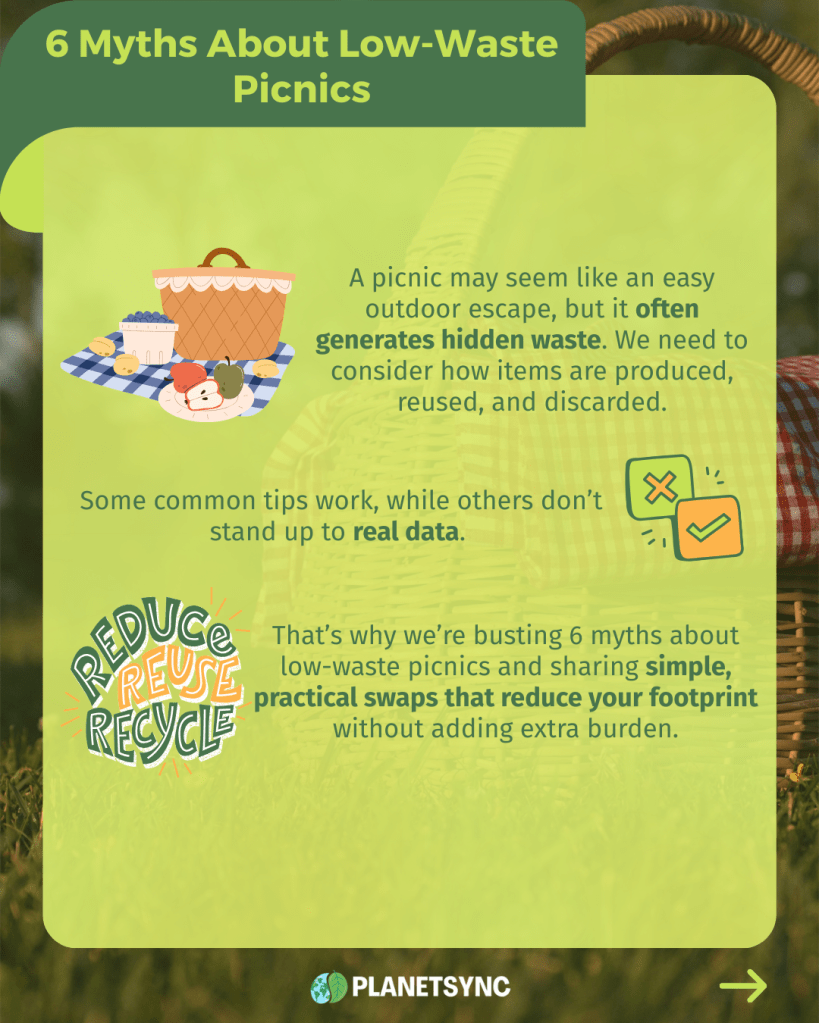
A picnic seems like the simplest way to enjoy the outdoors until you start thinking about the waste it creates. We need to be aware of the full picture: how items are made, how many times they’re used, what happens to leftovers, and where waste ends up.
Some popular tips work beautifully. Others sound good but don’t hold up when you look at the data from life-cycle studies, waste audits, and environmental monitoring. That’s why we unpack 6 common myths about low-waste picnics and show how small, practical choices can make your outing lighter on the planet without weighing down your basket.
Need the Gist? Swipe through the visuals below for a quick summary!


Myth 1: “Reusables always win.”
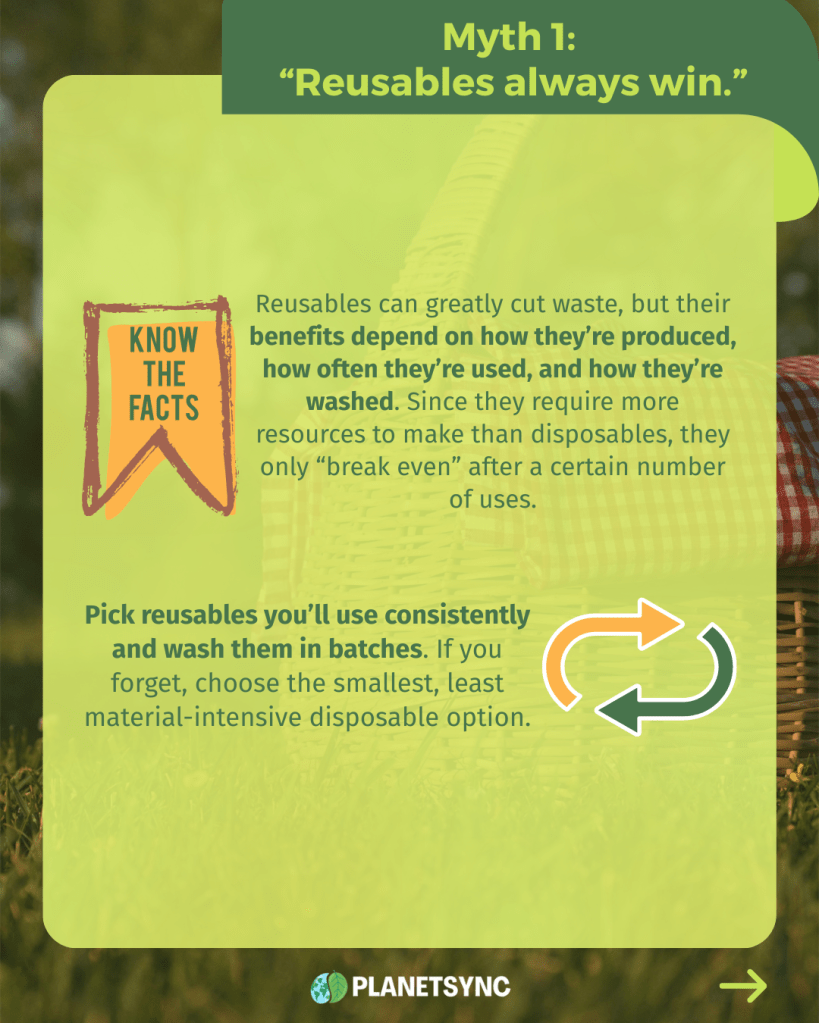
The truth: Reusables can cut waste significantly, but their benefits depend on how they’re made, used, and washed. A durable plate, cup, or fork requires more resources to produce than a single disposable, so it “breaks even”, meaning it has a lower overall environmental impact than the disposable, only after a certain number of uses. That break-even point varies by material, weight, and washing method, but it comes sooner if items are lightweight, used often, and cleaned efficiently (full dishwasher loads, energy-saving cycles). Poor washing habits or low return rates can erase the gains.
Do instead: Choose reusables you’ll actually keep and use often. Wash in batches. If you forget them, pick the smallest, least material-intensive single-use option.
Myth 2: “My small picnic won’t make a difference.”
The truth: Most plastic pollution comes from large-scale systems, but individual litter still adds up. An estimated 11 million metric tons of plastics enter the ocean every year from land-based sources. In the absence of drastic intervention, scientists predict a nearly three-fold increase of ocean plastic inputs totaling 29 million metric tons annually by 2040. So, your fork or a bottle cap might seem trivial, but they join billions of others.
Do instead: Before leaving, take 1 minute to scan for micro-litter like bottle caps, tear-offs, and wrappers, some of the most common items in clean-up surveys.
Myth 3: “Compostable plastic is the perfect solution.”
The truth: Many compostable plastics only break down under industrial composting conditions (high heat, controlled humidity) which home compost bins and parks rarely provide. Left in nature, they can linger just like regular plastic. Some newer materials are designed for home composting, but they’re still in limited circulation.
Do instead: Prioritize reusables and only use compostables where they’re certified and you know they’ll be properly processed.
Myth 4: “No plastic means guilt-free.”
The truth: Food waste can carry a heavier climate cost than its packaging. UNEP’s Food Waste Index Report 2024 about 19% of food available to consumers is wasted each year, driving greenhouse gas emissions and biodiversity loss. Throwing away a plastic-free organic apple is still a waste of the water, land, and energy that went into growing it.
Do instead: Pack realistic portions, and plan “second life” meals for leftovers.
Myth 5: “Plastic-free is expensive.”
The truth: Most households already have effective low-waste picnic gear like jars, old cutlery, cloth napkins, and metal cups work well. Buying new “eco-friendly” products makes sense only if they’ll replace many disposables, last for years, and fit your habits. Durability, loss rate, and ease of use matter more than branding.
Do instead: Build your picnic kit from what you own and replace only what’s genuinely missing.
Myth 6: “The bin at the park will take care of it.”
The truth: Public bins often overflow, and wind or rain can carry litter into waterways. Small items like bottle caps and candy wrappers are among the most common debris found in environmental cleanups worldwide.
Do instead: If the bin is covered and not full, use it. Otherwise, take your waste home, sort it properly, and do a quick litter sweep before you leave.
Even the Small Stuff Matters
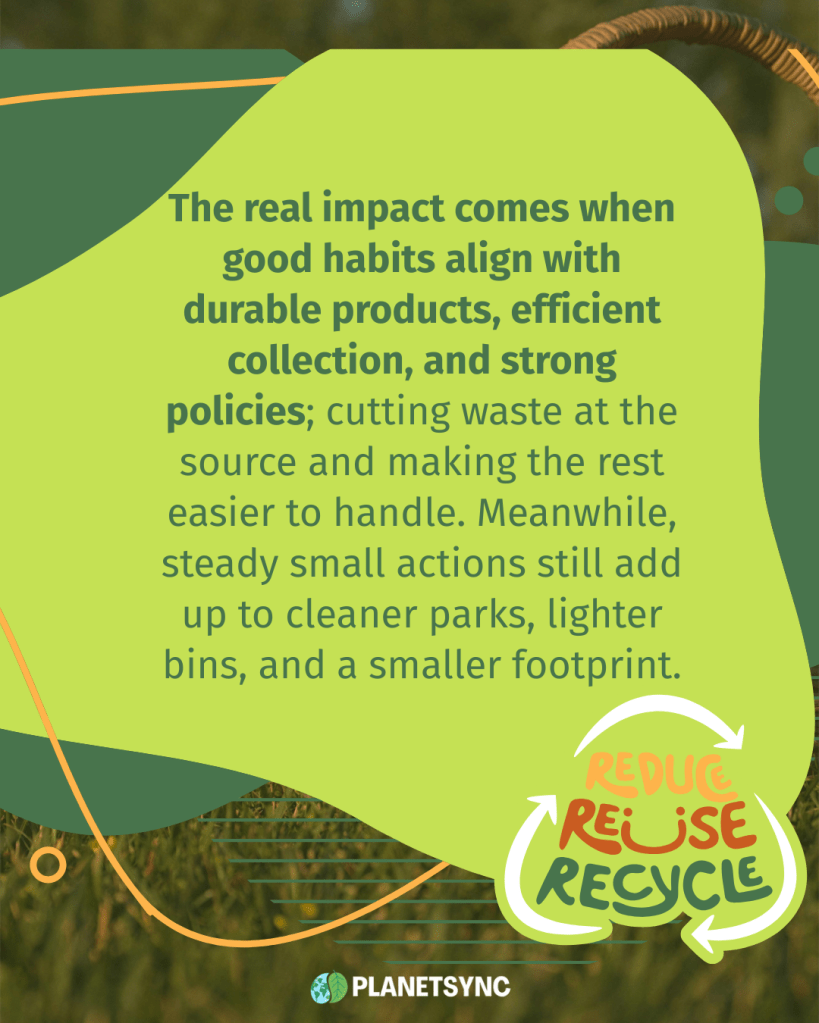
Every choice at a picnic plays a role in the wider waste system. The biggest impact comes when personal habits align with well-designed products, effective collection systems, and supportive policies. That’s when less waste is created at the start, and the rest is easier to manage. Until then, consistent small actions add up to cleaner parks, lighter bins, and a smaller footprint.
References & Resources
- Cottafava, D., Costamagna, M., Baricco, M., Corazza, L., Miceli, D., & Riccardo, L. E. (2021). Assessment of the environmental break-even point for deposit return systems through an LCA analysis of single-use and reusable cups. Sustainable Production and Consumption, 27, 228–241. https://doi.org/10.1016/j.spc.2020.11.002
- Eckhaus, O. A. (2024, October 14). Compostable Packaging In An Industrial Composter. TIPA. https://tipa-corp.com/blog/what-happens-to-compostable-plastic-packaging-in-an-industrial-composer/
- García Rellán, A., Vázquez Ares, D., Vázquez Brea, C., Francisco López, A., & Bello Bugallo, P. M. (2023). Sources, sinks and transformations of plastics in our oceans: Review, management strategies and modelling. Science of The Total Environment, 854, 158745. https://doi.org/10.1016/j.scitotenv.2022.158745
- Gastaldi, E., Buendia, F., Greuet, P., Benbrahim Bouchou, Z., Benihya, A., Cesar, G., & Domenek, S. (2024). Degradation and environmental assessment of compostable packaging mixed with biowaste in full-scale industrial composting conditions. Bioresource Technology, 400, 130670. https://doi.org/10.1016/j.biortech.2024.130670
- McGlade, J., Samy Fahim, I., Green, D., Landrigan, P., Andrady, A., Costa, M., Geyer, R., Gomes, R., Tan Shau Hwai, A., Jambeck, J., Li, D., Rochman, C., Ryan, P., Thiel, M., Thompson, R., Townsend, K., & Turra, A. (2021). From Pollution To Solution: A global assessment of marine litter and plastic pollution. https://nottingham-repository.worktribe.com/output/8047115
- Miao, X., Magnier, L., & Mugge, R. (2025). How Many Times Should I Use My Reusable Packaging?: Exploring the Role of an Environmental Break-Even Point in Shaping Consumers’ Intention to Reuse. Circular Economy and Sustainability, 5(1), 625–652. https://doi.org/10.1007/s43615-024-00437-8
- Ocean Conservancy. (n.d.). Ocean Conservancy: International Plastics Agreement. https://oceanconservancy.org/trash-free-seas/take-deep-dive/international-plastics-agreement/
- Ocean Conservancy. (2025, January 15). Plastic Bottles & Lids Among Top 10 Most Commonly Found Items at Cleanups. https://oceanconservancy.org/blog/2025/01/15/plastic-bottles-lids-most-commonly-found-cleanups/
- UN Environment Programme. (2024, March 21). Food Waste Index Report 2024 | UNEP. https://www.unep.org/resources/publication/food-waste-index-report-2024


 planetsync.blog
Leave a comment