


The Netherlands is one of Europe’s most water-engineered countries, with approximately 26% of its land area lying below sea level. The country’s geography has been shaped by water for centuries.
To promote sustainable water management, European countries implement the EU Water Framework Directive (WFD), which requires all water bodies to achieve “good status” at the latest by 2027. This standard encompasses ecological, chemical, and quantitative criteria to safeguard both the environment and water resources.
In alignment with these objectives, the Dutch government has articulated its strategy in the River Basin Management Plan (RBMP) 2022–2027. The plan identifies 745 surface water bodies, such as rivers, canals, lakes, estuaries, and coastal waters; and 23 groundwater bodies, which are reserves of water flowing below the ground in layers of rock and soil. Both surface and groundwater resources are essential for the country’s ecosystems, economy, and society, requiring careful stewardship to ensure sustainability for future generations.
Need the Gist? Swipe through the visuals below for a quick summary!



Classification of Dutch Water Bodies
Surface Water Bodies (SWBs)
Following the WFD, the Netherlands applies a standardized classification system that groups SWBs according to their degree of hydromorphological modification. The 3 categories are:
- Natural water bodies, where natural flow regimes and physical characteristics remain largely undisturbed by human intervention.
- Artificial water bodies (AWBs), means a body of surface water created by human activity (such as canals and reservoirs).
- Heavily modified water bodies (HMWBs), means a body of surface water which as a result of physical alterations by human activity is substantially changed in character. Alterations may include changes in size, slope, discharge, or the form and shape of the riverbed or banks, often to support navigation, flood protection, urban development, and water storage.
Of the 745 classified SWBs in the Netherlands, 286 are designated as HMWBs, 435 as AWBs, and only 24 remain as natural water bodies. This distribution reflects the Netherlands’ extensive engineering legacy.
Not all surface waters in the Netherlands are designated as water bodies under the WFD. In general, only surface waters of a certain size are designated as water bodies and the majority of the numerous ditches, canals and other small surface waters in the Netherlands are not designated as such.
Groundwater Bodies (GWBs)
The Netherlands identifies 23 GWBs under the WFD. These aquifers play a vital role in the national water system by supplying approximately 60% of drinking water, supporting agricultural irrigation (particularly in sandy soils and during dry periods), and providing high-quality water for specific industrial processes.
Driving Forces Affecting Dutch Water Resources
Agriculture
Agriculture is a key economic sector, covering approximately 54% of the Dutch land area and making the Netherlands the second-largest agricultural exporter globally by value. This high level of agricultural production has long driven the application of fertilizers, manure, and pesticides, contributing to diffuse pollution.
Industry
Industrial activity, although increasingly regulated, continues to contribute pollutants through legacy contamination and ongoing discharges.
Urbanization
Ongoing urbanization and high population density continue to shape water quality dynamics in the Netherlands. Increasing impervious surface areas in expanding cities and towns lead to greater stormwater runoff, which transports pollutants such as heavy metals, hydrocarbons, nutrients, and microplastics into SWBs. In addition, urbanization intensifies water demand and influences local hydrological regimes, increasing the complexity of managing both water quantity and quality in densely populated regions.
Climate Change
Climate change acts as an increasingly important cross-cutting driver. Increasingly frequent and severe droughts reduce river flow, diminishing the capacity of SWBs to dilute pollutants. This leads to higher concentrations of nutrients, metals, and organic contaminants during low-flow periods.
At the other end of the hydrological spectrum, more frequent and intense rainfall events, particularly in winter, drive pulses of surface runoff that rapidly transport nutrients, sediments, and pollutants into aquatic systems. These dynamics can exacerbate eutrophication, turbidity, and chemical contamination.
Sea-level rise and reduced river discharges promote the intrusion of saline water into freshwater systems, threatening both aquatic biodiversity and the availability of freshwater.
Finally, changing precipitation patterns and altered recharge dynamics affect groundwater systems. In particular, there is concern that climate-induced shifts in recharge processes may mobilize legacy contaminants that have accumulated in soils and sediments, further complicating groundwater quality management.
Key Pressures on Dutch Water Quality
Nutrient Loading from Agricultural Activities
Nutrient loading remains one of the most persistent pressures on water quality in the Netherlands. The widespread application of fertilizers and livestock manure leads to elevated concentrations of nitrogen (particularly nitrate and ammonium) and phosphorus in both surface waters and groundwater. Regions with permeable sandy and loess soils are particularly vulnerable to nutrient leaching, as these soil types facilitate rapid transport of dissolved nutrients into aquifers. Despite the implementation of the EU Nitrates Directive and related national measures, nutrient concentrations in many water bodies remain above ecological thresholds, hindering the achievement of WFD objectives.
Pesticide Contamination
A recent study by van Loon et al. (2025) detected 156 different pesticides and their metabolites in surface waters at key intake points from drinking water, with concentrations frequently exceeding regulatory standards. In other hand, 40% of monitored groundwater abstractions contain detectable pesticide residues, with 20% exceeding regulatory standards. The persistence of banned substances such as atrazine, which remains present in groundwater nearly two decades after its prohibition, highlights the long-term legacy of pesticide use.
Hydromorphological Modification
Decades of canalization, bank reinforcement, and flow regulation have altered flow regimes, disrupted sediment transport, and degraded aquatic habitats, reducing biodiversity and ecosystem resilience.
Chemical Pollution
Industrial emissions of heavy metals such as cadmium, mercury, lead, and nickel have declined substantially. However, reductions in nitrogen and phosphorus discharges from industry have been less pronounced.
In addition, emerging contaminants, particularly per- and polyfluoroalkyl substances (PFAS), now represent a significant and growing pressure. According to a 2023 risk assessment by RIVM, PFAS concentrations in Dutch drinking water frequently exceed health-based guidance values. Surface waters generally show higher PFAS concentrations due to greater exposure from industrial emissions and urban runoff. Among these substances, perfluorooctane sulfonic acid (PFOS) is a major contributor to overall PFAS exposure through drinking water.
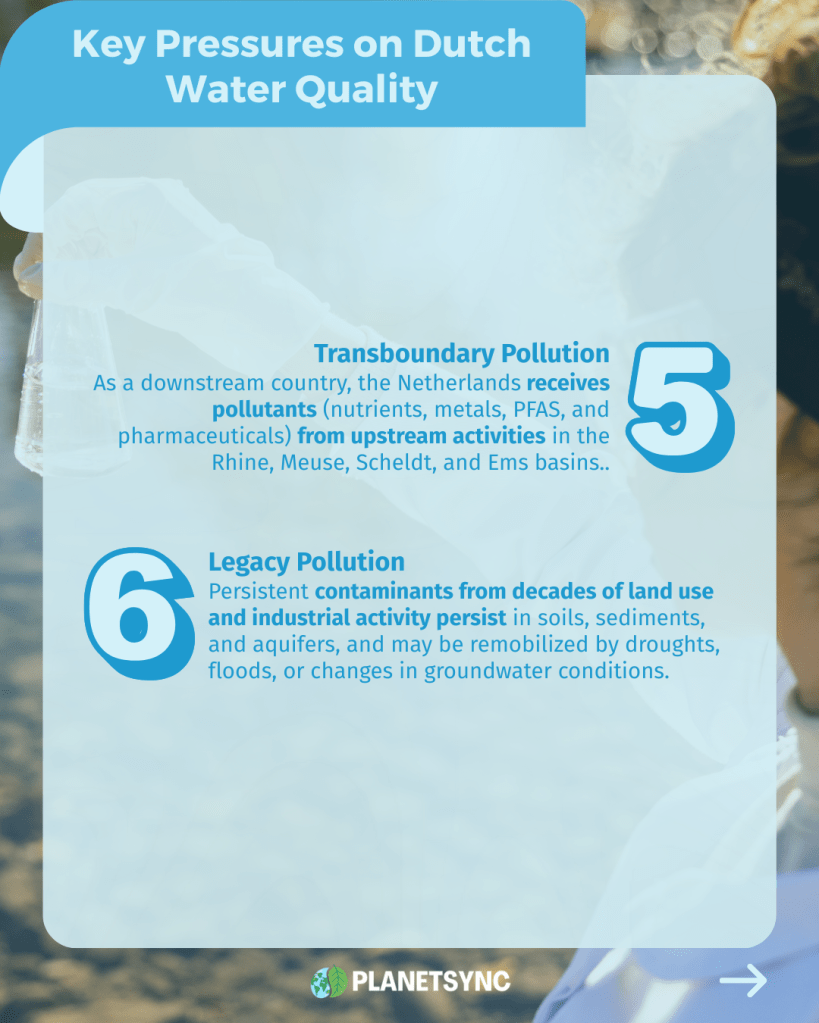
Transboundary Pollution
The Netherlands lies downstream in four major transboundary river basins: the Rhine (Rijn), Meuse (Maas), Scheldt (Schelde), and Ems (Eems). These rivers collect water from large areas across multiple countries, such as Germany, Belgium, France, and Switzerland, before entering Dutch territory and eventually discharging into the North Sea.
Because much of the water that enters the Netherlands originates outside its borders, activities taking place far upstream, sometimes hundreds of kilometers away, can directly affect Dutch water quality. These activities include farming, wastewater discharge, and industrial pollution, all of which can introduce substances like nitrates, phosphates, heavy metals, and emerging contaminants (such as pharmaceuticals and PFAS) into the rivers.
Legacy Pollution
Decades of intensive land use and industrial discharge have left a long-lasting legacy of contamination in Dutch soils, sediments, and groundwater. Substances such as atrazine, simazine, cadmium, mercury, arsenic, PCBs, and dioxins were widely used or released prior to the implementation of modern environmental regulations. Many of these pollutants are persistent and bioaccumulative, and some can become reactivated or mobilized under changing environmental conditions, such as rising groundwater levels, drought-induced oxidation, or flood-related sediment disturbance.
Complex Pressures, Urgent Choices
The Netherlands faces a complex set of pressures on its water resources, shaped by underlying socio-economic drivers such as intensive agricultural production, industrial demand, urbanization, and the growing impacts of climate change. These interacting forces have led to widespread nutrient loading, chemical contamination, hydromorphological modification, legacy pollution, and new emerging risks, challenging efforts to achieve sustainable water quality and ecosystem resilience.
Assessing the status of Dutch surface and groundwater bodies is therefore critical. The following article will examine how these pressures are reflected in recent WFD assessments.
References & Resources
- Boelee, Eline. (2024, July 3). Infographic: Water and Health. https://infographic.deltares.nl/water_and_health/infographic
- Claessens, J., van Gils, D., Brussée, T., van Duijnen, R., Oosterwoud, M., Vrijhoef, A., Plette, A., Kotte, M., Rozemeijer, J., Ouwerkerk, K., Gosseling, M., Roskam, J., & Taconis, F. (2025). Agricultural practices and water quality in the Netherlands: Status (2020–2023) and trends (1992–2023). Results of the monitoring of the effects of the EU Nitrates Directive action programmes, 2024. Rijksinstituut voor Volkgezondheid en Milieu RIVM. https://doi.org/10.21945/RIVM-2024-0209
- de Graaf, I. (2025, April 18). Imminent drought in The Netherlands: Groundwater levels plummet due to dry spring. WUR. https://www.wur.nl/en/research-results/research-institutes/environmental-research/show-wenr/imminent-drought-in-the-netherlands-groundwater-levels-plummet-due-to-dry-spring-1.htm
- EEA. (2024, December 9). PFAS pollution in European waters. https://www.eea.europa.eu/en/analysis/publications/pfas-pollution-in-european-waters
- European Commission. (2025). Third River Basin Management Plans Second Flood Hazard and Risk Maps and Second Flood Risk Management Plans Member State: Netherlands. https://eur-lex.europa.eu/legal-content/NL/ALL/?uri=CELEX:52025SC0032
- European Environment Agency. (2024, May 30). Industrial pollutant releases to water in Europe. https://www.eea.europa.eu/en/analysis/indicators/industrial-pollutant-releases-to-water
- European Parliament & Council of the European Union. (n.d.). Consolidated text: Directive 2000/60/EC of the European Parliament and of the Council of 23 October 2000 establishing a framework for Community action in the field of water policy. https://eur-lex.europa.eu/eli/dir/2000/60/2014-11-20/eng
- Government of the Netherlands. (2011, December 2). Agriculture and horticulture. Ministerie van Algemene Zaken. https://www.government.nl/topics/agriculture/agriculture-and-horticulture
- Kennisportaal Klimaatadaptatie. (n.d.). How is the climate in the Netherlands changing? [Overzichtspagina]. Spatial Adaptation; Rijkswaterstaat. https://klimaatadaptatienederland.nl/en/knowledge-dossiers/themes/climate-change/how-climate-netherlands-changing/
- Kleinhans, Maarten, Stouthamer, Esther, & Wanders, Niko. (2024, January 12). The limits of the Netherlands’ water system have been reached. https://www.uu.nl/en/opinie/the-limits-of-the-netherlands-water-system-have-been-reached
- Kuks, S. M. M. (2023). Commentary for the RAIN Symposium: Dutch Water Infrastructure Challenged by Climate Change. Public Works Management and Policy, 28(1), 89–100. https://doi.org/10.1177/1087724X221128814
- KWR. (n.d.). Reduction of pressure on groundwater through reuse of water from dairy plants in agriculture. https://www.kwrwater.nl/en/projecten/reduction-of-pressure-on-groundwater-through-reuse-of-water-from-dairy-plants-in-agriculture/
- Loon, A. van, Driezum, I. van, Pronk, T., & Clevers, S. (2025). Pesticide contamination across drinking water sources in the Netherlands (Nos. EGU25-16997). EGU25. Copernicus Meetings. https://doi.org/10.5194/egusphere-egu25-16997
- Ministerie van Infrastructuur en Waterstaat. (n.d.). Freshwater shortages and more flooding [Webpagina]. https://www.rijkswaterstaat.nl/en/news/archive/2024/04/freshwater-shortages-and-more-flooding-the-new-delta-scenarios-show-that-we-need-to-make-major-steps-ahead-this-century
- RIVM. (n.d.). Quality of drinking water. https://www.rivm.nl/en/soil-and-water/drinking-water/quality-of-drinking-water
- Schepens, M., te Biesebeek, J., Hartmann, J., van der Aa, N., Zijlstra, R., & Boon, P. (2023). Risk assessment of exposure to PFAS through food and drinking water in the Netherlands. Rijksinstituut voor Volksgezondheid en Milieu RIVM. https://doi.org/10.21945/RIVM-2023-0011
- The port that will take you ahead | Port of Rotterdam. (n.d.). https://www.portofrotterdam.com/en/why-rotterdam/port-will-take-you-ahead
- van Duren, Lucas & Boelee, Eline. (2024, May 23). Healthy water quality – Impact Report 2023. https://specials.deltares.nl/impact_report_2023/healthy_water_quality
- Waterstaat, M. van I. en. (2022). Stroomgebiedbeheerplannen Rijn, Maas, Schelde en Eems 2022 – 2027—Rapport—Rijksoverheid.nl [Rapport]. Ministerie van Algemene Zaken. https://www.rijksoverheid.nl/documenten/rapporten/2022/03/18/bijlage-stroomgebiedbeheerplannen-rijn-maas-schelde-en-eems-2022-2027
- Waterstaat, M. van I. en. (2024, September 16). Complete Delta Programme 2025 version [Publicatie]. Ministerie van Infrastructuur en Waterstaat. https://english.deltaprogramma.nl/documents/publications/2024/09/17/dp2025-complete-version


 planetsync.blog
Leave a comment