


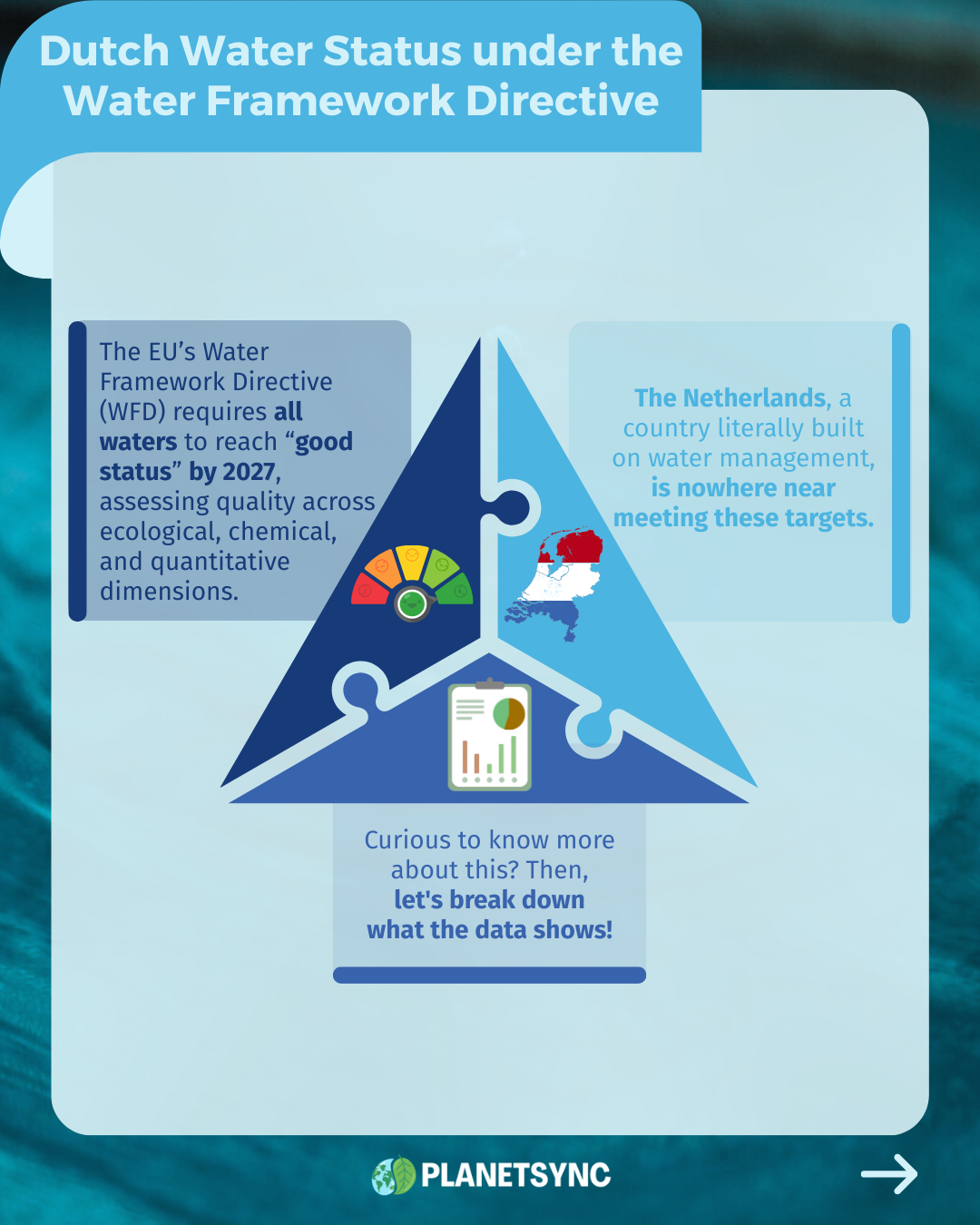
The European Union’s Water Framework Directive (WFD) requires all surface and groundwater bodies across Member States to reach at least ‘good status’ by 2027. That means meeting standards for ecological health, chemical safety, and sustainable use.
The Netherlands, a country built on water management, is nowhere near meeting these targets. Curious to know more about this? Then, let’s break down what the data shows!
Need the Gist? Swipe through the visuals below for a quick summary!
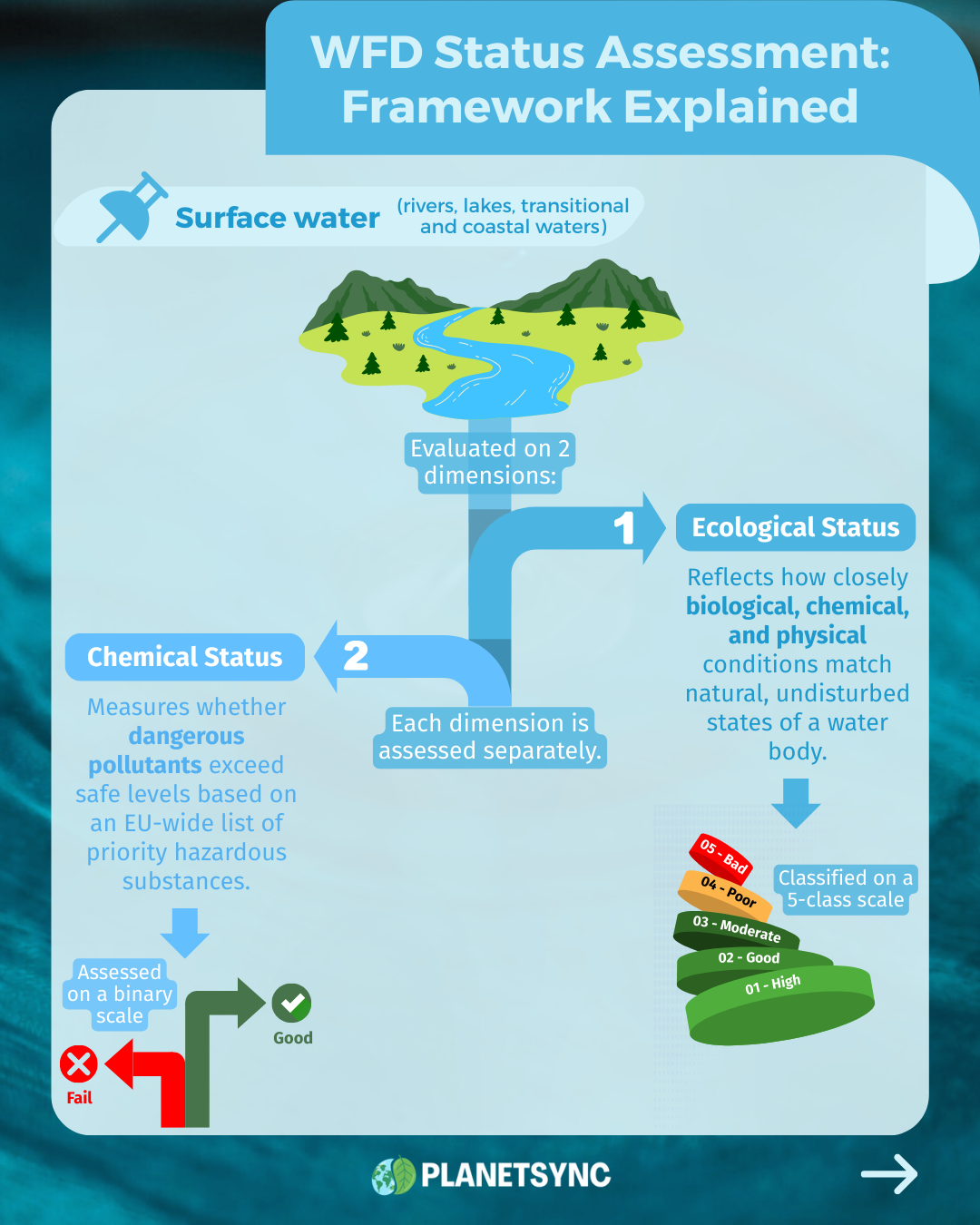
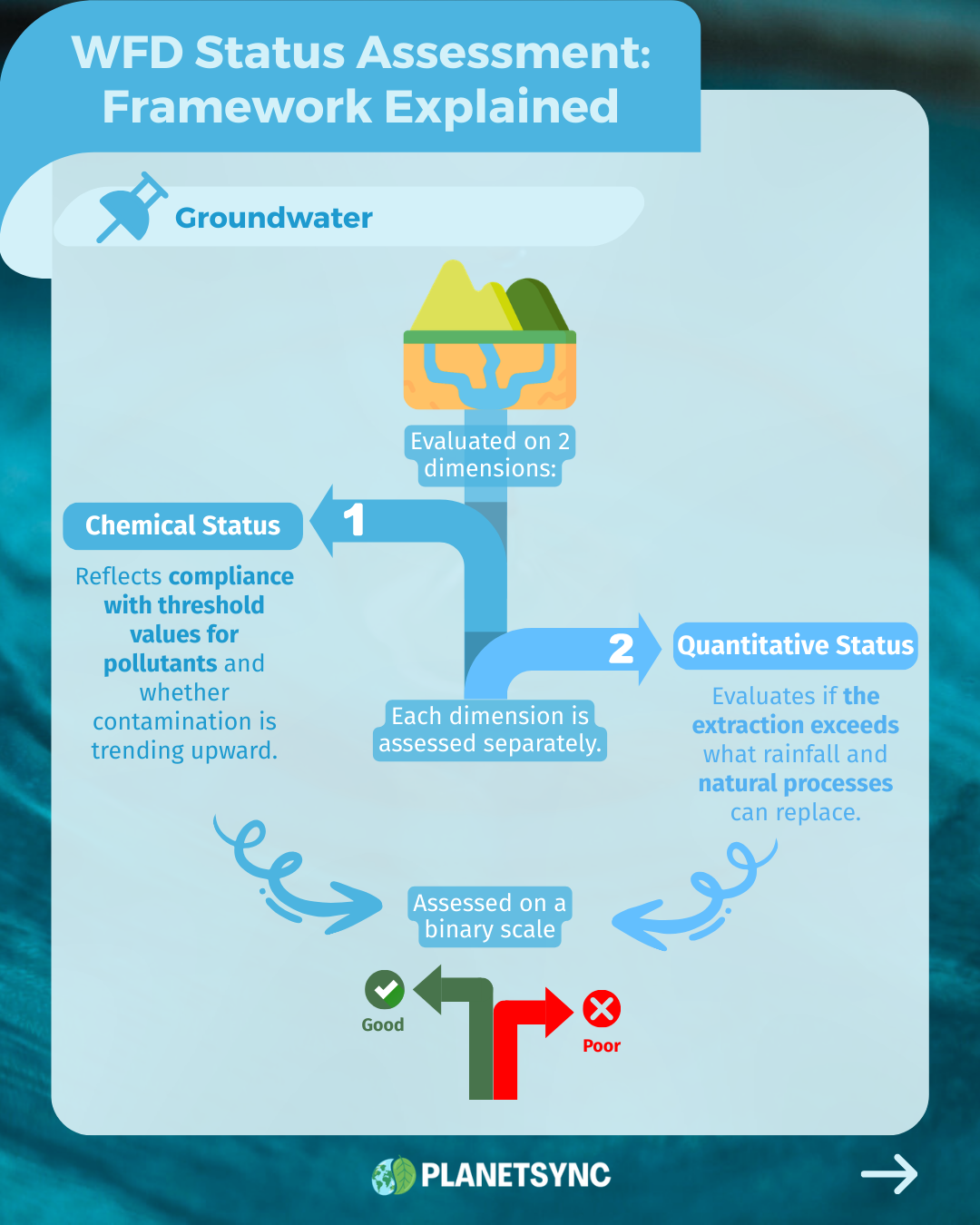
WFD Status Assessment: Framework Explained
Before diving into the results, let’s explain how the EU’s WFD evaluates water bodies.
Surface water (rivers, lakes, transitional and coastal waters)
Assessed on 2 dimensions:
| Ecological status | Chemical status |
| Classified on a five-class scale: high, good, moderate, poor, or bad. This looks at 3 things: biological conditions (which fish and plants are present), chemical conditions, and hydromorphological conditions (the physical shape). The ratings compare what exists now to what that water body would look like naturally, without human interference. High status means nearly untouched. Good means slight deviation, but biological communities are largely intact. Moderate means noticeable changes, though key natural integrity remains. Poor means serious biological degradation. Bad means severe ecological damage. | Assessed on a binary scale (good or fail). This measures whether dangerous pollutants exceed safe levels based on an EU-wide list of priority hazardous substances. |
These are assessed separately, so a surface water body can pass one and fail the other.
Groundwater
Assessed on 2 dimensions:
| Chemical status | Quantitative status |
| Reflects compliance with threshold values for pollutants and whether contamination is trending upward. Assessed on a binary scale (good or poor). | Evaluates if the extraction exceeds what rainfall and natural processes can replace. Assessed on a binary scale (good or poor). |
Again, these are independent; a groundwater body can pass one test and fail another.
Status of Dutch Surface Water Bodies (SWBs)
Ecological Status of SWBs
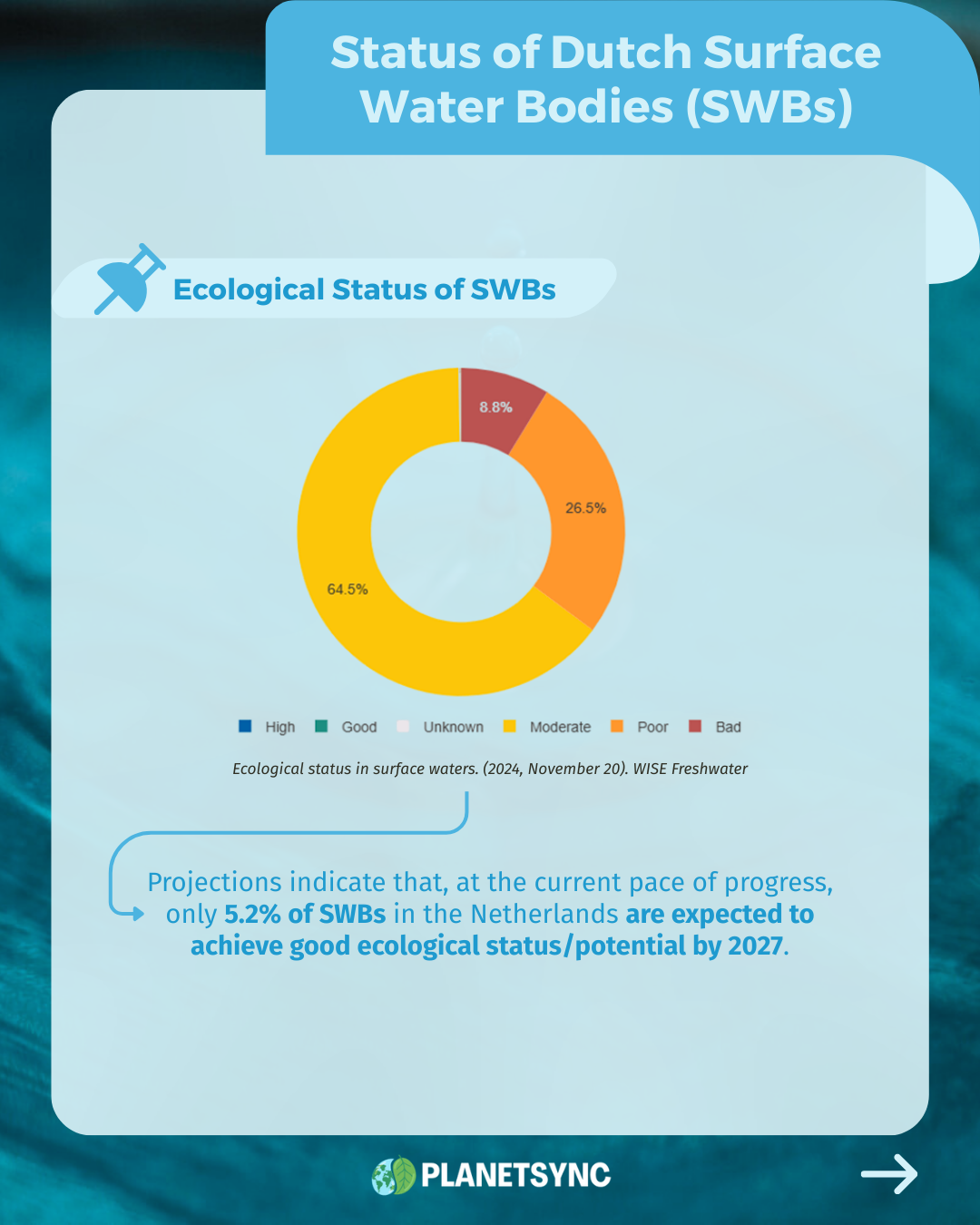
Not a single river, lake, or coastal water body in the Netherlands currently meets good or high ecological status. About 64.5% are classified as moderate, 26.5% as poor, 8.8% as bad, and 0.2% are unclassified due to lack of data. Worse yet, projections show that at the current pace, only 5.2% will achieve good ecological status by 2027.
Chemical Status of SWBs
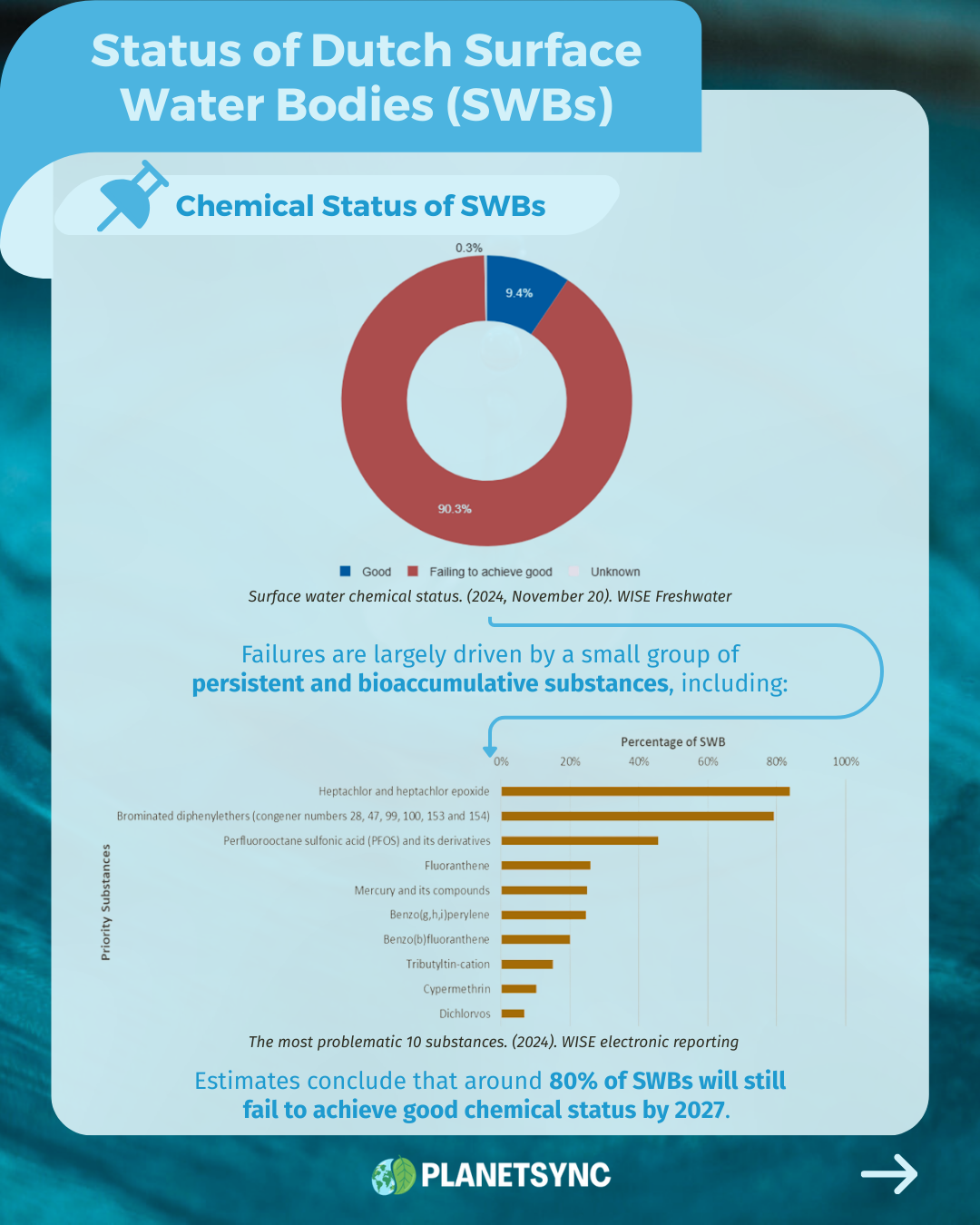
Chemical status isn’t any better. 90.3% of Dutch SWBs fail to achieve good chemical status. Failures are largely driven by a small group of persistent and bioaccumulative substances.
While industrial discharges of certain metals and organic pollutants have declined, the widespread environmental persistence of these substances and their bioaccumulation mean that further progress will be difficult without new and more effective interventions. Estimates conclude that around 80% of SWBs will still fail to achieve good chemical status by 2027.
Status of Dutch Groundwater Bodies (GWBs)
Chemical Status of GWBs
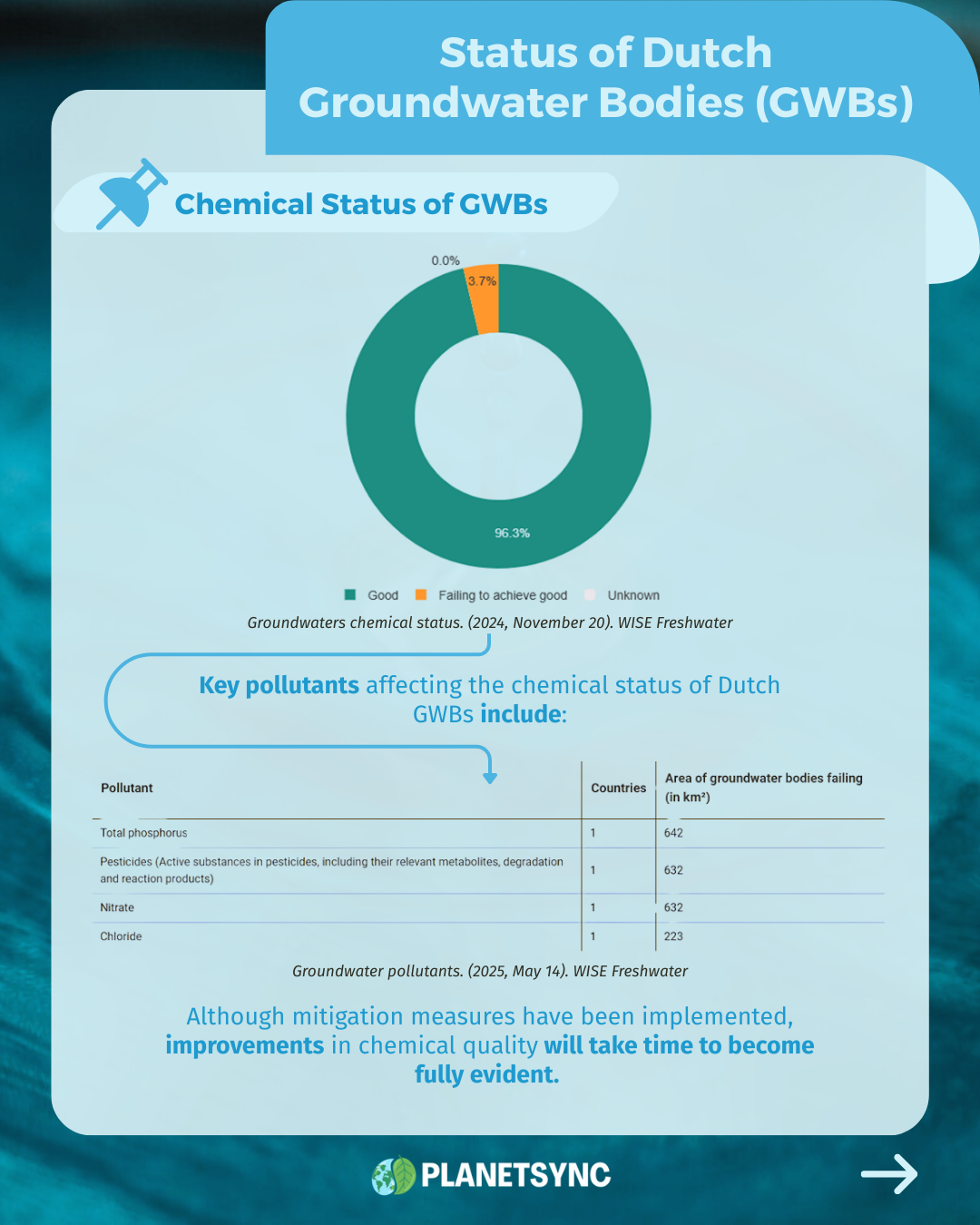
About 96.3% of GWBs have achieved good chemical status. The 3.7% that don’t are mainly contaminated by phosphorus from fertilizers, pesticides (especially in sandy soils where they seep through fast), nitrates from farm runoff, and chloride from saltwater intrusion and anthropogenic sources.
Quantitative Status of GWBs
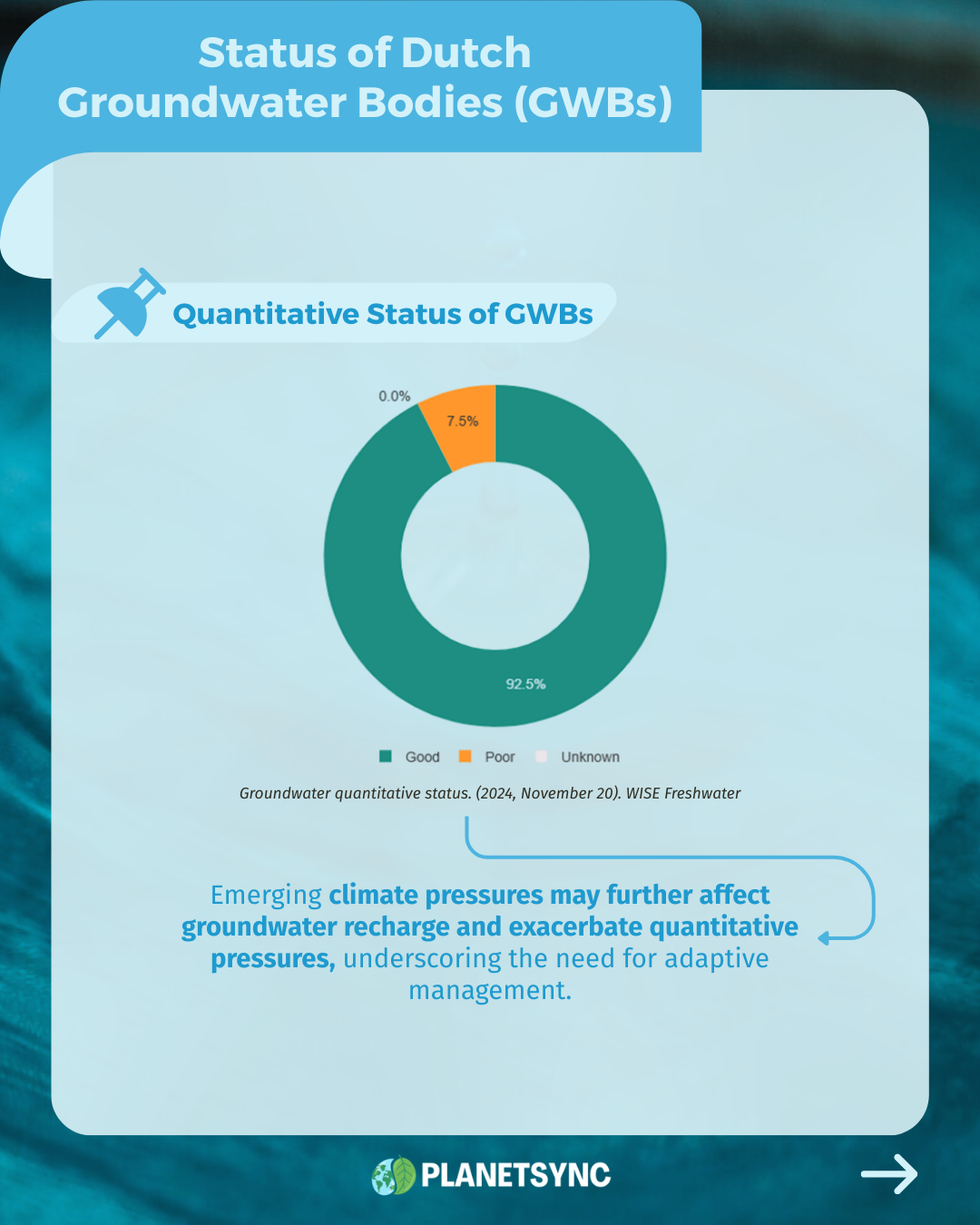
92.5% of GWBs are classified as having good quantitative status, and 7.5% are classified as poor. That percentage is expected to worsen by 2027 as climate change disrupts rainfall and increases evapotranspiration.
The Road Ahead for Dutch Waters
Although the Netherlands has made notable progress in improving water quality, the current pace is not fast enough to meet the targets of the EU WFD by 2027.
To accelerate progress, the Dutch government launched the WFD Stimulus Programme in spring 2023. This initiative aims to support the implementation of additional measures needed to close the remaining gaps and bring more water bodies into compliance with WFD objectives within the limited time remaining.
Looking ahead, meeting water quality and quantity goals will require a more integrated, adaptive, and ambitious approach. This includes stronger regulations, targeted investments, innovation in land and water management practices, and deeper collaboration across sectors and governance levels. In addition, sustained scientific research and continuous policy innovation will be essential to address today’s pressures and also the emerging risks posed by climate change.
References & Resources
- European Commission. (2025). Third River Basin Management Plans. State: Netherlands. https://eur-lex.europa.eu/legal-content/NL/ALL/?uri=CELEX:52025SC0032
- European Parliament & Council of the European Union. (n.d.). Consolidated text: Directive 2000/60/EC of the European Parliament and of the Council of 23 October 2000 establishing a framework for Community action in the field of water policy. https://eur-lex.europa.eu/eli/dir/2000/60/2014-11-20/eng
- WISE. (2024, March 8). Priority substances causing failure to achieve good chemical status. https://water.europa.eu/freshwater/europe-freshwater/water-framework-directive/surface-water-chemical-status/priority-substances-causing-failure-to-good-chemical-status
- WISE. (2024, November 20). Ecological status in surface waters. https://water.europa.eu/freshwater/europe-freshwater/water-framework-directive/ecological-status-of-surface-water
- WISE. (2024, November 20). Groundwater quantitative status. https://water.europa.eu/freshwater/europe-freshwater/water-framework-directive/groundwater-quantitative-status
- WISE. (2024, November 20). Groundwaters chemical status. https://water.europa.eu/freshwater/europe-freshwater/water-framework-directive/groundwater-bodies-chemical-status
- WISE. (2024, November 20). Surface waters chemical status. https://water.europa.eu/freshwater/europe-freshwater/water-framework-directive/surface-water-chemical-status
- WISE. (2024, December 17). Surface water bodies: Ecological status or potential (3rd, 2nd and 1st RBMP), by category [chart]. https://water.europa.eu/freshwater/resources/metadata/wfd-dashboards/surface-water-bodies-ecological-status-or-potential-3rd-2nd-and-1st-rbmp-chart


 planetsync.blog
Leave a comment