


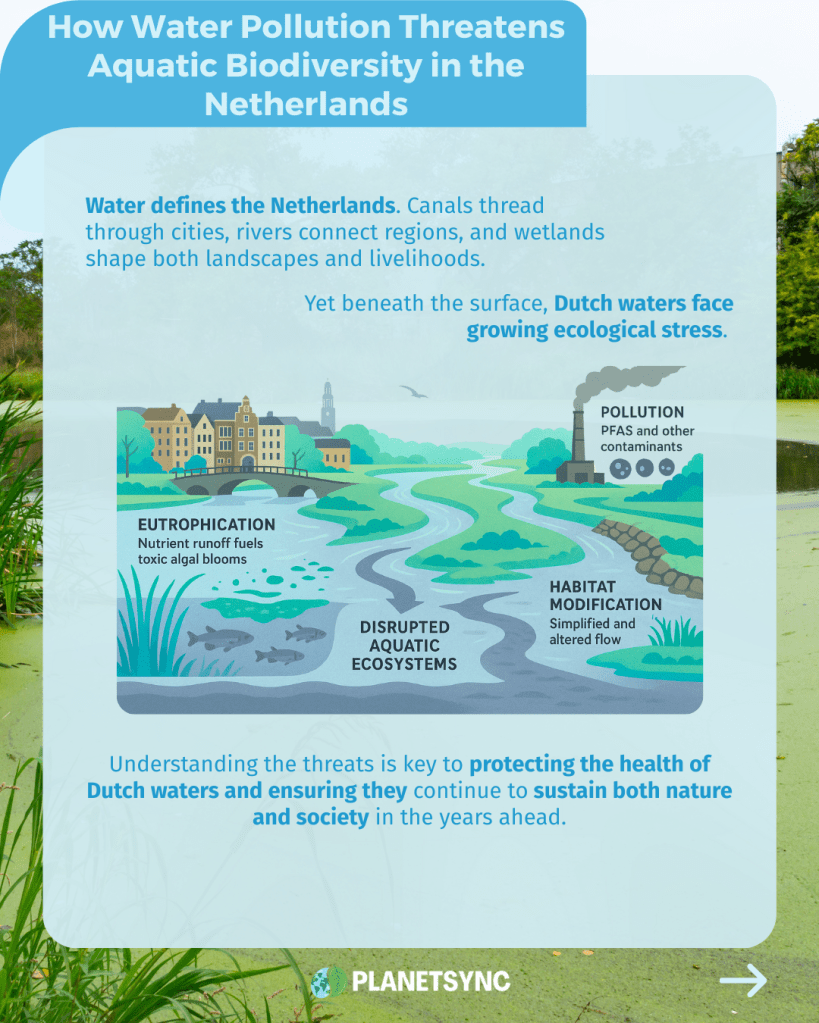
Water defines the Netherlands. Canals thread through cities, rivers connect regions, and wetlands shape both landscapes and livelihoods. Yet beneath the surface, Dutch waters face growing ecological stress. Nutrient overload, chemical contamination, and centuries of physical alteration are steadily eroding biodiversity and weakening ecosystem resilience.
In this article, we’ll explore how eutrophication, pollution, and habitat modification interact to disrupt aquatic ecosystems. From toxic algal blooms to PFAS contamination and simplified river channels, these overlapping pressures reveal the complex challenges of restoring water quality. Understanding these threats is key to protecting the health of Dutch waters and ensuring they continue to sustain both nature and society in the years ahead.
Need the Gist? Swipe through the visuals below for a quick summary!
Eutrophication: Nutrient Overload Driving Ecological Imbalance
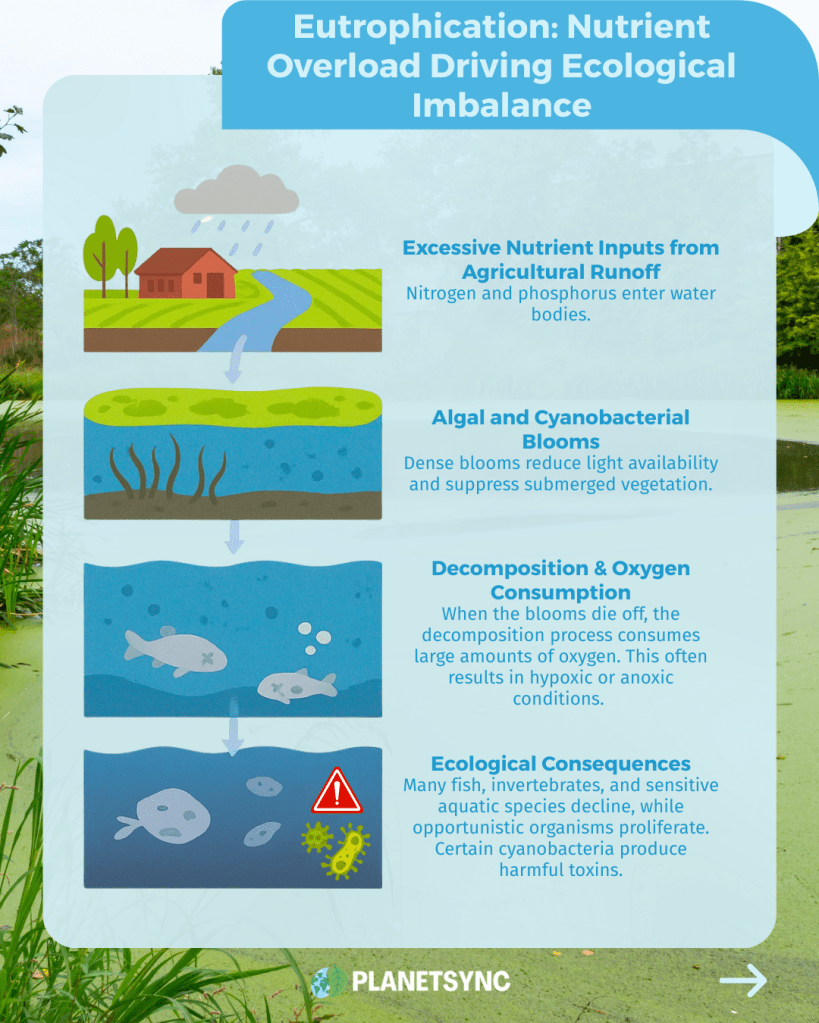
Eutrophication is one of the most persistent threats to the ecological health of Dutch waters. Excessive nutrient inputs, primarily nitrogen and phosphorus from agricultural runoff, trigger rapid algal and cyanobacterial blooms that fundamentally alter aquatic ecosystems. Dense blooms reduce light availability, suppress submerged vegetation, and when these blooms die off, the decomposition process consumes large amounts of oxygen. This often results in hypoxic (low oxygen) or anoxic (oxygen-depleted) conditions, particularly in deeper or stratified water bodies. Many fish, invertebrates, and sensitive aquatic species struggle to survive under these oxygen-starved conditions, while opportunistic, pollution-tolerant organisms proliferate. Certain cyanobacteria further exacerbate ecological stress by producing toxins harmful to both aquatic life and human health.
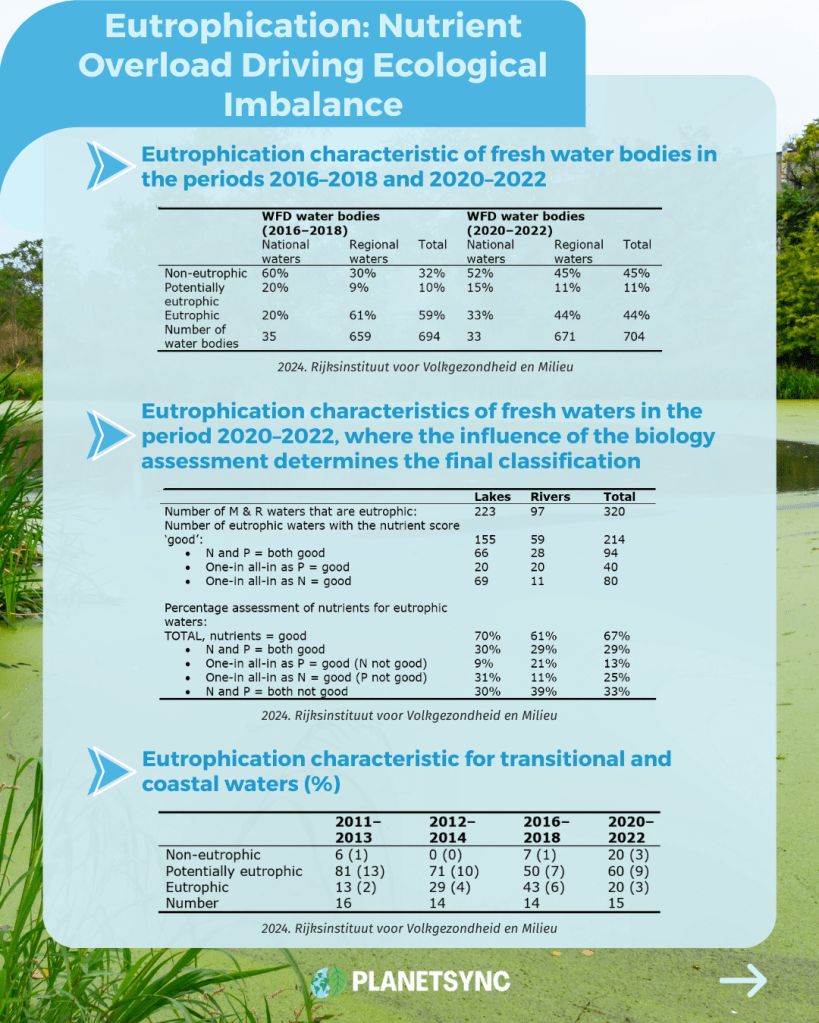
According to the Dutch National Institute for Public Health and the Environment (RIVM), 44% of Dutch freshwater bodies designated under the WFD were classified as eutrophic in 2023, meaning biological quality failed to meet standards. A further 45% were classified as non-eutrophic, meaning both their biological and nutrient conditions were acceptable. The remaining 11% were potentially eutrophic, meeting biological standards for now but with nutrient concentrations high enough to threaten future degradation. In costal and transitional waters, 20% of monitored waters were eutrophic, 20% non-eutrophic, and 60% potentially eutrophic.
Within eutrophic freshwater bodies, 33% exceeded thresholds for both nitrogen and phosphorus. In 38%, only one nutrient was above standards: 13% for nitrogen and 25% for phosphorus. The type of water body plays a key role: phosphorus exceedances are more frequent in lakes, ponds, ditches, and canals (M-type waters), while nitrogen more often exceeds limits in rivers and streams (R-type waters). In the remaining 29% of eutrophic waters, nutrient concentrations met target levels, yet biological quality remained poor, underscoring that ecosystems may not immediately recover even after nutrient reductions.
As a result, ecosystems shift toward simpler, less stable communities dominated by opportunistic species. Native biodiversity declines, habitats lose complexity, and the resilience of Dutch waters to other stressors, including climate extremes, chemical contamination, and habitat modification, is progressively weakened
Chemical Contamination: Emerging Pollutants with Long-Term Risks
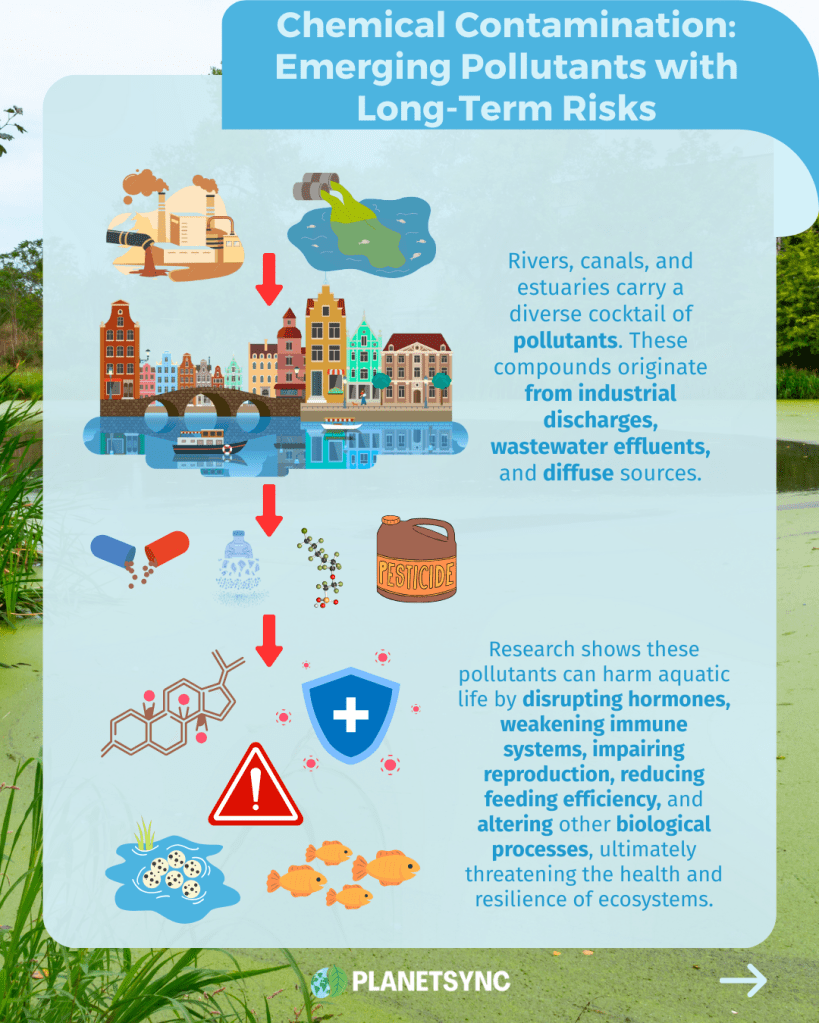
Beyond nutrient overload, chemical pollution introduces a new layer of complexity to Dutch aquatic ecosystems. Rivers, canals, and estuaries carry a diverse cocktail of pollutants, including pesticides, pharmaceuticals, microplastics, and particularly per- and polyfluoroalkyl substances (PFAS). These persistent and bioaccumulative compounds originate from industrial discharges, wastewater effluents, and diffuse sources across the landscape.
A comprehensive national study of Dutch inland and coastal waters (2008–2022) confirmed widespread PFAS contamination, including PFOS, with exceedances of EU water quality standards in major rivers such as the Rhine and Scheldt. Chronic PFAS exposure has been linked to endocrine disruption, immune suppression, and reproductive impairment in aquatic organisms. Laboratory studies using Daphnia magna, a sentinel species for freshwater health, have demonstrated multi-generational declines in reproduction and survival under PFAS exposure, indicating risks of cascading food web effects.
Pesticides are toxic to many non-target aquatic organisms, contributing to biodiversity loss, food web disruption, and impaired health in fish and invertebrates. Microplastics add further stress by being ingested by aquatic species, where they may cause physical harm, reduce feeding efficiency, and act as carriers for other pollutants that accumulate in food chains. Pharmaceuticals, meanwhile, are known to interfere with biological processes; for example, some compounds affect fish behavior, growth, and reproduction, with implications for ecosystem balance.
Hydromorphological Modification: Altered Habitats, Declining Species
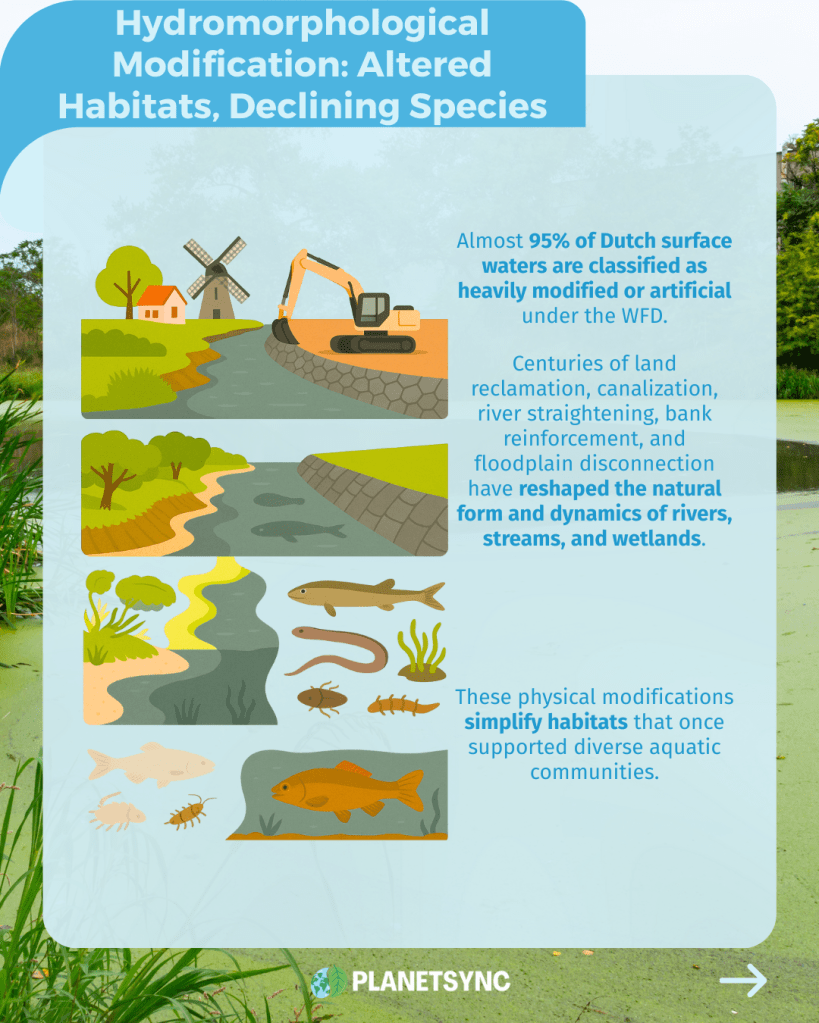
Almost 95% of Dutch surface waters are classified as heavily modified or artificial under the WFD. Centuries of land reclamation, canalization, river straightening, bank reinforcement, and floodplain disconnection have reshaped the natural form and dynamics of rivers, streams, and wetlands.
These physical modifications simplify habitats that once supported diverse aquatic communities. The loss of features such as rifles, pools, meanders, side channels, and varied bottom substrates reduces habitat complexity, eliminating critical spawning, feeding, and refuge areas. Species with specialized habitat needs are particularly vulnerable. For example, the European river lamprey (Lampetra fluviatilis) depends on clean gravel beds and complex flow patterns for reproduction, conditions that are rare or absent in highly regulated channels. Similarly, many invertebrates and juvenile fish lose shelter and feeding grounds when banks are reinforced, riparian vegetation is removed, and natural flow regimes are disrupted.
Complex Challenges in Restoring Aquatic Biodiversity
Aquatic biodiversity in the Netherlands faces significant challenges from nutrient enrichment, chemical pollution, and widespread hydromorphological alterations that have accumulated over decades. While nutrient inputs have declined in some sectors, persistent nutrient legacies in soils and sediments maintain elevated phosphorus and nitrogen loads, prolonging eutrophication. The increasing detection of complex chemical mixtures, including PFAS and pharmaceuticals, introduces additional stressors whose long-term ecological effects are not yet fully understood. Simultaneously, extensive hydromorphological modifications continue to limit habitat heterogeneity, affecting species that depend on diverse flow regimes and substrate structures.
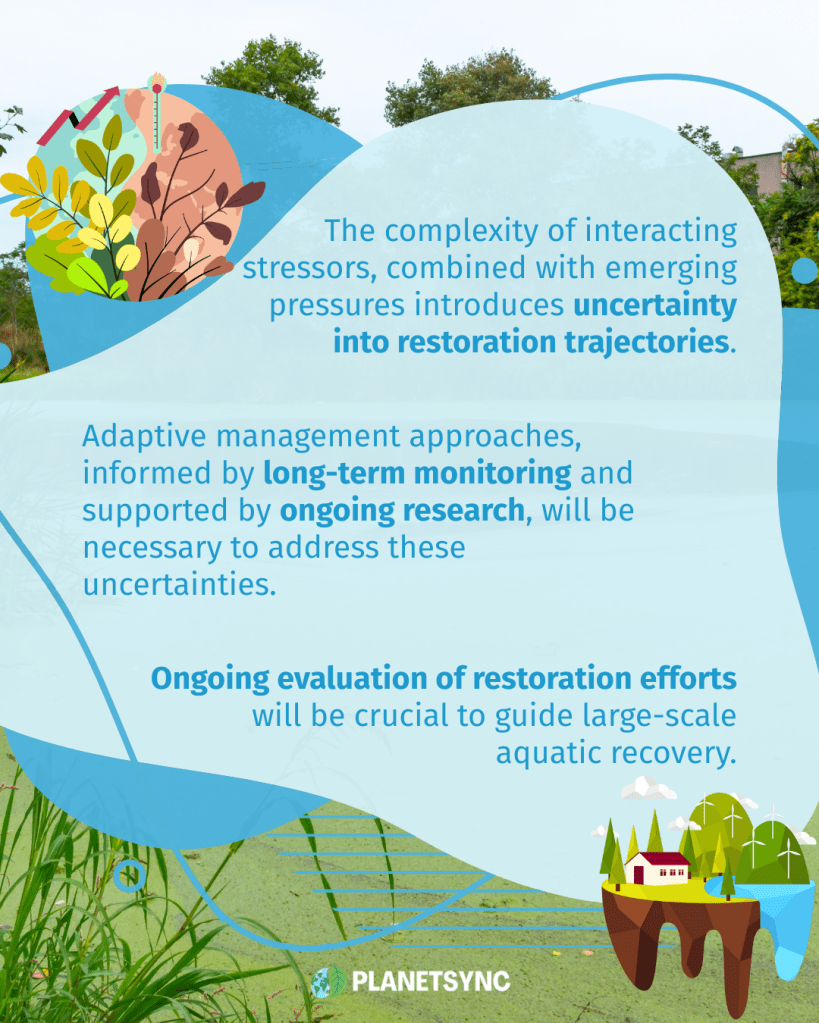
However, the complexity of interacting stressors, combined with emerging pressures such as climate change, introduces substantial uncertainty into restoration trajectories. Adaptive management approaches, informed by long-term monitoring and supported by ongoing research, will likely be necessary to address these uncertainties.
The challenges observed in the Netherlands are not unique but mirror those faced by other densely populated, intensively managed deltaic regions. Continued assessment of the outcomes from existing interventions will be essential to improve understanding of how large-scale aquatic restoration can proceed under conditions of persistent legacy pollution, evolving chemical threats, and climatic variability.
References & Resources
- Basu, N. B., Van Meter, K. J., Byrnes, D. K., Van Cappellen, P., Brouwer, R., Jacobsen, B. H., Jarsjö, J., Rudolph, D. L., Cunha, M. C., Nelson, N., Bhattacharya, R., Destouni, G., & Olsen, S. B. (2022). Managing nitrogen legacies to accelerate water quality improvement. Nature Geoscience, 15(2), 97–105. https://doi.org/10.1038/s41561-021-00889-9
- Claessens, J., van Gils, D., Brussée, T., van Duijnen, R., Oosterwoud, M., Vrijhoef, A., Plette, A., Kotte, M., Rozemeijer, J., Ouwerkerk, K., Gosseling, M., Roskam, J., & Taconis, F. (2025). Agricultural practices and water quality in the Netherlands: Status (2020–2023) and trends (1992–2023). Results of the monitoring of the effects of the EU Nitrates Directive action programmes, 2024. Rijksinstituut voor Volkgezondheid en Milieu RIVM. https://doi.org/10.21945/RIVM-2024-0209
- Dickey, J. C., Clemens, B. J., Dumelle, M., & Davis, M. J. (2025). Modeling lamprey distribution using flow, geomorphology, and elevation in a terminal lake system. Transactions of the American Fisheries Society, 154(3), 322–338. https://doi.org/10.1093/tafafs/vnaf017
- Huisman, J., Codd, G. A., Paerl, H. W., Ibelings, B. W., Verspagen, J. M. H., & Visser, P. M. (2018). Cyanobacterial blooms. Nature Reviews. Microbiology, 16(8), 471–483. https://doi.org/10.1038/s41579-018-0040-1
- Jonker, M. T. O. (2024). Per‐ and Polyfluoroalkyl Substances in Water (2008–2022) and Fish (2015–2022) in The Netherlands: Spatiotemporal Trends, Fingerprints, Mass Discharges, Sources, and Bioaccumulation Factors. Environmental Toxicology and Chemistry, 43(5), 965–975. https://doi.org/10.1002/etc.5846
- Ma, T., Wu, P., Wang, L., Li, Q., Li, X., & Luo, Y. (2023). Toxicity of per- and polyfluoroalkyl substances to aquatic vertebrates. Frontiers in Environmental Science, 11. https://doi.org/10.3389/fenvs.2023.1101100
- Ricolfi, L., Taylor, M. D., Yang, Y., Lagisz, M., & Nakagawa, S. (2024). Maternal transfer of per- and polyfluoroalkyl substances (PFAS) in wild birds: A systematic review and meta-analysis. Chemosphere, 361, 142346. https://doi.org/10.1016/j.chemosphere.2024.142346
- Xie, G., van Gestel, C. A. M., Vonk, J. A., & Kraak, M. H. S. (2025). Multigeneration responses of Daphnia magna to short-chain per- and polyfluorinated substances (PFAS). Ecotoxicology and Environmental Safety, 294, 118078. https://doi.org/10.1016/j.ecoenv.2025.118078


 planetsync.blog
Leave a comment