


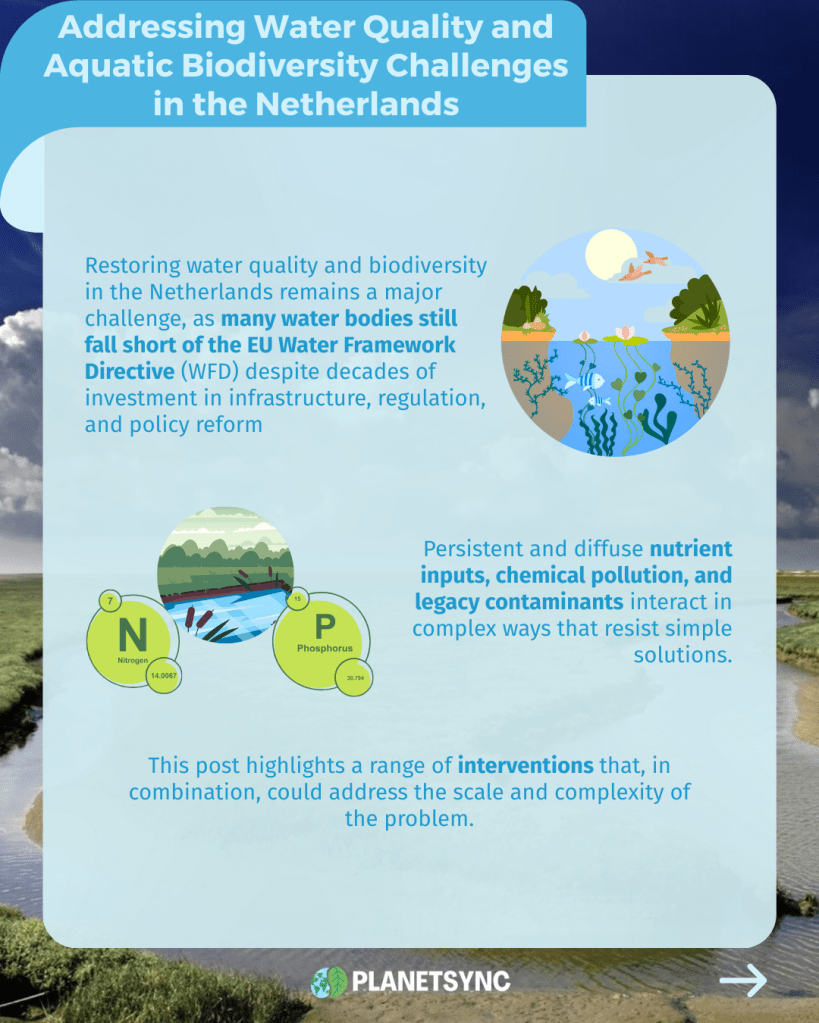
Restoring surface water quality and aquatic biodiversity in the Netherlands continues to be a major challenge. Despite decades of investment in infrastructure, regulation, and policy reform, many water bodies still don’t meet the ecological status objectives set by the EU Water Framework Directive (WFD). As explained in previous articles, this is largely due to diffuse nutrient inputs, chemical pollutants, and legacy contaminants. These stressors create complex interactions across ecological systems, making them resistant to narrow, sector-specific interventions.
There is a wide range of effective interventions available and of clear value in the Dutch context. This article will highlight a selection of these, demonstrating their relevance and practical application. While each offers tangible benefits, the scale and complexity of current challenges mean that no single measure can solve the problem alone.
Need the Gist? Swipe through the visuals below for a quick summary!





Nature-Based Solutions for Multifunctional Restoration
Nature-based solutions (NbS) offer multifunctional opportunities to improve water quality, conserve biodiversity, and enhance climate resilience. Wetlands, in particular, play a vital role in protecting water quality by trapping and removing pollutants through various natural mechanisms. These include physical processes like sedimentation and filtration, chemical interactions such as adsorption to soil and organic matter, and biological activities involving plants and microorganisms. Sunlight-driven UV exposure also contributes to disinfection. These ecosystems have demonstrated effectiveness in eliminating a wide range of contaminants from polluted water, including nutrients, heavy metals, and pesticides, while also providing essential habitat for aquatic and terrestrial species.
The Marker Wadden project exemplifies the large-scale application of NbS in the Dutch context. The artificial archipelago in Lake Markermeer demonstrated improvements in water clarity, sediment dynamics, and breeding habitat availability for diverse bird species and other fauna. Similarly, the Room for the River programme, completed in 2015, combined flood risk reduction with ecological and spatial enhancement. Through approximately 40 interventions, including dike relocation, floodplain lowering, and creation of bypasses, the programme increased river discharge capacity, reduced flood levels, and created thousands of hectares of multifunctional landscape, providing new recreational and ecological opportunities.
These cases illustrate the scalability and community support associated with well-designed NbS. While their contributions to nutrient load reduction are significant, it is important to recognize that, on their own, they are insufficient to address water, climate, and broader environmental challenges, particularly in catchments with persistent legacy pollution. Nonetheless, they remain essential components of a comprehensive restoration strategy.
Participatory Monitoring
Effective ecological restoration requires feedback mechanisms that enable adaptive management in response to evolving environmental conditions. While advanced sensor technologies provide high-resolution data, participatory monitoring approaches offer scalable, cost-effective ways to expand ecological data collection while strengthening community engagement.
In the Netherlands, citizen science platforms such as Waterdiertjes.nl have mobilized communities in macroinvertebrate monitoring. These initiatives generate ecological status assessments at low cost, help build public awareness, and support aquatic restoration efforts. However, the credibility and usability of volunteer-collected data for regulatory and scientific purposes require further development of standardized tools, training, and validation protocols.
Adaptive Governance for Multi-Stressor Ecosystem Restoration
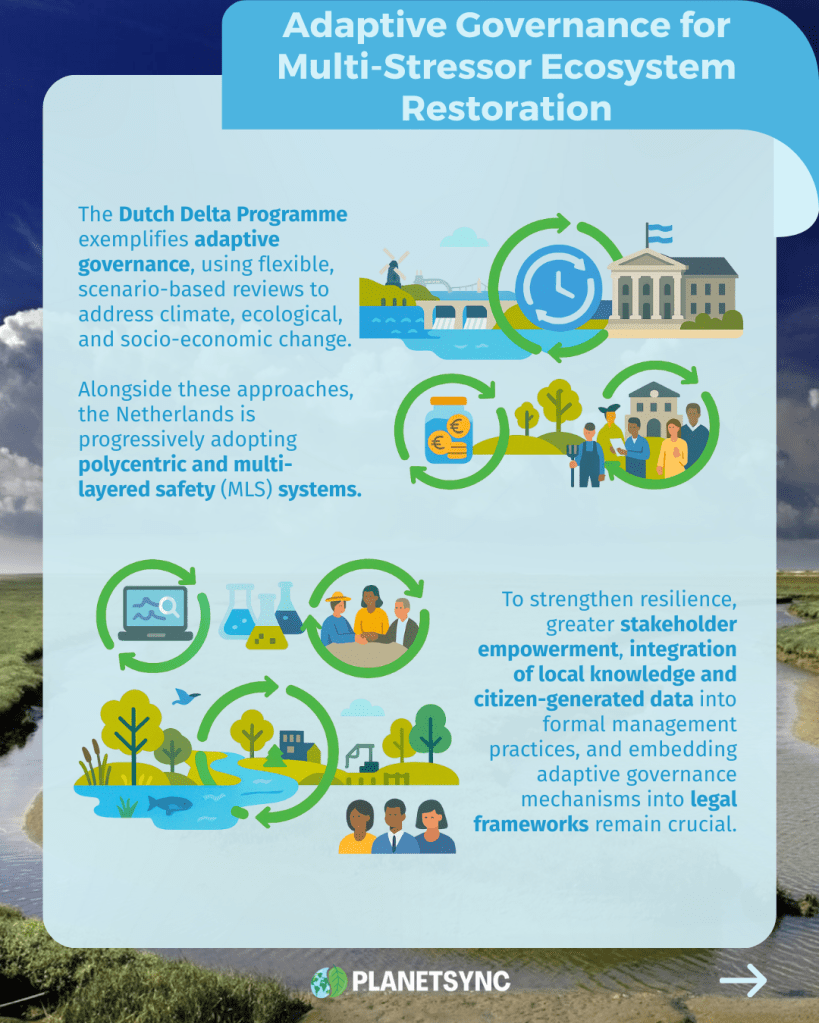
The Netherlands has long been recognized internationally for its progressive water management strategies, and its current approach offers a valuable model of adaptive governance, crucial for responding to climate change and complex ecological pressures. Central to this adaptive strategy is the Delta Programme, which moves beyond traditional rigid planning by incorporating continuous flexibility through periodic, scenario-based reviews. This iterative process enables policies to adapt effectively to emerging environmental data, climate shifts, and socio-economic developments, allowing policymakers to proactively integrate new scientific insights.
Alongside these structured policy approaches, the Netherlands is progressively adopting polycentric and multi-layered safety (MLS) systems, which distribute responsibilities across various governance levels, from government agencies to community groups and businesses. Although still developing and varied in implementation across the country, MLS frameworks encourage active stakeholder participation and the integration of local perspectives into broader national goals.
Effective adaptive governance will also depend on tangible support, including dedicated financial resources, technical guidance, and transparent data sharing. The Dutch Delta Fund, established under the Water Act, supports innovation, pilot interventions, and advanced monitoring platforms. These resources enable communities and authorities to rapidly experiment, learn, and deploy effective restoration measures.
However, achieving fully effective adaptive governance requires deeper institutional transformations. While participatory mechanisms are widespread, many remain consultative rather than decisional. Further empowerment of local stakeholders (farmers, NGOs, community groups) is essential. Enabling these actors to co-shape policy, supported by resources and legal authority, can accelerate restoration by embedding local knowledge and values into management frameworks.
The sustained effectiveness of Dutch ecological restoration efforts will significantly benefit from strategic advancements like embedding adaptive governance mechanisms within existing legal frameworks, continuing to establish clear pathways for innovation and continuous learning, and effectively integrating local knowledge and citizen-generated data into formal management practices. Together, these measures can enhance the resilience of governance systems, enabling more effective restoration and protection of critical ecosystems in the face of ongoing climatic and socio-economic change.
Agricultural Best Practices: Reducing Diffuse Nutrient Loads
Agriculture remains the dominant source of diffuse nutrient pollution in the Netherlands, particularly through nitrogen and phosphorus runoff from fertilizers and manure. However, several farm-level practices can significantly reduce this pollution without compromising agricultural productivity.
One approach is precision nutrient management. This method involves tailoring the type, amount, timing, and placement of fertilizers to the specific needs of crops, based on soil characteristics, weather conditions, and crop development stages. By aligning nutrient inputs more closely with plant uptake, this strategy reduces the risk of surplus nutrients leaching into groundwater or being transported to surface water during rainfall events. Despite its technical maturity, adoption remains underutilized on smaller or more traditional farms, where capital costs and advisory support can be limiting factors.
Cover crops are another effective strategy, particularly when sown in autumn to take up residual nutrients after harvest. These secondary crops absorb residual nutrients through their root systems, preventing them from being mobilized by rainfall. In addition to nutrient uptake, cover crops improve soil structure, enhance microbial activity, and reduce erosion, offering co-benefits for both water quality and long-term soil fertility. In the Dutch context, cover crops are broadly applicable, though their effectiveness will depend on precise timing and can be constrained by narrow planting windows and saturated autumn soils.
Vegetated buffer strips along field margins and watercourses intercept surface runoff and promote sedimentation and nutrient uptake before water enters adjacent ditches, canals, or rivers. In flat and intensively cultivated Dutch landscapes, spatial constraints often limit their width, but strategic placement, especially in headwater areas, can provide meaningful water quality and biodiversity benefits.
In regions with sandy soils, particularly in the east and southeast of the Netherlands, controlled drainage has emerged as a promising approach to reducing nutrient losses from farmland. Unlike conventional drainage systems that passively remove excess water, controlled drainage allows farmers to actively regulate groundwater levels using simple structures such as weirs or control boxes. This flexibility serves two critical functions: during wet periods, it limits the leaching of nitrates into nearby water bodies, and during dry spells, it helps retain water in the root zone, improving drought resilience and reducing irrigation needs. Scaling up this practice will require coordinated efforts among farmers, technical advisors, and regional water authorities, not only to implement the physical infrastructure but also to support training, monitoring, and long-term system adaptation.
Nutrient management poses challenges in livestock-intensive regions of the Netherlands, where long-standing manure surpluses have led to phosphorus saturation in agricultural soils. Measures such as manure separation (dividing slurry into liquid and solid fractions) allow for more targeted nutrient application and enable phosphorus-rich material to be transported to less saturated areas, both domestically and abroad. While these practices are supported through national and EU policy instruments, their broader uptake remains constrained by high costs, complex logistics, and regulatory fragmentation.
Integration as the Cornerstone of Restoration
Each of the interventions described above contributes to ecological restoration, yet their impact depends not on isolated implementation but on how effectively they are woven together across sectors and scales.
A more effective restoration strategy requires close coordination between water management, agriculture, spatial planning, and climate adaptation so that measures reinforce rather than compete with one another. It also depends on stronger alignment among local, regional, and national actors, supported by participatory mechanisms that allow stakeholders to co-shape decisions rather than simply respond to them. Long-term financial commitment is equally critical: while project-based support provides valuable momentum, it must evolve into durable funding streams that sustain innovation, collaboration, and monitoring at scale.
Embedding ecological restoration into wider spatial development strategies can help maximize multifunctionality and create synergies between land uses. By strengthening integration in this way, the Netherlands can not only increase the likelihood of meeting WFD goals but also build a transferable model for other intensively managed regions facing similar ecological constraints.
References & Resources
- Baumgarten, S., Aarts, N., Fliervoet, J. M., & Krabbenborg, L. (2025). Dynamics and Dependencies in Regional Collaboration for Biodiversity Restoration: Reflections from the Netherlands. Environmental Management, 75(1), 80–95. https://doi.org/10.1007/s00267-024-01958-6
- Bauwe, A., Eckhardt, K.-U., & Lennartz, B. (2022). Potential of constructed wetlands to reduce nitrate pollution in agricultural catchments. Ecological Engineering, 178, 106597. https://doi.org/10.1016/j.ecoleng.2022.106597
- Claessens, J., van Gils, D., Brussée, T., van Duijnen, R., Oosterwoud, M., Vrijhoef, A., Plette, A., Kotte, M., Rozemeijer, J., Ouwerkerk, K., Gosseling, M., Roskam, J., & Taconis, F. (2025). Agricultural practices and water quality in the Netherlands: Status (2020–2023) and trends (1992–2023). Results of the monitoring of the effects of the EU Nitrates Directive action programmes, 2024. Rijksinstituut voor Volkgezondheid en Milieu RIVM. https://doi.org/10.21945/RIVM-2024-0209
- Controlled drainage | STOWA. (n.d.). https://www.stowa.nl/deltafacts/zoetwatervoorziening/delta-facts-english-versions/controlled-drainage
- European Commission. (2025). Third River Basin Management Plans. State: Netherlands. https://eur-lex.europa.eu/legal-content/NL/ALL/?uri=CELEX:52025SC0032
- European Environment Agency. (n.d.). Interview—The Dutch make room for the river. https://www.eea.europa.eu/signals-archived/signals-2018-content-list/articles/interview-2014-the-dutch-make
- Ferreira, C. S. S., Kašanin-Grubin, M., Solomun, M. K., Sushkova, S., Minkina, T., Zhao, W., & Kalantari, Z. (2023). Wetlands as nature-based solutions for water management in different environments. Current Opinion in Environmental Science & Health, 33, 100476. https://doi.org/10.1016/j.coesh.2023.100476
- Hsu, C.-Y., Yan, G.-E., Pan, K.-C., & Lee, K.-C. (2021). Constructed Wetlands as a Landscape Management Practice for Nutrient Removal from Agricultural Runoff—A Local Practice Case on the East Coast of Taiwan. Water, 13(21), Article 21. https://doi.org/10.3390/w13212973
- Köninger, J., Lugato, E., Panagos, P., Kochupillai, M., Orgiazzi, A., & Briones, M. J. I. (2021). Manure management and soil biodiversity: Towards more sustainable food systems in the EU. Agricultural Systems, 194, 103251. https://doi.org/10.1016/j.agsy.2021.103251
- Molenveld, A., & van Buuren, A. (2019). Flood Risk and Resilience in the Netherlands: In Search of an Adaptive Governance Approach. Water, 11(12), Article 12. https://doi.org/10.3390/w11122563
- Nakachew, K., Yigermal, H., Assefa, F., Gelaye, Y., & Ali, S. (2024). Review on enhancing the efficiency of fertilizer utilization: Strategies for optimal nutrient management. Open Agriculture, 9(1), 20220356. https://doi.org/10.1515/opag-2022-0356
- Natuurmonumenten. (n.d.). Marker Wadden. https://www.natuurmonumenten.nl/projecten/marker-wadden/english-version
- Paauw, M., Scown, M., Triyanti, A., Du, H., & Garmestani, A. (2022). Adaptive Governance of River Deltas Under Accelerating Environmental Change. Utrecht Law Review, 18(2). https://doi.org/10.36633/ulr.803
- Peeters, E. T. H. M., Gerritsen, A. A. M., Seelen, L. M. S., Begheyn, M., Rienks, F., & Teurlincx, S. (2022a). Monitoring biological water quality by volunteers complements professional assessments. PLoS ONE, 17(2), e0263899. https://doi.org/10.1371/journal.pone.0263899
- Peeters, E. T. H. M., Gerritsen, A. A., Seelen, L. M., Begheyn, M., Rienks, F., & Teurlincx, S. (2022b). Recordings of aquatic macroinvertebrates by volunteers (2018-2020) and professionals (2013-2019) in the Netherlands (Version 5, p. 7356941 bytes) [Dataset]. Dryad. https://doi.org/10.5061/DRYAD.GHX3FFBPF
- Quintarelli, V., Radicetti, E., Allevato, E., Stazi, S. R., Haider, G., Abideen, Z., Bibi, S., Jamal, A., & Mancinelli, R. (2022). Cover Crops for Sustainable Cropping Systems: A Review. Agriculture, 12(12), Article 12. https://doi.org/10.3390/agriculture12122076
- Rewilding Europe. (2017, May 7). Marker Wadden. https://rewildingeurope.com/rew-project/marker-wadden-restoration-project/
- STOWA. (n.d.). Room for the river. https://www.stowa.nl/deltafacts/waterveiligheid/waterveiligheidsbeleid-en-regelgeving/room-river
- Vlotman, W.F. & Jansen, H.C. (n.d.). Controlled drainage for integrated water management. https://www.wur.nl/en/publication-details.htm?publicationId=4a9aa5a2-6aa3-43ed-ba00-ebbfee5c74fc
- WUR. (2022, March 16). Waterdiertjes.nl. WUR. https://www.wur.nl/en/project/waterdiertjes.htm
- Xing, Y., & Wang, X. (2024). Precise application of water and fertilizer to crops: Challenges and opportunities. Frontiers in Plant Science, 15. https://doi.org/10.3389/fpls.2024.1444560


 planetsync.blog
Leave a comment