


In the Netherlands, centuries of engineering turned a vulnerable delta into a prosperous society. Yet this success masks a deep ecological deficit: no Dutch surface water meets the EU’s good ecological status, over 90% fail chemical standards, biodiversity is declining, and ecosystems remain degraded.
These are not mere technical flaws. Seen through the lens of the right to a healthy environment and the triple planetary crisis, they reveal systemic failures with direct consequences for human rights. Let’s uncover why!
Need the Gist? Swipe through the visuals below for a quick summary!




The Right to a Healthy Environment
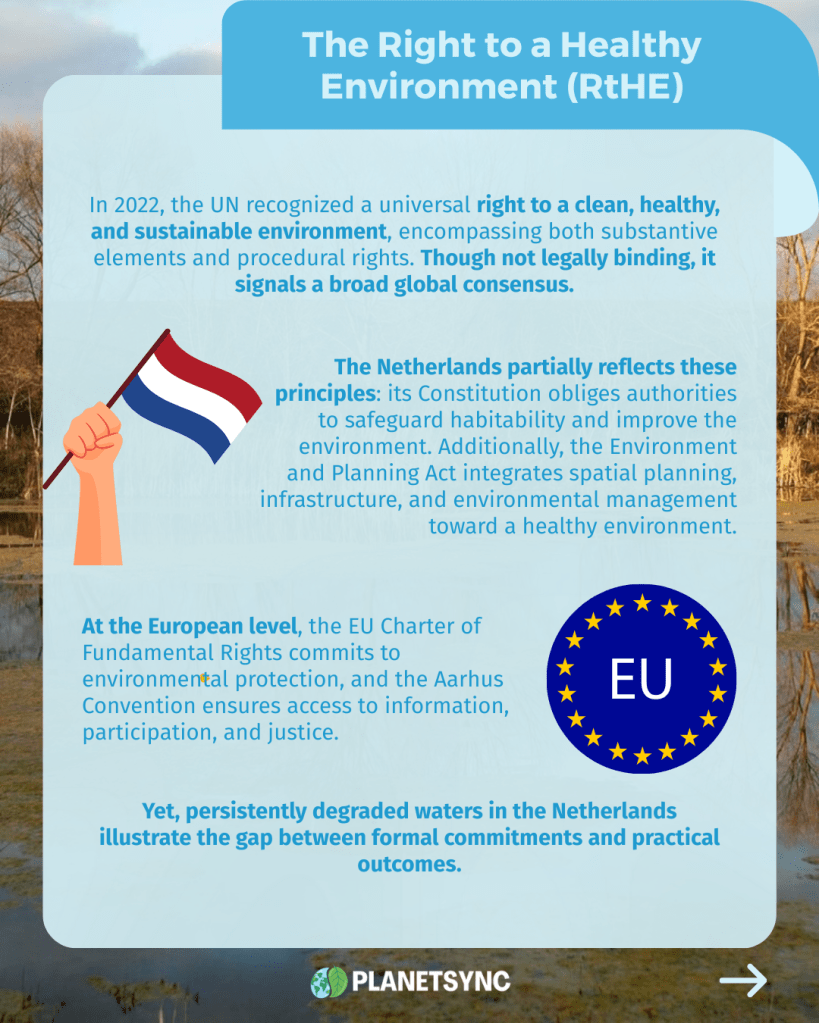
In July 2022, the United Nations General Assembly formally recognized the human right to a clean, healthy, and sustainable environment. The right encompasses substantive elements including clean air, safe and sufficient water, healthy and sustainably produced food, a safe climate, healthy biodiversity and ecosystems, and non-toxic environments. It also guarantees procedural rights such as access to information, participation in decision-making, and access to justice. While the resolution is not legally binding, it reflects an emerging global consensus that environmental quality is inseparable from human dignity.
The Dutch legal framework partially reflects these principles. For example, article 21 of the Dutch Constitution tasks authorities with keeping the country habitable and improving the environment, though it does not explicitly establish an individual fundamental right to a healthy environment. Environmental governance is further structured through a range of statutes. The Environment and Planning Act, in force since 2024, integrates spatial planning, infrastructure, and environmental management with the stated aim of creating a healthy, safe, and sustainable living environment.
At the European level, Article 37 of the EU Charter of Fundamental Rights commits to a high level of environmental protection, while the Aarhus Convention guarantees access to information, participation, and justice on environmental issues.
However, the persistence of degraded waters in the Netherlands highlights the disjunction between commitments on paper and outcomes in practice. Rights can be acknowledged in principle but undermined in practice when governance mechanisms fail to address structural drivers of environmental decline.
Water Pollution in the Context of the Triple Planetary Crisis
The United Nations Environment Programme identifies 3 interconnected crises: pollution, biodiversity loss, and climate change, as defining environmental challenges of the twenty-first century.
Pollution
Nutrient pollution remains the most persistent problem. Agricultural surpluses of nitrogen and phosphorus continue to exceed EU limits, resulting in widespread eutrophication. Beyond nutrients, chemical pollution adds complexity. Pesticides are regularly detected in surface waters and, in some cases, in groundwater abstraction points. PFAS (per- and polyfluoroalkyl substances) have accumulated in rivers and estuaries to the extent that consumption of self-caught fish and shellfish is restricted in areas such as the Westerschelde. National studies confirm that Dutch residents ingest PFAS above recommended safety thresholds, mainly via food. The persistence of such contaminants underscores the difficulty of reversing pollution once it becomes embedded in aquatic systems.
Biodiversity loss
No Dutch surface water body currently meets “good” or “high” ecological status under the Water Framework Directive, mainly due to excess nutrients, chemical pollution, and heavy engineering. These pressures simplify ecosystems, reduce habitat, and drive biodiversity loss.
Climate change
Climate change amplifies existing water-quality pressures in the Netherlands. Periods of drought and low flows in the Rhine and Meuse concentrate pollutants and allow saltwater intrusion into freshwater systems, reducing options for safe abstraction. Heavy rainfall, by contrast, can raise short-term pollution risks: runoff from urban and agricultural areas increases nutrient and contaminant loads, and in some urban catchments older sewer infrastructure may overflow. Such events have, in certain instances, led to temporary declines in bathing water quality.
Taken together, these dynamics demonstrate how Dutch water pollution reflects the convergence of global environmental crises within a single national context. The implications extend beyond ecological degradation alone; they strike at the core of the right to a healthy environment.
How Water Pollution Threatens the Right to a Healthy Environment
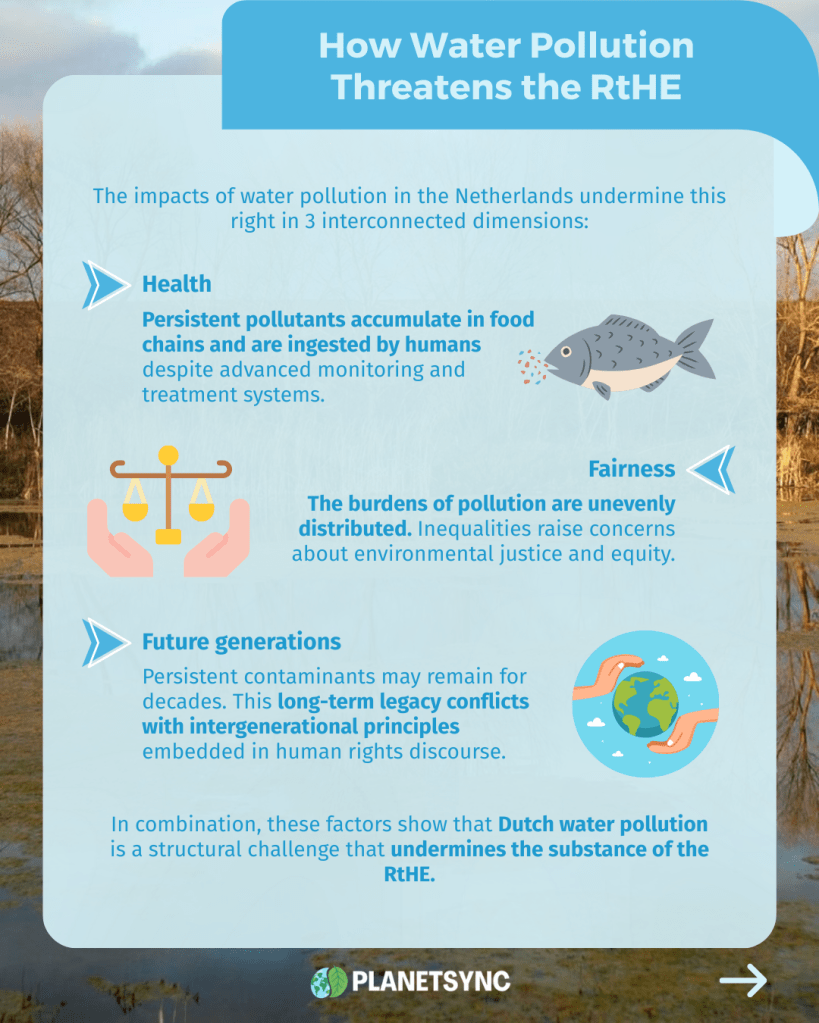
The impacts of water pollution in the Netherlands undermine this right in 3 interconnected dimensions.
Health
Persistent pollutants accumulate in food chains and are ingested by humans despite advanced monitoring and treatment systems. The inability to fully prevent exposure illustrates the limits of existing technological safeguards.
Fairness
The burdens of pollution are unevenly distributed. Communities dependent on estuarine fisheries, residents of livestock-intensive regions, and urban neighborhoods with aging sewer infrastructure face disproportionate exposure. These inequalities raise concerns about environmental justice and equity within Dutch society.
Future generations
Persistent contaminants embedded in soils and sediments may remain for decades, while degraded ecosystems can take generations to recover. This long-term legacy restricts the ecological options available to future generations and conflicts with intergenerational principles embedded in human rights discourse.
In combination, these factors show that Dutch water pollution is a structural challenge that undermines the substance of the right to a healthy environment.
Aligning Dutch Water Policy with Human Rights
Dutch water policy includes instruments that could, in theory, secure the right to a healthy environment: nutrient reduction targets, PFAS monitoring programs, ecological restoration projects, and participatory frameworks. Yet results remain limited: measures are fragmented, enforcement is inconsistent, and environmental goals often yield to economic priorities. A rights-based perspective demands structural reform in at least four areas:
- Closing the implementation gap. Regulations on nutrient runoff and chemical discharges exist but must be enforced with consistency and ambition.
- Making ecological restoration central. Projects such as Marker Wadden and Room for the River illustrate that large-scale restoration is possible, but they remain exceptional. Restoration must become a structuring principle in spatial planning and agriculture rather than an add-on.
- Strengthening participation. Although Dutch governance provides opportunities for consultation, decision-making power remains concentrated in authorities and sectoral interests. A rights-based approach requires more meaningful participation, with affected communities and civil society organizations involved in co-decision processes.
- Embedding equity and intergenerational justice. Policies increasingly reference fairness and sustainability, yet persistent pollution burdens show that obligations to future generations are not being met. Rights-based water governance must make these principles explicit and non-negotiable.
From Compliance to Justice
The Dutch case demonstrates the limits of a governance model that treats water as a technical resource problem. In a rights-based framework, water quality cannot be separated from justice, equity, and long-term responsibility.
Continuing with incremental measures, fragmented governance, and prioritization of economic productivity will lock in long-term ecological degradation. A different trajectory requires addressing structural drivers through coordinated, systemic change.
Finally, success must no longer be measured by compliance reports alone but by tangible realities: cleaner waters, restored ecosystems, and equitable access to healthy environments for all communities. Anything less reduces the right to a healthy environment to rhetorical aspiration, while pollution, inequality, and ecological decline continue unchecked.
References & Resources
- Delta Programme. (n.d.). National Delta Programme 2025. https://english.deltaprogramma.nl/documents/2024/09/17/dp2025-complete-version
- European Commission. (n.d.). Third River Basin Management Plans Second Flood Hazard and Risk Maps and Second Flood Risk Management Plans Member State: Netherlands. https://eur-lex.europa.eu/legal-content/EN/TXT/?uri=celex:52025SC0032
- European Commission. (2021, July 13). The Aarhus Convention and the EU. https://environment.ec.europa.eu/law-and-governance/aarhus_en
- European Union Agency for Fundamental Rights. (2015, April 25). Article 37—Environmental protection. https://fra.europa.eu/en/eu-charter/article/37-environmental-protection
- GGD Zeeland. (n.d.). PFAS in voedsel en drinkwater. https://www.ggdzeeland.nl/pfas-in-voedsel-en-drinkwater/
- Government of the Netherlands. (2017, February 14). Legislation protecting nature in the Netherlands—Nature and biodiversity [Onderwerp]. Ministerie van Algemene Zaken. https://www.government.nl/topics/nature-and-biodiversity/legislation-protecting-nature-in-the-netherlands
- Koninkrijksrelaties, M. van B. Z. en. (n.d.). Omgevingswet [Wet]. https://wetten.overheid.nl/BWBR0037885/2025-07-01
- Lindhout, R. (2023, September 1). News but nothing new: Many pesticides in Dutch swimming and natural waters. Leiden University. https://www.universiteitleiden.nl/en/news/2023/09/news-but-nothing-new-many-pesticides-in-dutch-swimming-and-natural-waters
- Ministerie van Algemene Zaken. (2019, February 28). The Constitution of the Kingdom of the Netherlands 2018—Report—Government.nl [Rapport]. Ministerie van Algemene Zaken. https://www.government.nl/documents/reports/2019/02/28/the-constitution-of-the-kingdom-of-the-netherlands
- OHCHR, UNEP, & UNDP. (n.d.). What is the Right to a Healthy Environment? https://www.undp.org/sites/g/files/zskgke326/files/2023-01/UNDP-UNEP-UNHCHR-What-is-the-Right-to-a-Healthy-Environment.pdf
- Peters, S., Ouboter, M., Lugt, K. van der, Koop, S., & Leeuwen, K. van. (2021). Retrospective Analysis of Water Management in Amsterdam, The Netherlands. Water, 13(8), 1099. https://doi.org/10.3390/w13081099
- RIVM. (n.d.). Na regen komt… Verhoogd risico op uitbraken door verslechterde waterkwaliteit / IB 09 2024. https://www.rivm.nl/weblog/ib-na-regen-komt-verhoogd-risico-op-uitbraken-door-verslechterde-waterkwaliteit-ib-09-2024
- Schepens, M., te Biesebeek, J., Hartmann, J., van der Aa, N., Zijlstra, R., & Boon, P. (2023). Risk assessment of exposure to PFAS through food and drinking water in the Netherlands. Rijksinstituut voor Volksgezondheid en Milieu RIVM. https://doi.org/10.21945/RIVM-2023-0011
- Sjerps, R. M. A., Kooij, P. J. F., Van Loon, A., & Van Wezel, A. P. (2019). Occurrence of pesticides in Dutch drinking water sources. Chemosphere, 235, 510–518. https://doi.org/10.1016/j.chemosphere.2019.06.207
- UNEP. (2022, July 28). In historic move, UN declares healthy environment a human right. https://www.unep.org/news-and-stories/story/historic-move-un-declares-healthy-environment-human-right
- UNFCCC. (n.d.). What is the Triple Planetary Crisis? https://unfccc.int/news/what-is-the-triple-planetary-crisis
- Utrecht University. (n.d.). Heatwaves and droughts—In depth. https://www.uu.nl/en/organisation/in-depth/heatwaves-and-droughts
- Wageningen University & Research. (2023, January 2). Bottom of the class for water quality. WUR. https://www.wur.nl/en/show-longread/bottom-of-the-class-for-water-quality.htm
- Wegman, T. M., Pietrzak, J. D., Horner-Devine, A. R., Dijkstra, H. A., & Ralston, D. K. (2025). Observations of Estuarine Salt Intrusion Dynamics During a Prolonged Drought Event in the Rhine-Meuse Delta. Journal of Geophysical Research: Oceans, 130(1). https://doi.org/10.1029/2024JC021655
- Zwartsen, A., & Boon, P. (2022). Consumptie van producten verontreinigd met PFAS uit de Westerschelde. Rijksinstituut voor Volksgezondheid en Milieu RIVM. https://doi.org/10.21945/RIVM-2022-0020


 planetsync.blog
Leave a comment