

When we think of human rights, freedoms like speech, education, or political participation often come to mind. But another right is steadily gaining recognition: the right to a healthy environment. This right links human dignity directly to the quality of the air we breathe, the water we drink, and the ecosystems we depend on. Let’s understand this better!
Need the Gist? Swipe through the visuals below for a quick summary!



How the Right Emerged
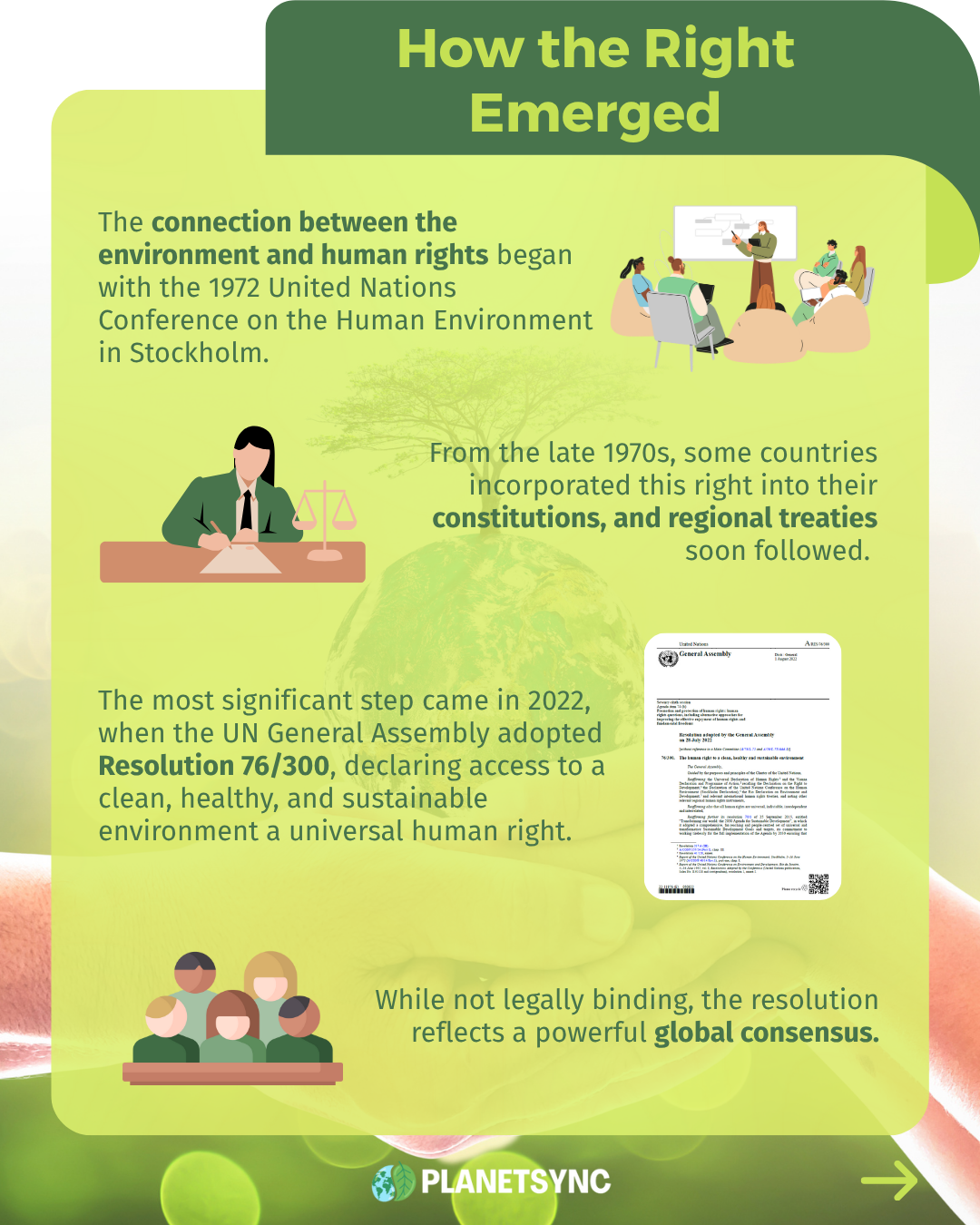
The connection between the environment and human rights is relatively recent. It gained global attention at the 1972 United Nations Conference on the Human Environment in Stockholm, where states affirmed that people are entitled to “an environment of a quality that permits a life of dignity and well-being.”
From the late 1970s onward, environmental rights began appearing in constitutions, for example, in Portugal (1976), Spain (1978), and Peru (1979). Regional treaties soon followed, including the African Charter on Human and Peoples’ Rights (1981), the San Salvador Protocol in the Americas (1988), the Aarhus Convention (1998) in Europe, and the Escazú Agreement (2018) in Latin America and the Caribbean.
The most significant global milestone came in 2022, when the United Nations General Assembly adopted Resolution 76/300, declaring that access to a clean, healthy, and sustainable environment is a universal human right. The resolution does not impose direct legal obligations, but it reflects international consensus.
What the Right Covers
The right to a healthy environment has both substantive and procedural dimensions. Substantive elements include clean air, a safe and stable climate, access to safe water and adequate sanitation, healthy and sustainably produced food, non-toxic environments in which people can live, work, and study, and thriving biodiversity and ecosystems.
Procedural elements ensure that people can obtain information, participate meaningfully in environmental decision-making, and seek justice and remedies when harm occurs, all without fear of reprisals. These combined guarantees make the right enforceable in practice.
Is It a Right Everywhere?
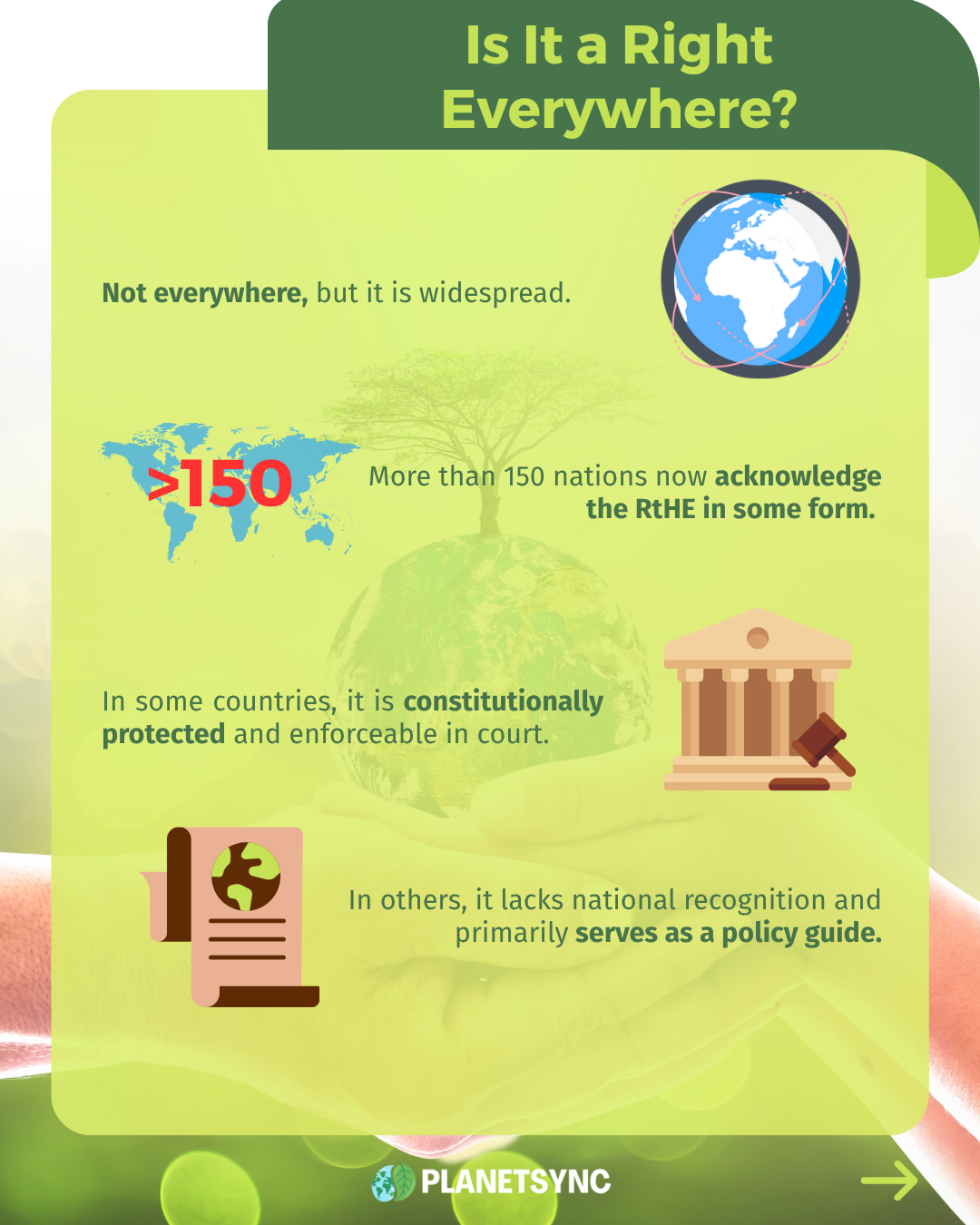
Not everywhere, but it is widespread. More than 150 countries now acknowledge the right to a healthy environment in some form. In places like South Africa, Costa Rica, and France, it is constitutionally protected, giving citizens powerful grounds to challenge polluting industries or weak government enforcement. By contrast, in the United States, there is no explicit recognition at the federal level, though several states have adopted so-called “green amendments” and courts occasionally interpret existing rights in environmental terms.
This variation matters. In some countries the right can be invoked directly in court; in others it operates more as a guiding principle for policymaking.
Why This Right Is Crucial
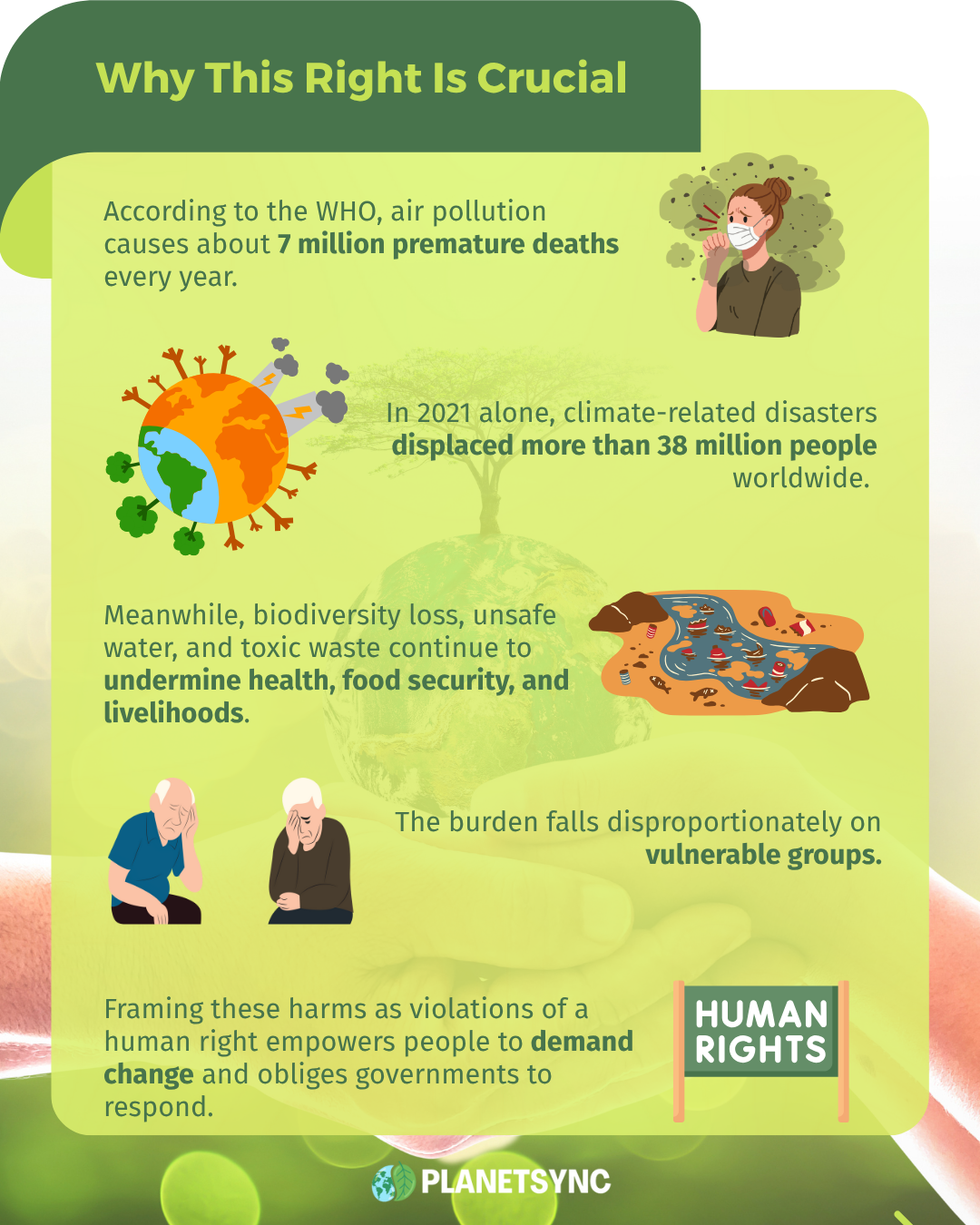
The stakes are clear. According to the World Health Organization, air pollution causes about 7 million premature deaths every year. In 2021 alone, climate-related disasters displaced more than 38 million people worldwide. Meanwhile, biodiversity loss, unsafe water, and toxic waste continue to undermine health, food security, and livelihoods.
The burden falls disproportionately on vulnerable groups: children, women, Indigenous peoples, and marginalized communities. Framing these harms as violations of a human right empowers people to demand change and obliges governments to respond.
A Right for the Future
Recognition by the UN does not automatically create binding obligations. But history shows that such recognition can serve as a catalyst, encouraging constitutional reform, strengthening environmental laws, guiding court decisions, and empowering communities.
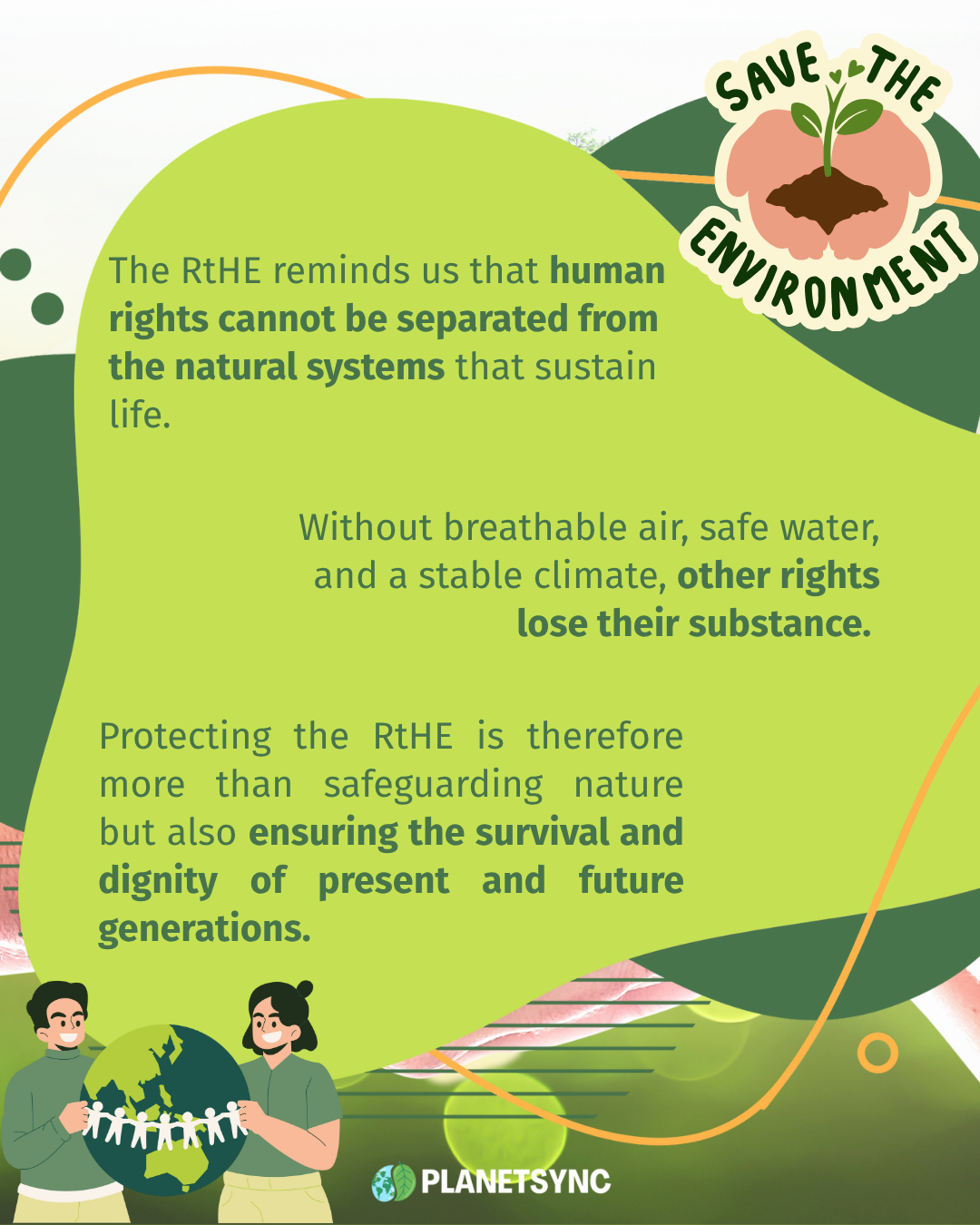
Ultimately, the right to a healthy environment reminds us that human rights cannot be separated from the natural systems that sustain life. Without breathable air, safe water, and a stable climate, other rights lose their substance. Protecting this right is therefore more than safeguarding nature but also ensuring the survival and dignity of present and future generations.
References & Resources
- SIWI. (2021, December 06). The human right to a safe, clean, healthy, and sustainable environment: The legal nitty-gritty. https://siwi.org/latest/the-human-right-to-a-safe-clean-healthy-and-sustainable-environment-the-legal-nitty-gritty/
- UN. General Assembly (76th sess. : 2021-2022) (Ed.). (1). The human right to a clean, healthy and sustainable environment: Resolution. UN. https://digitallibrary.un.org/record/3983329
- UNEP. (2024, June 20). Making good on the right to a healthy environment. https://www.unep.org/news-and-stories/speech/making-good-right-healthy-environment
- UNEP, UNDP, UNHR. (2023). What is the Right to a Healthy Environment? https://www.undp.org/publications/what-right-healthy-environment
- United Nations. (2022, July 28). With 161 Votes in Favour, 8 Abstentions, General Assembly Adopts Landmark Resolution Recognizing Clean, Healthy, Sustainable Environment as Human Right. https://press.un.org/en/2022/ga12437.doc.htm


 planetsync.blog
Leave a comment