

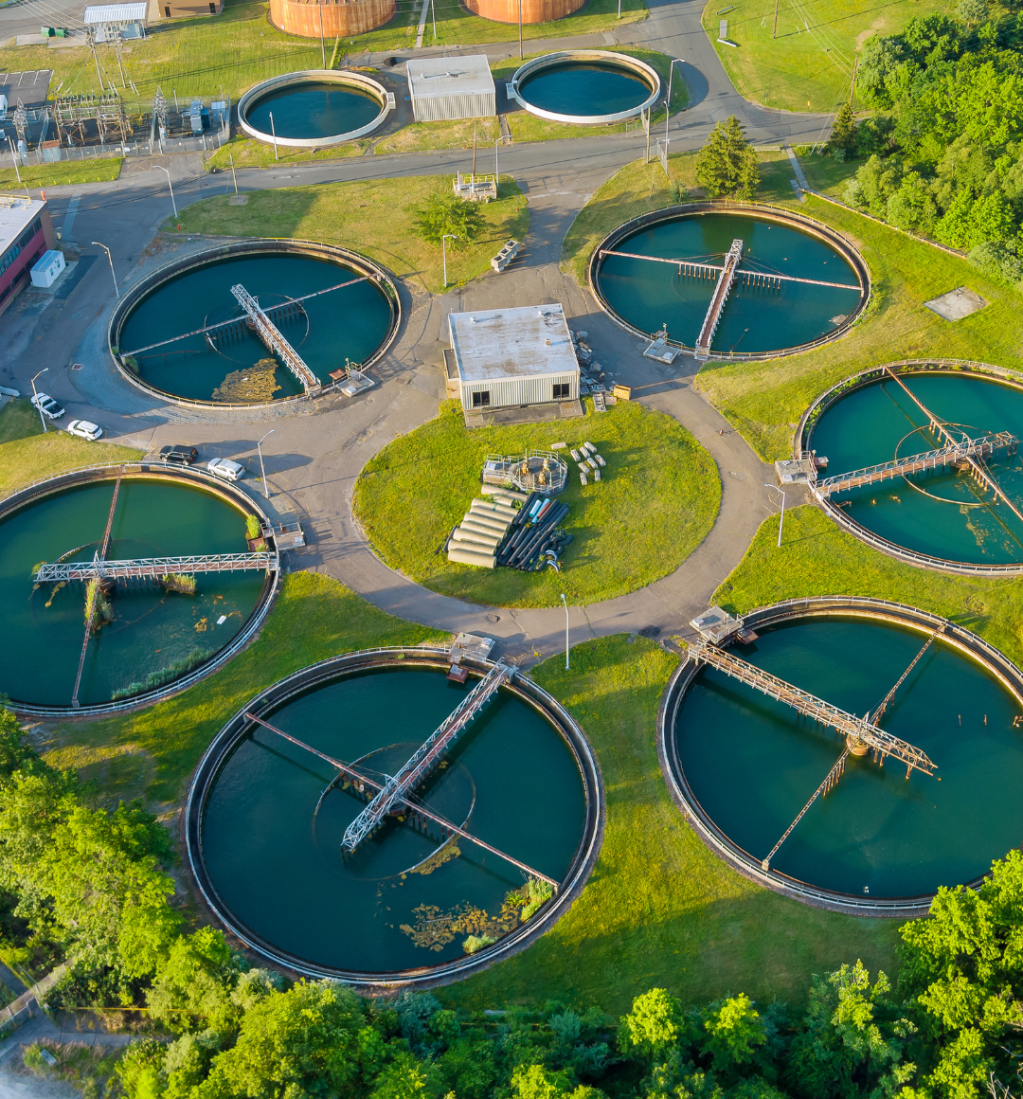
For decades, wastewater treatment plants (WWTPs) have served as guardians of public health and the environment. Their primary task has been to remove pollutants, organic matter, and pathogens from treated water before returning it safely to nature, thereby protecting rivers, lakes, and oceans from contamination and supporting the health of ecosystems and communities.
Today, engineers and scientists are reimagining these facilities as centers for resource recovery. Rather than treating wastewater as something to be discarded, they see it as a potential source of energy, nutrients, and materials. Let’s take a closer look at how this shift is transforming the future of wastewater management!
Need the Gist? Swipe through the visuals below for a quick summary!


The Role of WWTPs in a Circular Economy
Modern WWTPs are becoming multi-purpose recovery systems designed to extract value from every stage of the treatment process. This shift reflects the principles of a circular economy, where waste is minimized and resources are reused instead of discarded. Here are some key examples of how this transformation is already taking shape.
Generating Green Electricity
In many medium and large WWTPs, the organic material that remains after treatment, known as sludge, is stabilized through a process called anaerobic digestion. In this oxygen-free environment, microorganisms break down organic matter and produce biogas, a renewable mix of methane and carbon dioxide.
Traditionally, this biogas has been burned on-site to generate heat and electricity for the plant itself. But advances in gas-cleaning technologies now make it possible to upgrade biogas into biomethane, a purified form of methane that is nearly identical to natural gas. By removing impurities such as carbon dioxide and hydrogen sulfide, biomethane can be safely injected into gas networks or used as vehicle fuel.
Countries including Sweden, Denmark, and the Netherlands already operate some full-scale systems that feed wastewater-derived biomethane into their national energy grids. This approach allows WWTPs to meet part of their own energy demand and also to contribute renewable gas to local communities.
Producing Green Hydrogen
Hydrogen is widely regarded as a key clean fuel for the future, especially for sectors that are hard to electrify, such as steelmaking and heavy transport. It can be produced by electrolysis, a process that splits water into hydrogen and oxygen using electricity, ideally from renewable sources.
Because electrolysis requires very high-purity water, WWTPs could serve as sources of water for hydrogen production when combined with additional purification steps. Treated effluent from modern WWTPs can undergo further polishing to produce water suitable for electrolysis, helping to reduce reliance on freshwater resources.
Several pilot projects, such as those in Germany’s Fraunhofer Institute and Australia’s Hydrogen Park projects, are exploring this connection between water reuse and hydrogen generation. While still in early stages, these projects demonstrate how WWTPs could support the broader clean transition.
Recovering Valuable Materials
Wastewater contains organic matter and nutrients that can be converted into useful materials. Certain bacteria used in some treatment processes naturally produce polyhydroxyalkanoates (PHAs), a family of biodegradable plastics, when they consume organic waste. Research funded by the European Union’s Horizon 2020 programs (such as NextGen and Water2Return) has shown that PHAs produced from sewage sludge offer a renewable alternative to petroleum-based plastics. Though still on pilot scale, this approach could significantly reduce plastic pollution and reliance on fossil fuels if scaled up.
At the same time, WWTPs can recover nutrients like phosphorus and nitrogen, which are essential for agriculture. Techniques such as struvite crystallization allow these nutrients to be turned into slow-release fertilizers. Companies like Ostara Nutrient Recovery Technologies already operate full-scale plants that recover phosphorus from wastewater in North America and Europe.
From Waste to Value
Together, these innovations demonstrate how WWTPs can become key enablers of circular resource systems. By transforming wastewater into renewable energy, reusable water, and recoverable materials, WWTPs can help cities cut greenhouse gas emissions, conserve natural resources, create new economic opportunities, and move toward more sustainable systems.
This transformation requires continued investment, regulatory support, and collaboration among scientists, engineers, policymakers, and the public.
References & Resources
- Acharjee, S. A., Bharali, P., Gogoi, B., Sorhie, V., Walling, B., & Alemtoshi. (2022). PHA-Based Bioplastic: A Potential Alternative to Address Microplastic Pollution. Water, Air, & Soil Pollution, 234(1), 21. https://doi.org/10.1007/s11270-022-06029-2
- Aquafin. (n.d.). Biogas turns into biomethane. https://www.aquafin.be/en/zero-waste-water-cycle/biogas-turns-into-biomethane
- Aquatech. (n.d.). Generate green hydrogen with wastewater. https://www.aquatechtrade.com/news/water-treatment/generate-green-hydrogen-with-wastewater
- Australian Gas Networks. (n.d.). Hydrogen Park Adelaide. https://www.agig.com.au/hydrogen-park-adelaide
- Baena-Moreno, F. M., Malico, I., & Marques, I. P. (2021). Promoting Sustainability: Wastewater Treatment Plants as a Source of Biomethane in Regions Far from a High-Pressure Grid. A Real Portuguese Case Study. Sustainability, 13(16), 8933. https://doi.org/10.3390/su13168933
- Ben Abdallah, M., Saadaoui, I., Al-Ghouti, M. A., Zouari, N., Hahladakis, J. N., Chamkha, M., & Sayadi, S. (2025). Advances in polyhydroxyalkanoate (PHA) production from renewable waste materials using halophilic microorganisms: A comprehensive review. Science of The Total Environment, 963, 178452. https://doi.org/10.1016/j.scitotenv.2025.178452
- CAMBI. (n.d.). Biogas from Wastewater: A Sustainable Energy Solution. https://www.cambi.com/blog/biogas-wastewater
- Cassol, G. S., Shang, C., An, A. K., Khanzada, N. K., Ciucci, F., Manzotti, A., Westerhoff, P., Song, Y., & Ling, L. (2024). Ultra-fast green hydrogen production from municipal wastewater by an integrated forward osmosis-alkaline water electrolysis system. Nature Communications, 15(1), 2617. https://doi.org/10.1038/s41467-024-46964-8
- DMT. (n.d.). Waternet, a Wastewater Treatment Plant (WWTP): The Netherlands. https://dmt-international.com/project/waternet-amsterdam/
- Fuelcellsworks. (2024, August 13). Fraunhofer IGB Innovates with Green Hydrogen Production from Industrial Wastewater. https://fuelcellsworks.com/news/fraunhofer-igb-innovates-with-green-hydrogen-production-from-industrial-wastewater
- González-Rojo, S., Paniagua-García, A. I., & Díez-Antolínez, R. (2024). Advances in Microbial Biotechnology for Sustainable Alternatives to Petroleum-Based Plastics: A Comprehensive Review of Polyhydroxyalkanoate Production. Microorganisms, 12(8), 1668. https://doi.org/10.3390/microorganisms12081668
- Hilbrink, L. (2022, July 20). WTT Learning Centre: What is Anaerobic Digestion? WTT. https://wtt.nl/what-is-anaerobic-digestion/
- IEA. (n.d.). Outlook for biogas and biomethane: Prospects for organic growth. https://www.iea.org/reports/outlook-for-biogas-and-biomethane-prospects-for-organic-growth/an-introduction-to-biogas-and-biomethane
- Latief, Y. (n.d.). Turning wastewater into energy: A story of hydrogen and circularity. https://www.enlit.world/library/turning-wastewater-into-energy-a-story-of-hydrogen-and-circularity
- Nguyen, L. N., Kumar, J., Vu, M. T., Mohammed, J. A. H., Pathak, N., Commault, A. S., Sutherland, D., Zdarta, J., Tyagi, V. K., & Nghiem, L. D. (2021). Biomethane production from anaerobic co-digestion at wastewater treatment plants: A critical review on development and innovations in biogas upgrading techniques. Science of The Total Environment, 765, 142753. https://doi.org/10.1016/j.scitotenv.2020.142753
- Ostara. (n.d.). Nutrient Recovery Solutions for Municipalities, Industries & More. https://www.ostara.com/nutrient-recovery/municipalities-industries-more/
- Rajvanshi, J., Sogani, M., Kumar, A., Arora, S., Syed, Z., Sonu, K., Gupta, N. S., & Kalra, A. (2023). Perceiving biobased plastics as an alternative and innovative solution to combat plastic pollution for a circular economy. Science of The Total Environment, 874, 162441. https://doi.org/10.1016/j.scitotenv.2023.162441
- Silva, J., Gonçalves, J. C., Rocha, C., Vilaça, J., & Madeira, L. M. (2024). Biomethane production from biogas obtained in wastewater treatment plants: Process optimization and economic analysis. Renewable Energy, 220, 119469. https://doi.org/10.1016/j.renene.2023.119469
- US EPA, O. (2019, March 18). How Does Anaerobic Digestion Work? [Overviews and Factsheets]. https://www.epa.gov/agstar/how-does-anaerobic-digestion-work
- Yan, Y., Kallikazarou, N. I., Nisiforou, O., Shang, Q., Fu, D., Antoniou, M. G., & Fotidis, I. A. (2025). Phosphorus recovery through struvite crystallization from real wastewater: Bridging gaps from lab to market. Bioresource Technology, 427, 132408. https://doi.org/10.1016/j.biortech.2025.132408


 planetsync.blog
Leave a comment