


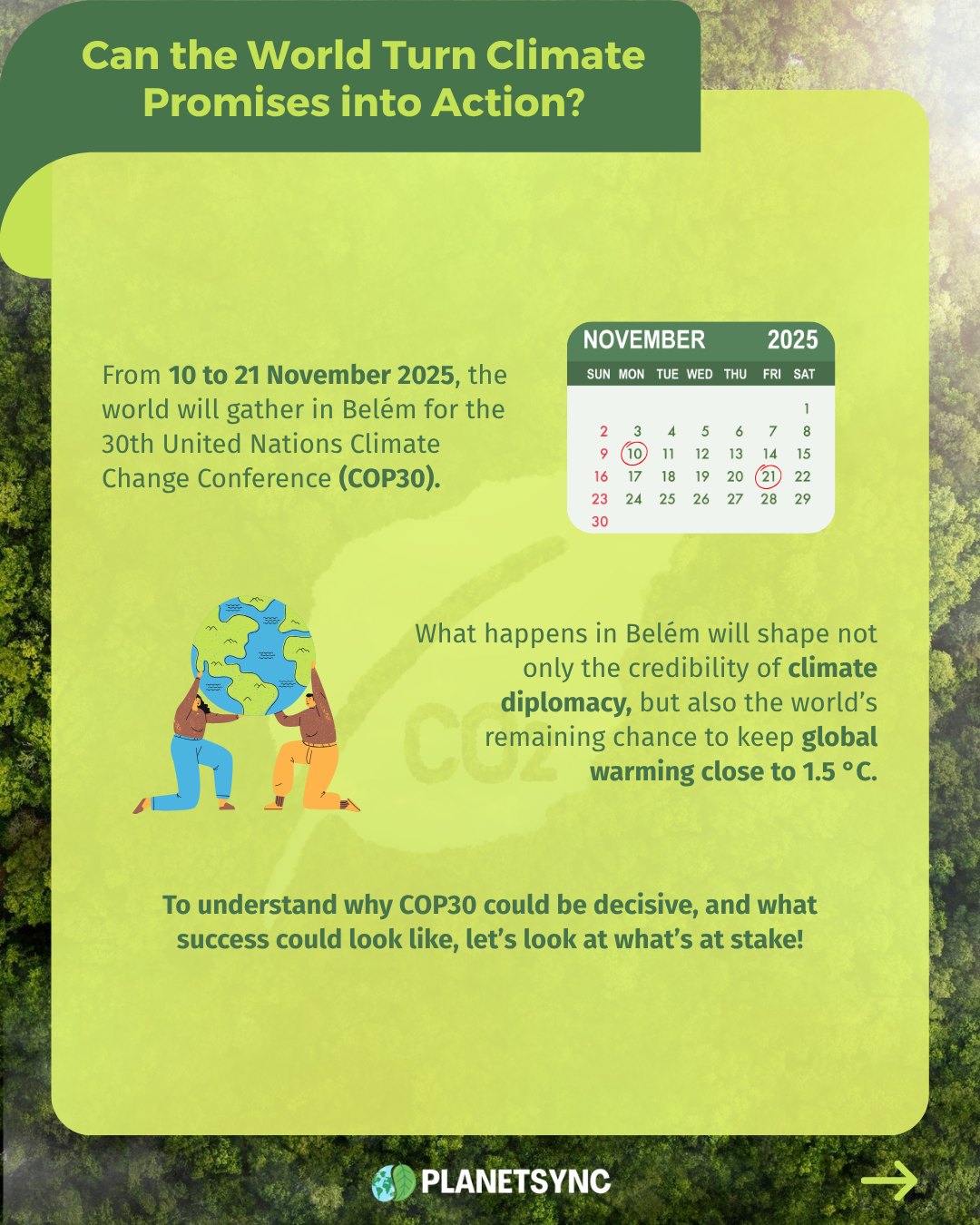
From 10 to 21 November 2025, the world will gather in Belém, a gateway to the Amazon rainforest in northern Brazil, for the 30th United Nations Climate Change Conference (COP30). What happens there will shape not only the credibility of climate diplomacy, but also the world’s remaining chance to keep global warming close to 1.5 °C. To understand why COP30 could be decisive, and what success could look like, let’s look at what’s at stake!
Need the Gist? Swipe through the visuals below for a quick summary!



The Amazon as a Stage for Climate Action
Belém’s selection as host is far more than a logistical choice. The Amazon rainforest absorbs billions of tonnes of CO2 each year, regulates rainfall across much of South America, and supports around 30 million people. Yet deforestation, fires, and land clearing are eroding its resilience. Scientists warn that large areas may be nearing a “tipping point”, where the forest could shift toward drier savannah and release the carbon it once stored.
By bringing the world to the Amazon, COP30 puts this reality on full display. Brazil’s government has pledged to end illegal deforestation by 2030 and present the region as a model for sustainable development. But it also faces criticism for pursuing new oil and gas exploration, a contradiction that mirrors the global dilemma: how to balance economic growth with the rapid decarbonization that science demands.
The Moment to Deliver, Not to Debate
Over the past three decades, the annual COP meetings have produced countless declarations, yet global emissions have continued to rise. That is why Brazil, as host, has chosen a single guiding theme for COP30: implementation.
Under the Paris Agreement, 2025 marks the deadline for every country to submit an updated national climate plan, known as a Nationally Determined Contribution (NDC), outlining how it will cut emissions and adapt to a warming world. Yet the latest UN Environment Programme Emissions Gap Report shows that current commitments still put the planet on track for around 2.7 °C of warming.
COP30 will test whether governments are ready to turn words into measurable action, with stronger national plans, transparent monitoring systems, and credible strategies for phasing out fossil fuels.
Financing the Transition
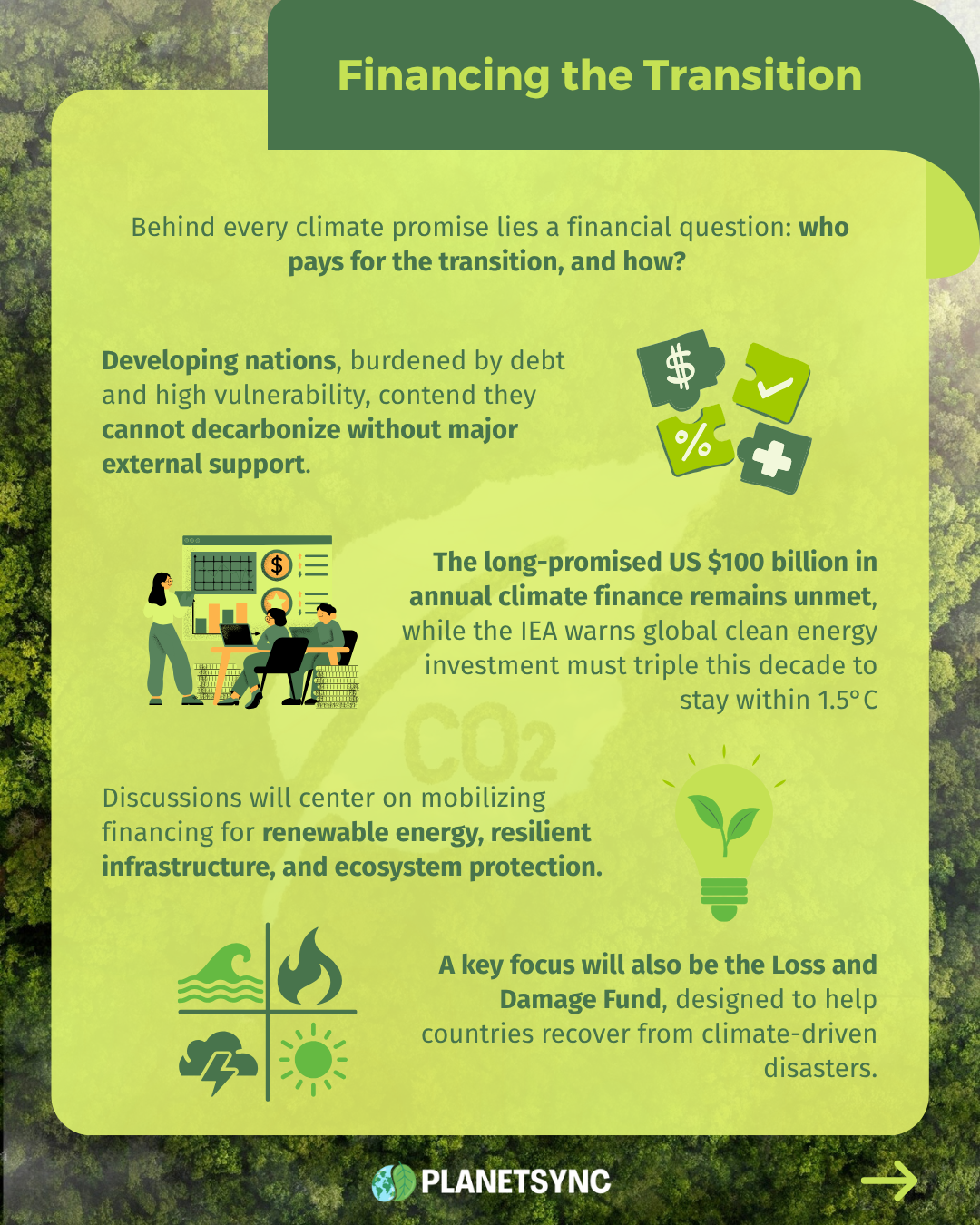
Behind every climate promise lies a financial question: who pays for the transition, and how? Developing countries, many of them facing rising debt and climate vulnerability, argue that they can’t decarbonize without substantial external support. The long-standing goal of mobilizing US $100 billion a year in climate finance from wealthier nations has never been fully met. Meanwhile, the scale of the challenge has grown: according to the International Energy Agency, global investment in clean energy must triple this decade to stay within 1.5 °C.
Attention in Belém will focus on how to unlock trillions in both public and private investment, funds needed for renewable energy, climate-resilient infrastructure, and ecosystem protection. Another crucial debate will revolve around the Loss and Damage Fund, designed to help countries recover from climate-driven disasters. Decisions about how that fund is governed and financed will reveal whether solidarity in climate politics can move from rhetoric to reality.
Integrating Environment and Equity
Protecting forests remains one of the fastest and most cost-effective ways to cut global emissions. But forest policy can’t be separated from issues of food security, Indigenous rights, and local livelihoods.
Delegates are expected to confront a central question: how can environmental goals align with social and economic fairness? Small farmers, for example, need ways to earn a living without clearing new land. Indigenous peoples are calling for a stronger voice in decision-making and a fair share of climate finance. And global food systems must evolve so that feeding the world no longer means exhausting the planet’s ecological limits.
These debates reflect a growing recognition that climate action and social justice are inseparable. As Brazil’s Amazonian leaders often remind international audiences: there is no environmental sustainability without equity.
What Success Might Look Like
When the delegates leave Belém, the measure of success will not lie in the number of agreements signed or the length of the final declaration, but in the clarity of the path forward.
If COP30 produces stronger national plans, real funding mechanisms, and credible steps to protect forests and communities, it could mark the beginning of a more practical era of climate cooperation. If not, it risks being remembered as another missed opportunity, another year of rising emissions and fading time.
References & Resources
- Climate Action Tracker. (n.d.). Policies & action. https://climateactiontracker.org/countries/brazil/2023-12-05/policies-action/
- COP30. (n.d.-a). Action Agenda. https://cop30.br/en/action-agenda
- COP30. (n.d.-b). What is the COP? https://cop30.br/en/about-cop30/what-is-the-cop
- Mitchell, I., & Wickstead, E. (2024). Has the $100 Billion Climate Goal Been Reached? https://www.cgdev.org/publication/has-100-billion-climate-goal-been-reached
- OECD. (n.d.). Climate Finance and the USD 100 billion goal. https://www.oecd.org/en/topics/climate-finance-and-the-usd-100-billion-goal.html
- SciencesPo. (2025, August 1). Why Brazil needs to end deforestation by 2030. https://www.sciencespo.fr/psia/chair-sustainable-development/2025/08/01/why-brazil-needs-to-end-deforestation-by-2030/
- UN Environment Programme. (2025a, October 24). Emissions Gap Report 2025. https://www.unep.org/resources/emissions-gap-report-2025
- UN Environment Programme. (2025b, November 7). Six issues that will dominate COP30. https://www.unep.org/news-and-stories/story/six-issues-will-dominate-cop30
- UNFCCC. (n.d.). About COP 30. https://unfccc.int/cop30/about-cop30
- Waskow, D., Srouji, J., Zoysa, K. de, Elliott, C., Cogswell, N., Cogan, D., & Alayza, N. (2025). 5 Ways COP30 Can Make Progress Where Countries’ Climate Plans Fall Short. https://www.wri.org/insights/cop30-progress-country-climate-plans


 planetsync.blog
Leave a comment