

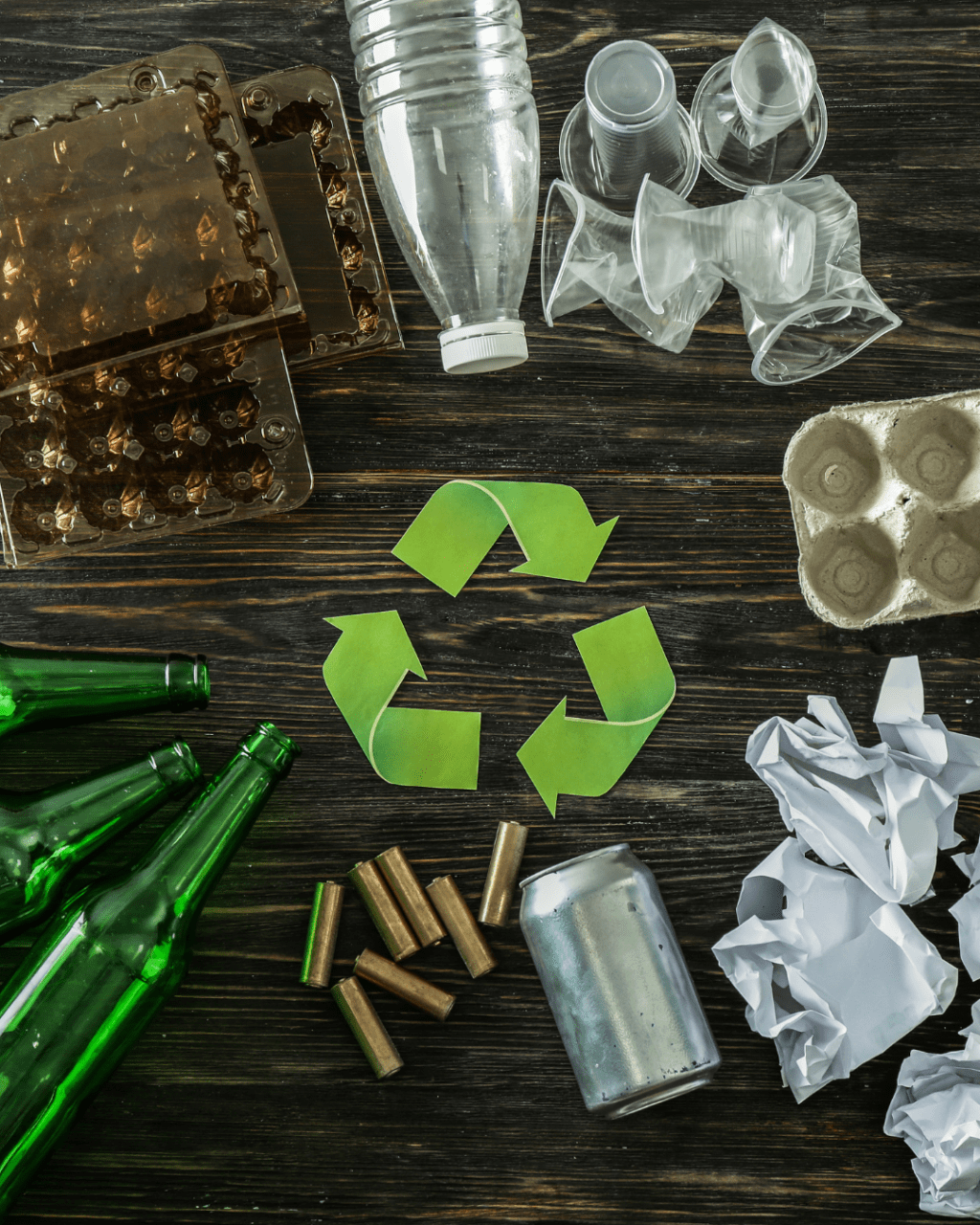
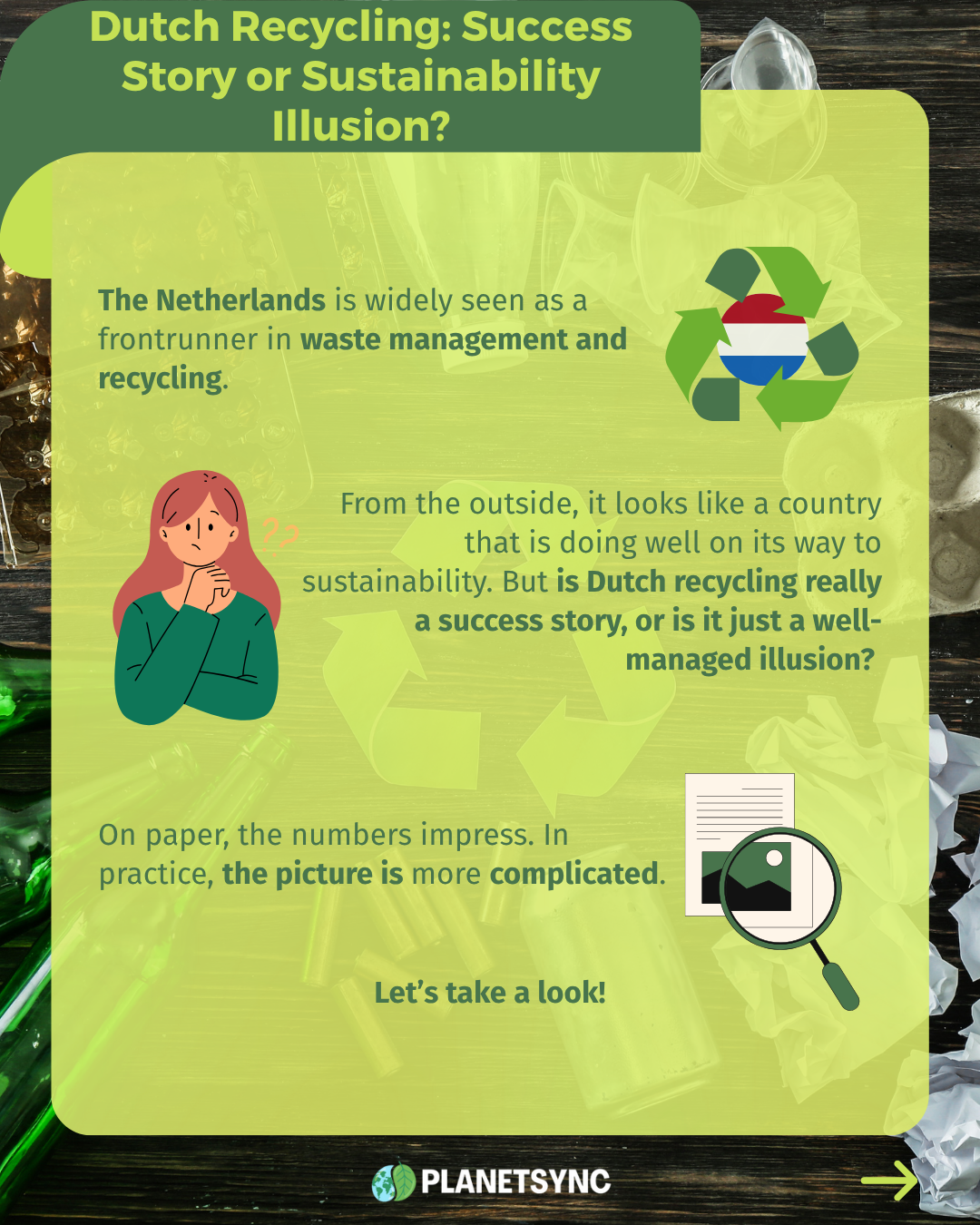
The Netherlands is widely seen as a frontrunner in waste management and recycling. With ambitious goals like a 50% reduction in the use of non-renewable resources by 2030 and full circularity by 2050, it is often portrayed as a model for other nations to follow.
From the outside, it looks like a country that is doing well on its way to sustainability. But is Dutch recycling really a success story, or is it just a well-managed illusion? On paper, the numbers impress. In practice, the picture is more complicated. So, let’s take a look!
Need the Gist? Swipe through the visuals below for a quick summary!



A System That Works… But Not for Everything
According to the European Environment Agency’s 2025 country profile, the Netherlands is meeting its EU recycling targets for both municipal and packaging waste. In 2022, the country achieved a 58% rate for preparing-for-reuse and recycling of municipal waste, above the EU’s 55% target and the EU-27 average of 49%. This rate includes both materials reprocessed into new products and those cleaned or repaired for continued use.
Packaging waste recycling is even stronger: 75% of all packaging was recycled in 2022. Materials like paper, cardboard, glass, and metals exceeded EU benchmarks. These materials are relatively easy to sort, retain their quality through multiple cycles of reuse, and are supported by well-developed recycling markets and processing facilities. As a result, they are often successfully returned to production as valuable raw materials. But this strength doesn’t extend to all materials, especially not to plastic.
The Plastic Problem: A Break in the Loop
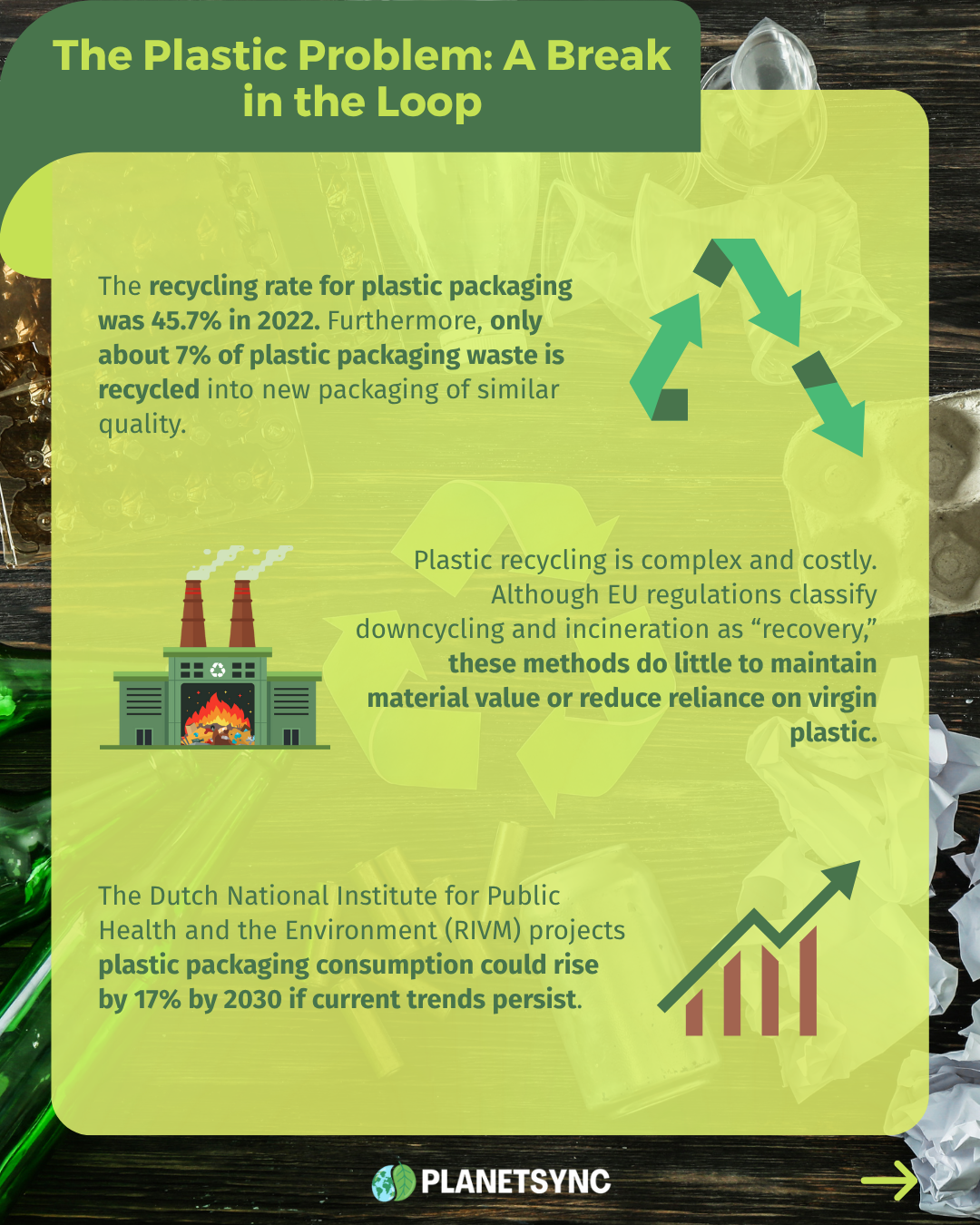
Despite growing public awareness and investment in collection schemes, the recycling rate for plastic packaging was just 45.7% in 2022, falling short of the EU’s 50% target and trailing far behind other packaging materials. But the real issue goes beyond this. According to studies, only about 7% of plastic packaging waste is recycled into new packaging of similar quality, a process known as closed-loop recycling. The rest is typically downcycled into lower-quality products, incinerated for energy, or even exported abroad, where their final fate is less certain.
Plastic complexity lies in its diversity. It often contains multiple types of polymers, dyes, and food residues, making high-quality recycling complex and costly. While EU regulations count downcycling and incineration as “recovery,” these processes do little to preserve material value or reduce dependence on virgin plastic.
Adding urgency is the scale of plastic use. The Dutch National Institute for Public Health and the Environment (RIVM) projects that plastic packaging consumption could increase by 17% by 2030 if current patterns continue. Even the best recycling infrastructure will not be able to keep pace unless the system changes fundamentally.
Incineration and Export: Convenient, But Not Circular
One of the Netherlands’ headline achievements is its dramatic reduction in landfill use. In 2022, the landfill rate for municipal waste remained below 2% thanks to strong policies and infrastructure. But this success hides a deeper reliance on incineration. That same year, 41% of municipal waste was incinerated. Though Dutch incinerators are among the most efficient in Europe and contribute to energy recovery, they also destroy materials that could otherwise be retained in the economy, a contradiction to the principles of circularity.
Economic incentives do little to change this. As of 2024, the environmental tax on both landfill and incineration stood at €39.23 per tonne. While this discourages dumping, it offers no added motivation for municipalities or businesses to invest in higher-value alternatives, such as reuse, repair, or high-quality recycling.
Waste exports add another layer of concern. The Netherlands is one of the highest per capita exporters of plastic waste globally. Much of this waste is sent to countries with weaker environmental oversight. Once abroad, its treatment becomes harder to trace and may involve incineration, landfilling, or even illegal dumping. While this helps the Netherlands manage waste volumes at home, it outsources the environmental burden, distancing the country from the consequences of its own consumption.
The Circularity Gap
According to the Circularity Gap Report, just 24.5% of materials in the Dutch economy are reused or kept in circulation. This means that more than three-quarters of raw materials are used once and then discarded.
True circularity requires more than high recycling rates. It demands a fundamental shift in how products are designed, consumed, and managed. This includes durable, repairable products, reusable packaging, modular design, and producer responsibility for end-of-life recovery. While the Netherlands has made progress through Extended Producer Responsibility schemes and deposit-return systems, these remain partial measures.
So… Success Story or Sustainability Illusion?
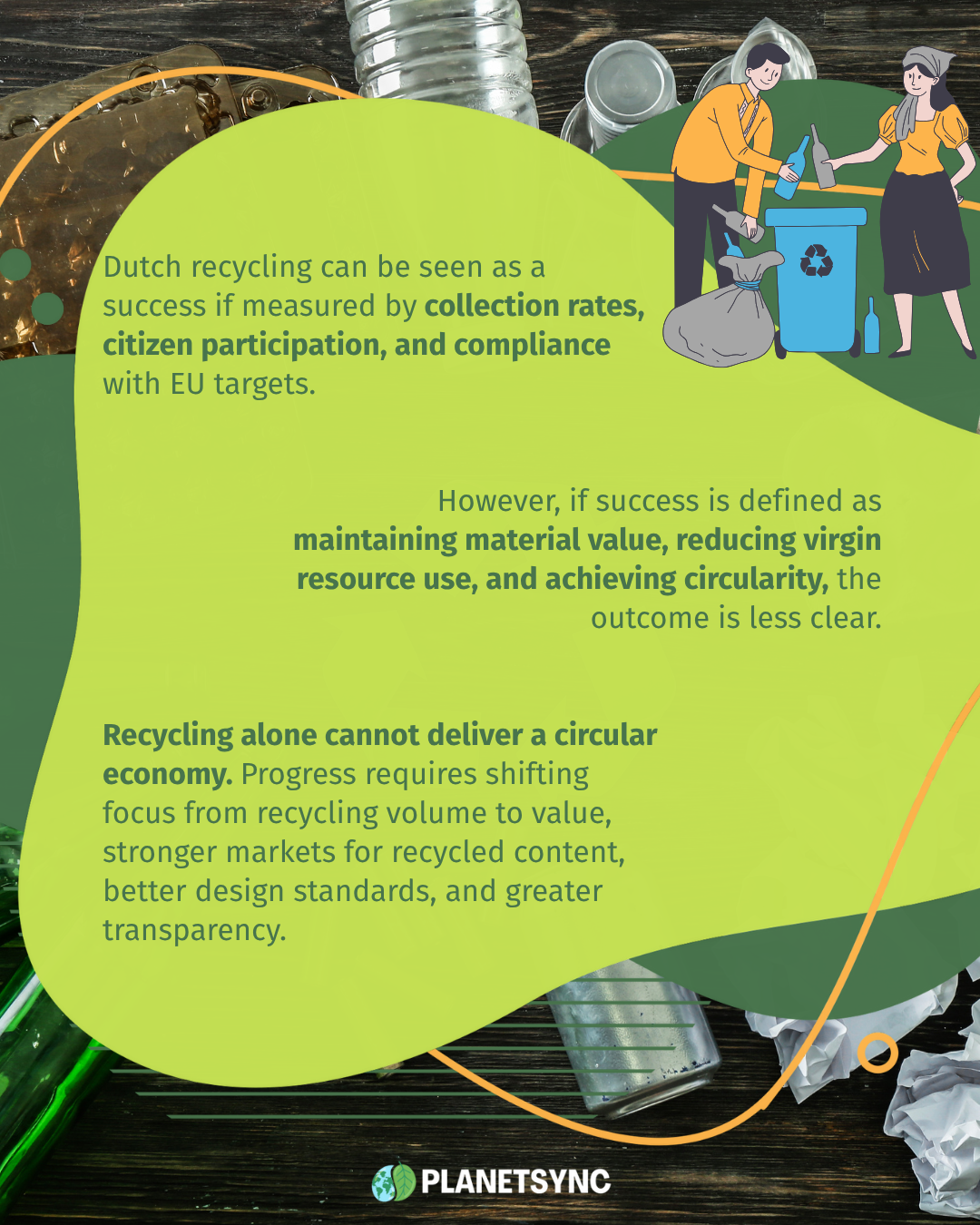
Whether Dutch recycling is a true success or a sustainability illusion depends on how we define success. If success is measured by collection rates, citizen participation, and compliance with EU targets, then the Netherlands performs exceptionally well. The infrastructure is advanced, landfill is nearly eliminated, and many material streams, like paper, glass, and metals, are recycled efficiently and repeatedly.
But if success means keeping materials in use at their highest value, reducing dependence on virgin resources, and building a truly circular economy, the picture becomes more ambiguous. Especially when it comes to plastics, much of what we call recycling doesn’t close the loop, it simply delays or disguises disposal.
That doesn’t make the Dutch model a failure. In many respects, it provides a solid foundation that other countries can learn from. But it also reveals a deeper truth: good recycling systems alone don’t create a circular economy.
To bridge the gap, the Netherlands must shift focus from recycling volume to recycling value. That means investing in advanced sorting and recycling technologies, stimulating stronger markets for recycled content, and enforcing design standards that make materials easier to recover. It also requires greater transparency, so citizens understand what truly happens to the waste they carefully sort. Trust in the system depends on honesty, about both its strengths and its shortcomings.
The Netherlands has the tools, the technology, and the policy frameworks. What remains is to align action with ambition.
References & Resources
- Circulaire strategieën voor fossielvrije verpakkingen in 2050. (2025, September 4). tno.nl/nl. https://www.tno.nl/nl/newsroom/2024/09/fossielvrije-verpakkingen-in-2050/
- Eijk, F. van, Breukelman, H., Keesman, B., & Prummel, J. (2022, October). Waste Management as a catalyst to a Circular Economy. https://www.rvo.nl/sites/default/files/2024-02/NL%20Branding-Waste_Management.P-online.pdf
- Elzinga, R. (2024, September 3). Circularity not yet a priority in Dutch housing, energy, or plastic packaging sectors. https://www.uu.nl/en/news/circularity-not-yet-a-priority-in-dutch-housing-energy-or-plastic-packaging-sectors
- European Circular Economy Stakeholder Platform. (2020, June 9). Circularity Gap Report: The Netherlands. https://circulareconomy.europa.eu/platform/en/knowledge/circularity-gap-report-netherlands
- European Environment Agency. (2023, August 6). Early warning assessment related to the 2025 targets for municipal waste and packaging waste. Netherlands [File]. https://www.eea.europa.eu/publications/many-eu-member-states/netherlands
- Lobelle, D., Shen, L., van Huet, B., van Emmerik, T., Kaandorp, M., Iattoni, G., Baldé, C. P., Lavender Law, K., & van Sebille, E. (2024). Knowns and unknowns of plastic waste flows in the Netherlands. Waste Management & Research, 42(1), 27–40. https://doi.org/10.1177/0734242X231180863
- RIVM. (n.d.). Recycled Plastic Packaging in the Netherlands Still Falls Short. https://www.rivm.nl/en/news/recycled-plastic-packaging-in-netherlands-still-falls-short
- Statista. (n.d.-a). Netherlands: Plastic waste export volume 2023. https://www.statista.com/statistics/1357867/plastic-waste-export-volume-netherlands/
- Statista. (n.d.-b). Netherlands: Plastic waste exports by country 2023. https://www.statista.com/statistics/1357887/plastic-waste-export-volume-netherlands-destination/
- TNO. (2025, March 11). Circular plastics by 2050: What will it take? Tno.Nl/En. https://www.tno.nl/en/newsroom/2024/10/information-required-circular-plastics/


 planetsync.blog
Leave a comment