

You don’t truly value a resource until you’re forced to account for every drop.
On Artemis II, water was a controlled resource that tolerated no improvisation. There were no taps to turn, no reservoirs to dip into, no second chances if something leaked or miscalculated. Every gram was launched with intent.
So, let’s break down how Orion stored, moved, and controlled water.
Where the Water Was Stored
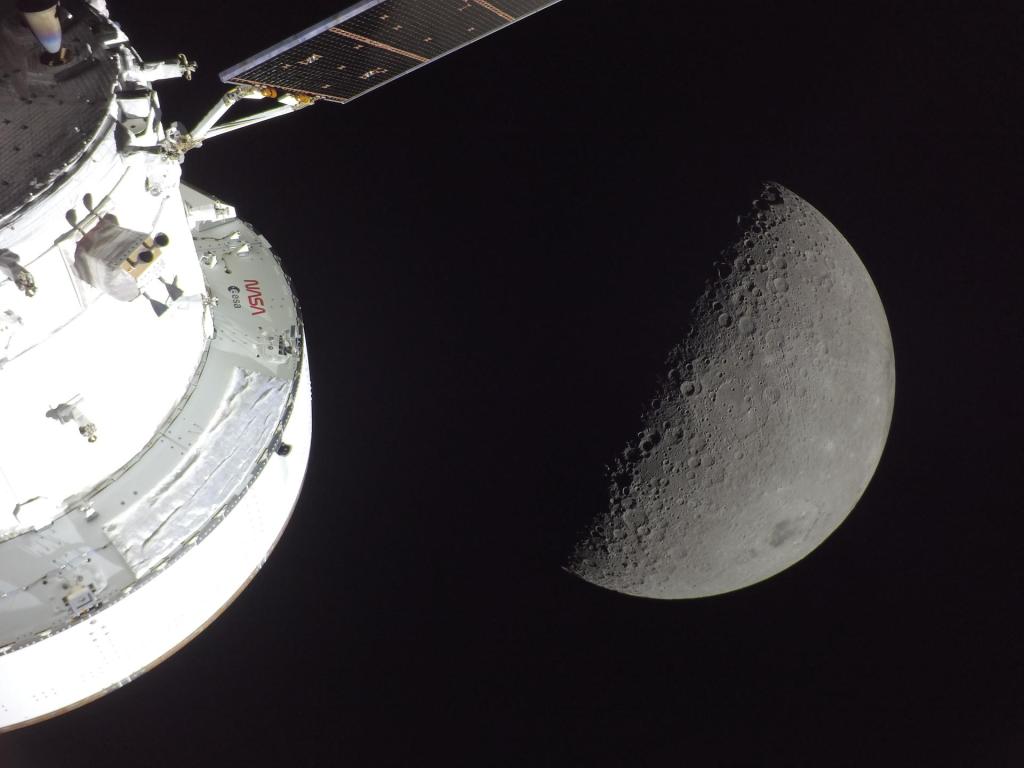
Artemis II’s potable water was carried in Orion’s European Service Module (ESA), the unpressurized section below the crew module that also supplied propulsion, power, thermal control, air, and water.
ESA technical data indicated that the service module carried approximately 240 kg of drinking water. NASA documentation described the supply as 4 water tanks, each holding about 125 pounds of water, consistent with a total of roughly 500 pounds (~227 kg). The small difference likely reflects rounding or document-version variations.
How the Water Reached the Crew
Each storage tank used an internal bellows mechanism, pressurized by a regulated nitrogen supply, to expel water from the tank. In microgravity, this replaced gravity as the force moving fluid through the system.
The four tanks fed into a common manifold, which distributed water through two independent lines into the crew module. At the crew interface, each line terminated in a manually operated valve paired with a quick-disconnect coupling, giving astronauts direct physical control over flow.
Water wasn’t dispensed freely into open containers. Instead, the crew connected a potable water dispenser assembly to a quick-disconnect point. This unit performed two functions simultaneously: it filtered the water to remove residual contaminants, and it used a small integrated needle to pierce sealed food or drink pouches, injecting water directly into them.
To obtain a specific volume, the crew followed pre-calculated reference tables generated daily for the mission. These tables translated system conditions, such as cabin pressure, temperature, and tank pressure, into precise valve-open times. In practice, astronauts opened the manual valve, tracked the elapsed time using a timer or onboard clock, and then closed the valve once the required duration was reached. The filled package could then be detached and, if necessary, placed in a food warmer before consumption.
What the Crew Used Water For
Within Orion, water’s primary role was physiological: maintaining crew hydration under tightly controlled conditions. Every quantity consumed was pre-calculated, measured, and tied to mission timelines.
Operationally, the same supply supported specific onboard processes, most notably the rehydration of freeze-dried food and the preparation of powdered drinks. Its use also extended to limited medical scenarios where potable water was required under controlled conditions.
Why Water Could Not Be Treated Like It Is on Earth
On Earth, fluid behavior is governed by gravity. Inside Orion, surface tension becomes the dominant force. Water doesn’t settle; it adheres to surfaces, forms floating masses, and migrates along edges. In this environment, even a small amount of free-floating liquid becomes a system hazard. A single drifting droplet can short-circuit sensitive electronics, obscure optical sensors, or contaminate the air filtration system.
Why Artemis II Didn’t Recycle Water
Artemis II didn’t employ a closed-loop water recovery system. This was a deliberate engineering decision driven by mission duration and reliability.
For a mission of 10 days, carrying a finite water supply was more predictable than introducing recycling hardware with additional failure modes. The mass penalty remained acceptable, while overall system complexity was kept low.
Closed-loop systems, such as those used aboard the International Space Station, are designed for long-duration missions where resupply isn’t feasible. They recover water from humidity and waste streams but require continuous processing, monitoring, and maintenance.
Artemis II operated under different constraints. As a first crewed deep-space test of Orion, the priority was validation under controlled conditions. A stored-water architecture ensured that availability was known, measurable, and independent of onboard processing.
This distinction probes a clear boundary. Short-duration missions can rely on carried water if it is carefully managed. Missions that extend beyond that timeframe, whether sustained lunar operations or Mars transit, will require high-efficiency recycling and, eventually, in-situ resource utilization.
References & Resources
- ESA. (n.d.). Artemis II. Retrieved April 9, 2026, from https://www.esa.int/Science_Exploration/Human_and_Robotic_Exploration/Orion/Artemis_II
- nasa. (n.d.). Crew Systems. Retrieved April 9, 2026, from https://www.nasa.gov/reference/crew-systems/
- NASA. (n.d.-a). Life Support Subsystems. Retrieved April 9, 2026, from https://www.nasa.gov/reference/jsc-life-support-subsystems/
- NASA. (n.d.-b). Recycling Water and Air. Retrieved April 9, 2026, from https://www.nasa.gov/podcasts/houston-we-have-a-podcast/recycling-water-and-air/
- NASA. (2026, March 3). Artemis II: What’s on the Menu?https://www.nasa.gov/missions/artemis/artemis-2/artemis-ii-whats-on-the-menu/


 planetsync.blog
Leave a comment