


“Hey ChatGPT, can you help me with my weekend plans?”
It’s something probably many of us do without much thought, right? Just a quick question or request to an AI. But what if I told you that every time you make a request to an AI, not only does it use energy, it uses water too. And we’re not talking about a little bit either, it’s like sipping from a 500ml water bottle, except it’s the AI doing the “drinking”.
Intrigued? Let’s explore how that happens.
Need the Gist? Check out the infographic below for a quick, visual summary of the key points!
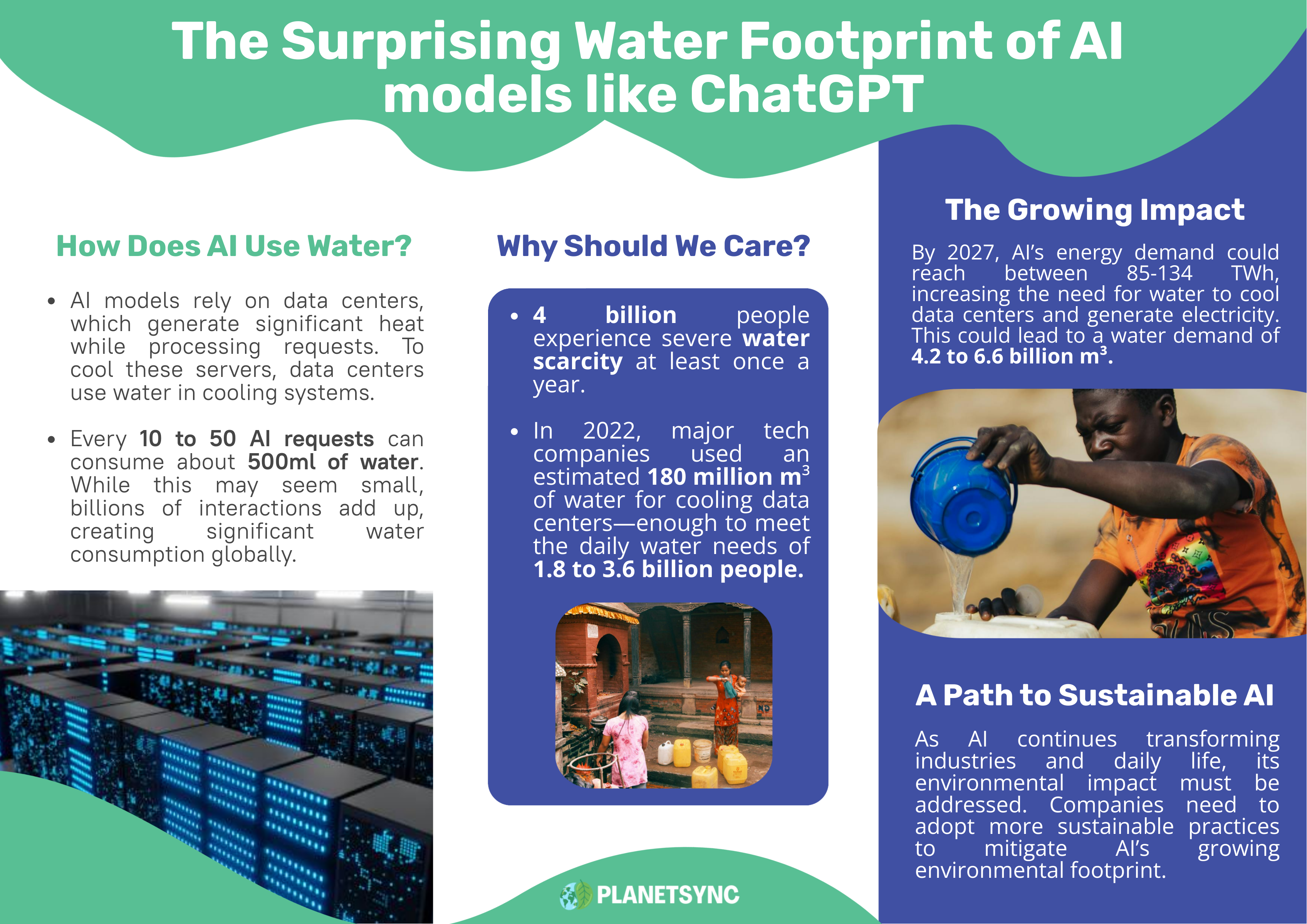
AI’s Hidden Water Cost: A Brief Breakdown
Whenever you interact with AI tools like ChatGPT, there’s a lot happening behind the scenes. Massive computers (known as servers) in large data centers process your requests, generating intense heat. These servers can heat up to over 80°C (176°F), as hot as boiling water for your tea.! To prevent them from overheating, cooling systems are used, and that’s where water comes in.
Water is commonly used in data centers as part of the cooling process, especially in what’s called cooling towers. Here’s how it works: water circulates through these systems, absorbs the heat from the servers, and then evaporates to release that heat into the environment. That’s one way how AI consumes water: through evaporation during cooling. But this water doesn’t come back most of the time; it’s lost to the air.
Every 10 to 50 requests made to large AI models, depending on the time and place, could equate to around 500ml of water consumed. While this may seem small, think about the billions of AI interactions happening daily worldwide. That adds up fast and poses a growing environmental concern.
Why Should You Care About Water and AI?
You might be thinking: “Why should I care about how much water tech companies are using?” The answer is simple: freshwater is one of our planet’s most precious and limited resources, and it’s already under stress. Today, 4 billion people experience severe water scarcity at least once a year. If global water challenges aren’t tackled with comprehensive and inclusive solutions, almost half of the world’s population could face serious water shortages by 2030. The last thing we need is additional pressure on water resources, yet AI development is quietly contributing to this challenge.
Major companies like Google, Microsoft, and Meta, which operate large data centers, are key players in this unseen water usage. In 2022, these tech giants together withdrew an estimated 2.2 billion m3 of water to keep their data centers running and cool. This water is taken from rivers, lakes, and other natural sources. Although not all of this water was lost, 180 million m3 was consumed, primarily through evaporation during cooling.
To put that into perspective, the World Health Organization (WHO) estimates that a person needs between 0.05 and 0.10 m3 of water per day to meet their basic needs, including drinking, cooking, and hygiene. The 180 million m3 of water consumed by data centers in 2022 could have met the daily water needs of between 1.8 billion to 3.6 billion people, or provided enough water for nearly 5 million people to meet their basic needs for an entire year.
The Future: More AI, More Water?
As AI continues to grow, the environmental impact also increases. Recent projections suggest that by 2027, the electricity demand needed to support AI technologies could be between 85 and 134 terawatt-hours (TWh), a huge amount, comparable to the annual energy use of entire nations. If this projection holds, the water required, both for directly cooling data centers and for electricity generation, could total between 4.2 and 6.6 billion m3. To help visualize this, 6.6 billion m3 is enough water to fill 2.6 million Olympic-sized swimming pools!
In regions facing drought or water scarcity, this demand for water to keep AI running can create conflicts. For example, in Uruguay, Google’s plans to build a data center sparked protests because the project was expected to use significant water resources in a country already struggling with droughts.
Charting a Path Toward Sustainable AI
AI is undeniably transforming our lives, from simplifying everyday tasks to driving innovation across industries. However, it comes with a cost.
The companies behind AI technologies must take the lead in addressing their substantial water consumption. By embracing transparency, accountability, and sustainable practices, they can drive meaningful change and help mitigate AI’s growing environmental footprint.
Acknowledgment
This article was based on the findings from the study: Making AI Less “Thirsty: Uncovering and Addressing the Secret Water Footprint of AI Models


 planetsync.blog
Leave a comment