


Water reporting is crucial to corporate sustainability because it directly links a company’s environmental impact to the management of one of the planet’s most precious and increasingly scarce resources. The European Sustainability Reporting Standards (ESRS) have introduced new requirements for businesses. While the ESRS covers a wide range of environmental, social, and governance (ESG) issues, this article will focus on water-related disclosures.
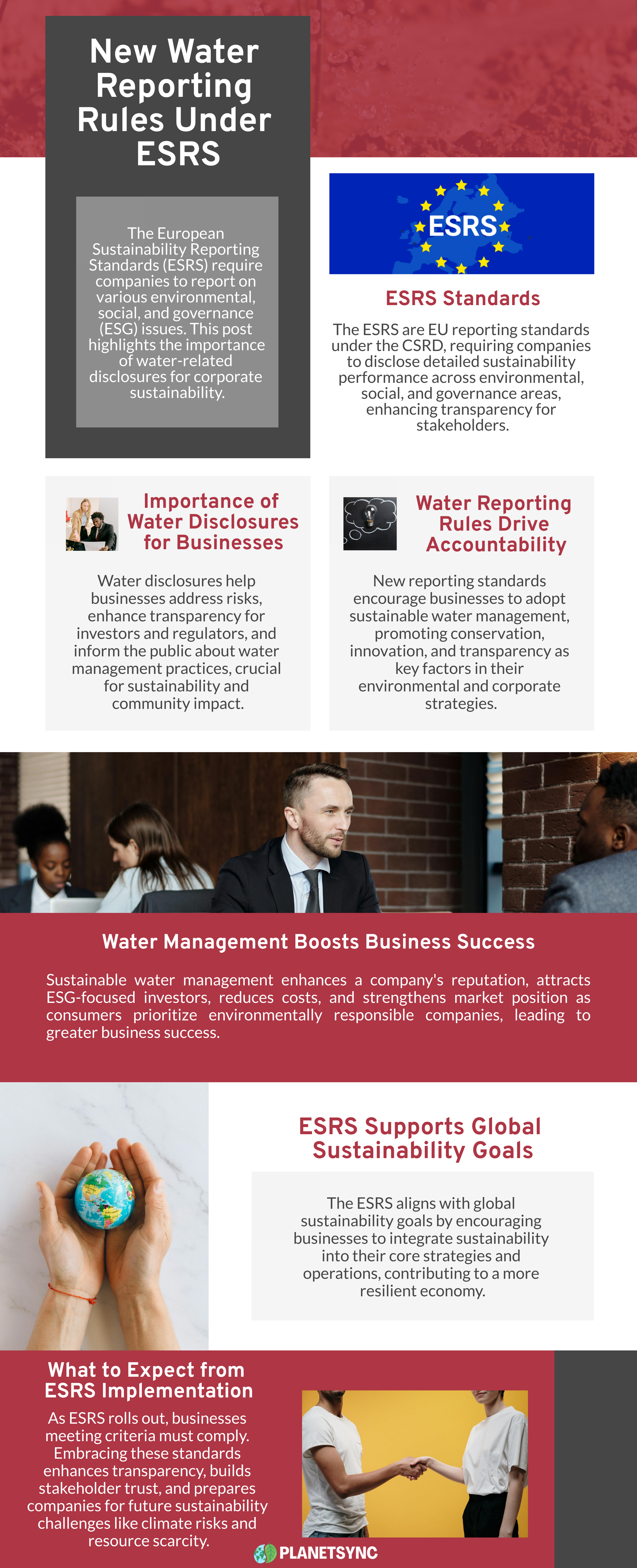
Need the Gist? Check out the infographic below for a quick, visual summary of the key points!
What Are the ESRS?
The ESRS are a set of reporting standards established by the European Union as part of the Corporate Sustainability Reporting Directive (CSRD). They provide a framework for how companies should report on their sustainability performance. These standards require companies to provide detailed reports on a broad array of topics within environmental, social, and governance areas—including climate change mitigation, pollution reduction, efficient resource use, circular economy strategies, biodiversity conservation, labor practices, supply chain management, and corporate governance. By encompassing the full spectrum of sustainability efforts, the ESRS enhance transparency and provide stakeholders—such as investors, regulators, and the public—with a clear view of a company’s sustainability performance.
Why Do Water Disclosures Matter for Every Business?
Water is fundamental to every business, no matter the sector. Companies face increasing risks tied to water scarcity, pollution, and inefficiency. With the ESRS, businesses must now disclose their water consumption and management practices, along with any risks or opportunities related to water resources. This level of transparency is essential for several reasons. First, it allows investors and regulators to assess the environmental footprint of a company, enabling them to make informed decisions about the company’s long-term sustainability. It also provides the public with critical insight into how businesses manage water, a resource that directly impacts communities and ecosystems.
Why are Water-Related Disclosures important? The Benefits Beyond Compliance
The ESRS mandate that companies disclose detailed information about their water usage and management practices, aiming to:
Support Sustainable Development
The ESRS promote water conservation and pollution reduction, directly contributing to broader sustainable development goals. By encouraging better water management, these standards help address global challenges like climate change and resource depletion.
Enhance Transparency
By requiring comprehensive water-related disclosures, the ESRS ensure that stakeholders, including investors, regulators, and the public, have access to vital information about a company’s water consumption, efficiency measures, and environmental impacts. This transparency is crucial for assessing corporate performance and sustainability practices.
Drive Accountability
Public disclosure of water-related data holds companies accountable for their environmental impact. It also provides a basis for regulatory and consumer-driven incentives that encourage the adoption of more sustainable water management practices.
Facilitate Informed Decision-Making
Investors and other stakeholders can use these disclosures to evaluate a company’s sustainability performance, including its resilience to water-related risks such as scarcity, pollution, and regulatory changes. This information is increasingly critical in an era where environmental, social, and governance (ESG) factors are central to investment decisions.
What Can We Expect as the ESRS is Implemented?
The ESRS are being gradually implemented, and eventually, all companies that meet specific criteria will be required to comply. While some businesses might view these new rules as burdensome, those that embrace them will be better equipped to face future sustainability challenges.
Don’t miss my next article, “Key Facts Companies Should Know About the New ESRS” where we’ll break down the phased implementation of the ESRS, key steps for the transition, tools and resources for compliance, explore detailed requirements for water-related disclosures, and uncover how these regulations can be leveraged for a company’s success. Stay tuned!


 planetsync.blog
Leave a comment