


Artificial intelligence (AI) is amazing. It helps us in countless ways. But there’s a hidden cost: AI is thirsty. Really thirsty. In my previous article, we looked at how AI technologies like ChatGPT use massive amounts of water to power their data centers. The good news? We can fix this. There are real, actionable solutions to curb AI’s water footprint.
Need the Gist? Check out the infographic below for a quick, visual summary of the key points!
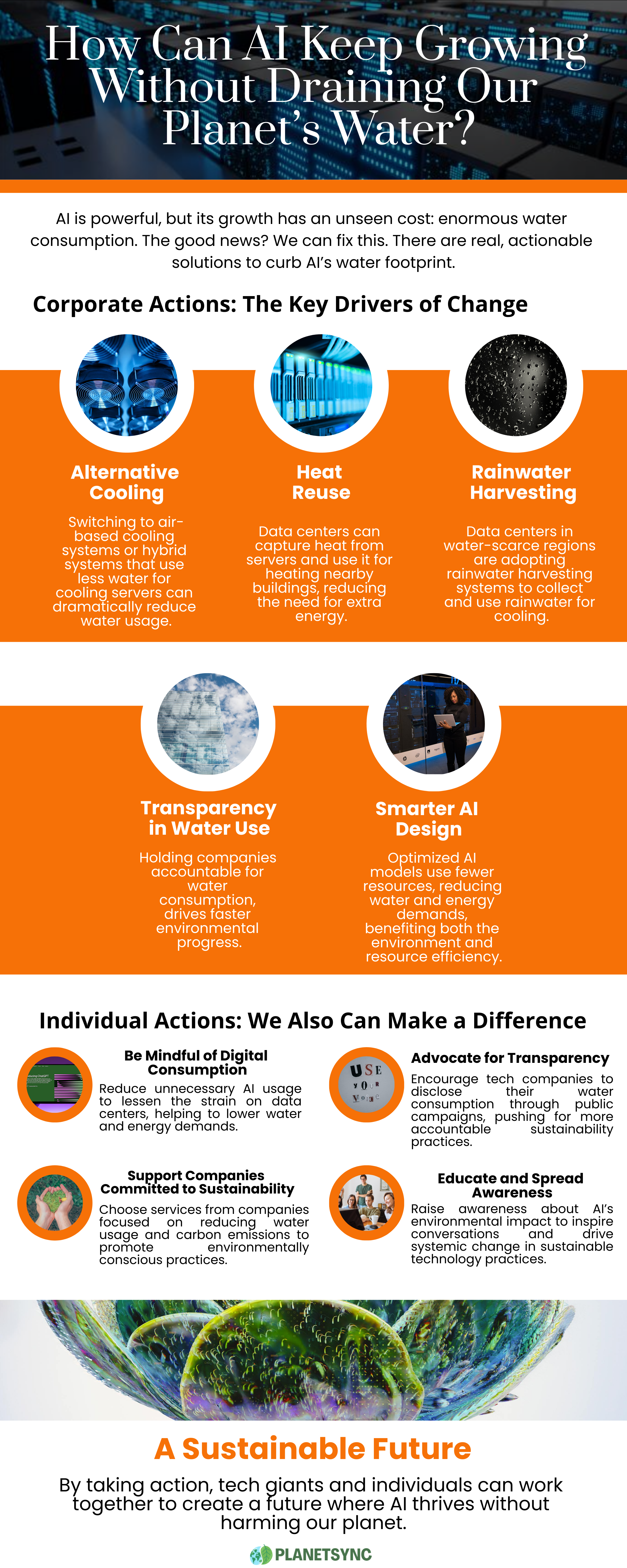
Corporate Actions: The Key Drivers of Change
Big tech companies like Google, Microsoft, and Meta run massive data centers that power AI. These centers are the backbone of the digital world—but they’re also responsible for most of the water consumption in AI. That’s why corporate-level solutions are key to reducing AI’s environmental footprint. Here are some concrete steps companies can take:
Adopting Alternative Cooling Systems
- Air cooling is a great alternative to traditional water-based cooling. This technology uses outside air to cool servers. This is already working well in cooler climates where the air is cold enough to do the job.
- Hybrid cooling systems combine air and water but use water only when necessary. Think of it as a system that only taps into its water reserve on the hottest days, saving a significant amount of water. Several tech companies are piloting hybrid systems, and their use is expanding.
- Direct-to-chip liquid cooling is a method uses liquid to cool specific components (like the CPU or GPU) directly, which is far more efficient than air cooling and requires less water overall.
- Immersion cooling. In this method, servers are fully submerged in a liquid that absorbs heat directly. This reduces the need for traditional cooling methods and can save large amounts of water.
- Adiabatic Cooling. This method uses evaporation to cool the air before it is circulated in the data center. It requires significantly less water than traditional water-based systems. It is particularly useful in regions with moderate to high temperatures.
Heat Reuse
Some data centers are exploring ways to reuse the heat generated by servers. For example, Facebook has experimented with using waste heat from data centers to warm nearby buildings. This reduces the need for additional energy for heating, while also providing community benefits.
Rainwater Harvesting and Recycled Water
Data centers in regions where fresh water is scarce are beginning to implement rainwater harvesting systems to supply their cooling needs. Microsoft, for example, has installed systems to capture rainwater for cooling purposes in Sweden and other countries. They are also exploring the use of recycled water, as seen in their Quincy, Washington facility, which recycles water for data center operations.
Increasing Transparency in Water Use
Tech companies often report their carbon emissions, but many shy away from disclosing their water usage. Why? Partly because it’s not required, but also because the numbers can be staggering. However, greater transparency in reporting water consumption can drive improvements. When companies openly share how much water they use, it creates pressure to innovate and adopt more efficient practices. Imagine if every tech giant were held accountable for water, just like carbon—progress would be faster.
Smarter AI Design
Recent advances in model optimization enable AI systems to operate with fewer resources. For example, developers are working on lightweight models that require less computational power, reducing the need for large-scale server operations. These improvements not only save water but also cut energy consumption, benefiting the environment overall.
What Can We Do as Individuals?
You might be wondering, “What does this have to do with me?” While tech companies carry most of the responsibility, individuals can also make a difference. Here are some ways we can collaborate:
Be Mindful of Digital Consumption
Every time we ask AI a question or interact with a smart assistant, we’re creating demand on data centers. By reducing unnecessary queries and being mindful of how often we rely on AI, we can lessen the strain on these systems. For example, before you ask an AI to generate something or use a virtual assistant, think: Do I really need this? Small reductions in usage, especially across millions of users, can have a ripple effect in reducing water and energy demands on data centers.
Support Companies Committed to Sustainability
As consumers, we have the power to influence change by supporting companies that prioritize sustainable practices. Look for companies that disclose their environmental impact, especially those committed to reducing water usage and carbon emissions. Many companies are now releasing sustainability reports that detail their resource consumption, including water. By choosing services from these companies, we can create market demand for more environmentally conscious practices.
Advocate for Transparency
Demanding transparency from tech companies about their water usage can push them to be more accountable. This doesn’t have to be complicated—public campaigns, petitions, or even reaching out on social media can encourage companies to do better. When we ask companies to disclose their water usage alongside carbon emissions, we’re helping to make water conservation a priority.
Educate and Spread Awareness
Knowledge is power. Raising awareness about AI’s water consumption can spark broader conversations about sustainability in technology. Share articles, videos, and conversations about how our digital activities impact the environment with friends, family, and your broader network. The more people understand AI’s water footprint, the more pressure can be applied for systemic changes.
A Sustainable AI Future: It’s Possible, and We Need It
Imagine a future where AI helps solve some of the world’s biggest challenges without creating new ones. That future isn’t far off, but it depends on one crucial thing: making AI sustainable. Right now, the massive data centers powering AI consume a huge amount of water and energy, and that’s a problem we can’t ignore.
Sure, small actions—like being mindful of how we use AI—help, but the real responsibility falls on the tech giants. They’re the ones running these data centers, and they have the power to make real change. It is their infrastructure, resource management, and technological decisions that drive most of the water consumption in AI.
But here’s the thing: they’ll only move faster if we demand it. By supporting companies committed to sustainability, we send a clear message that we want AI to be as good for the planet as it is for innovation. Together, we can push for a future where AI isn’t just brilliant, it’s also kind to the world we all share.
References & Resources
- Innovative cooling solutions reduce datacenter water consumption
- Modern datacenter cooling
- Sustainable by design: Transforming datacenter water efficiency
- To cool datacenter servers, Microsoft turns to boiling liquid
- Co-designing electronics with microfluidics for more sustainable cooling
- Our commitment to climate-conscious data center cooling
- Water Efficiency
- Microsoft 2024 Environmental Sustainability Report


 planetsync.blog
Leave a comment