


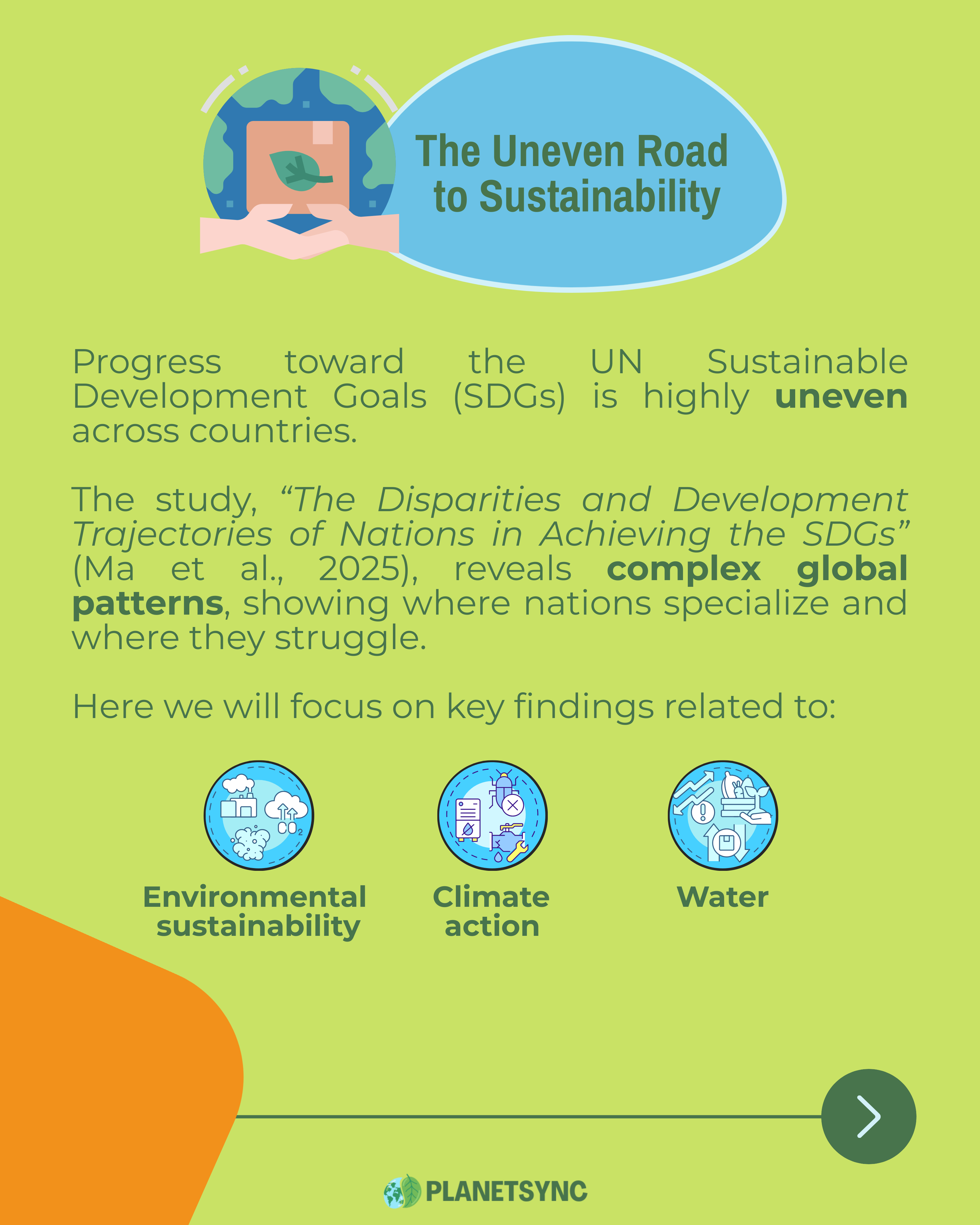
The Sustainable Development Goals (SDGs) provide a comprehensive framework for societal progress and planetary health, aiming to guide the world toward a more sustainable, fair, and resilient future. However, progress remains highly uneven across nations. While some countries excel in sustainability, others continue to struggle, with significant variations in development paths.
A recent study, The Disparities and Development Trajectories of Nations in Achieving the Sustainable Development Goals” (Ma et al., 2025), highlights these disparities and explores how nations specialize in different SDG indicators. This article focuses on key findings related to environmental sustainability, climate action, and water.
Need the Gist? Swipe through the visuals below for a quick summary!
Mapping Global Sustainability Patterns
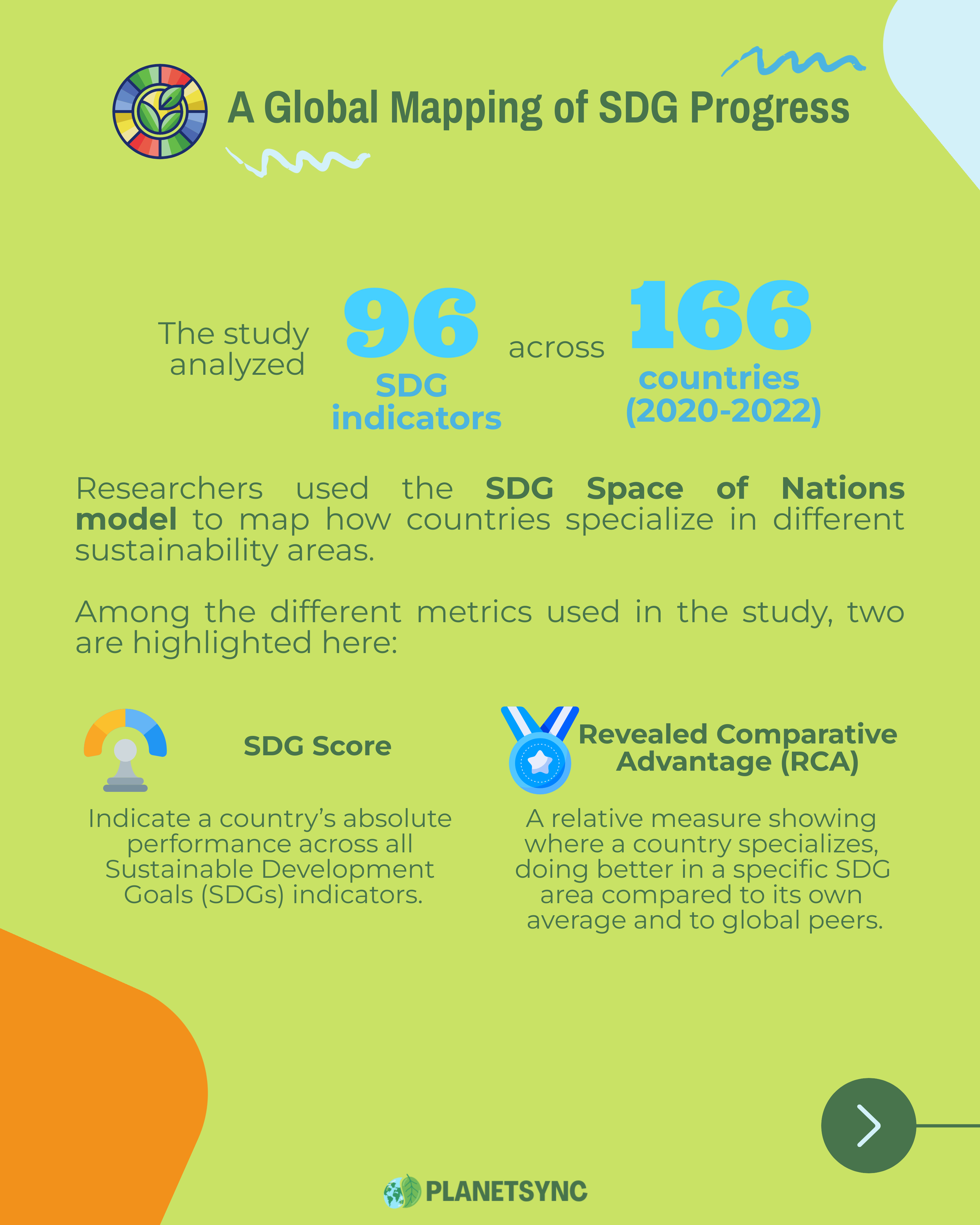
The study examined data from 166 countries between 2000 to 2022, tracking 96 SDG indicators that measure progress toward all 17 Sustainable Development Goals (SDGs).
To analyze global sustainability trends, researchers developed the SDG Space of Nations, a model that maps how countries specialize in different sustainability areas. This approach reveals which aspects of sustainability nations prioritize and which goals may be overlooked.
A key concept in this study is Revealed Comparative Advantage (RCA), which measures how much a country specializes in sustainability areas. A country has a high RCA in a particular SDG indicator if its performance in that indicator is strong, both when compared to its own average performance across all SDG indicators and when compared to the average performance of other countries. This highlights where a country is relatively specialized. For instance, if a country outperforms in wastewater treatment but lags in reducing carbon emissions, it would have a high RCA in wastewater management but low RCA in emissions control.
To assess overall performance, the study utilizes overall SDG Scores, which represent a country’s absolute performance across the SDG indicators.
Key Findings on Water, Environment and Climate: Where Countries Excel and Struggle
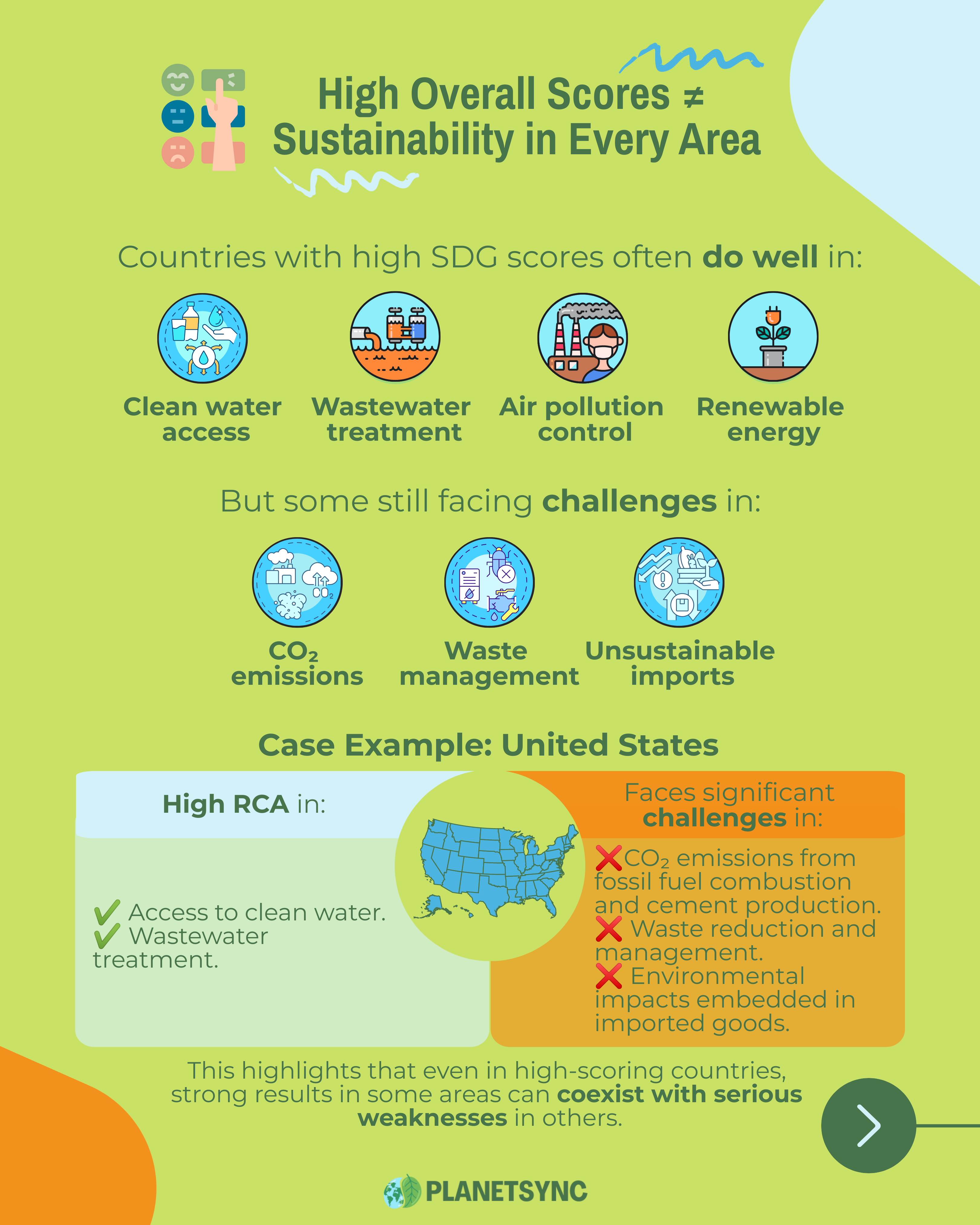
Countries with high overall SDG scores tend to show stronger progress in indicators related to air pollution treatment, wastewater management, access to clean water, basic sanitation services, basic drinking water services, and clean energy. However, performance varies across nations, with some high-SDG-score countries still facing sustainability challenges in specific areas such as CO₂ emissions, waste management, high water consumption, overextraction of groundwater, and unsustainable consumption.
For instance, countries such as the United States has a high RCA in access to clean water and wastewater treatment, indicating strong relative performance in these indicators. However, the country continues to struggle with reducing CO₂ emissions from fossil fuel combustion and cement production, waste reduction, and addressing the environmental impacts linked to imported goods.
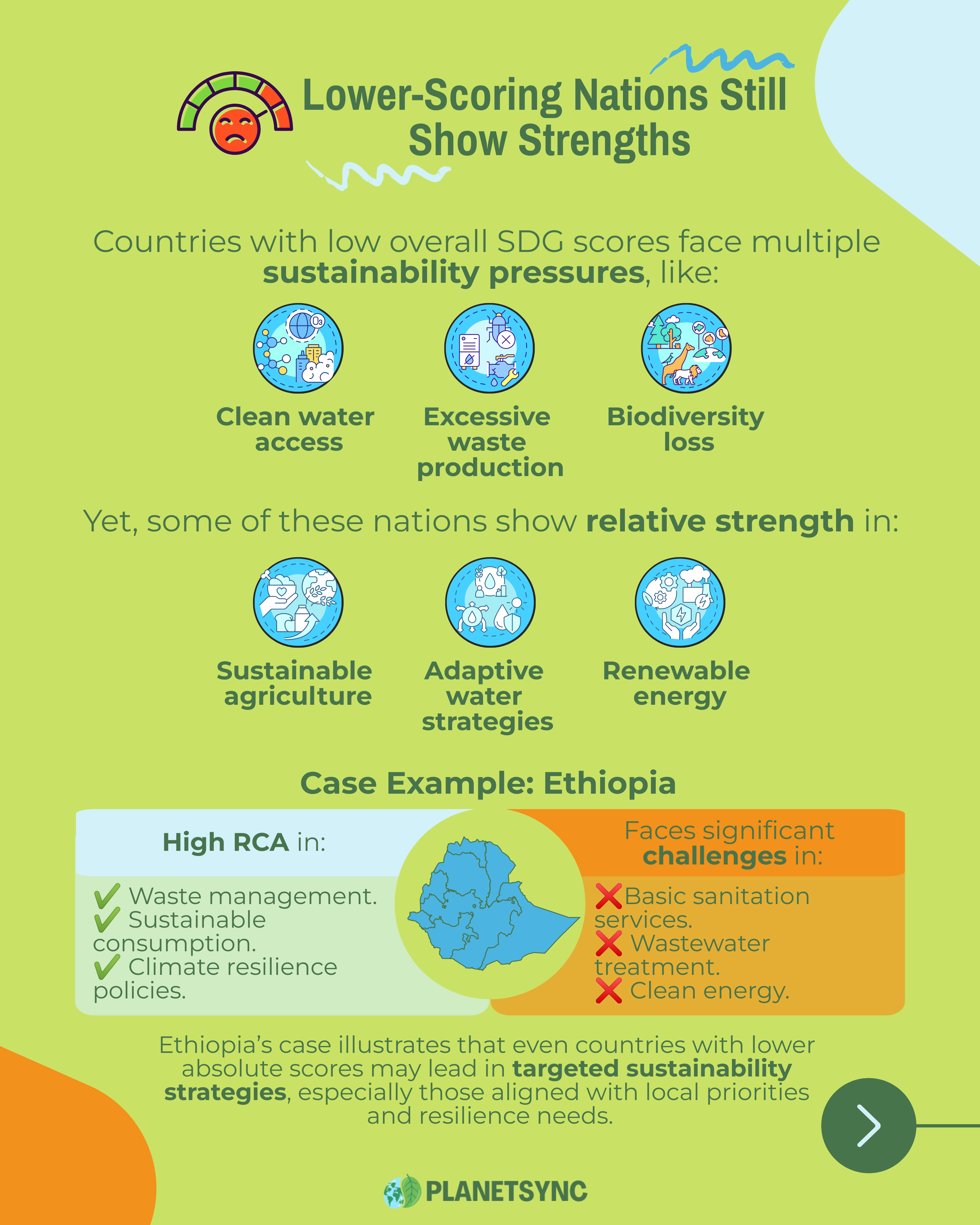
In contrast, countries with low overall SDG scores face widespread sustainability challenges, including clean water access, high water consumption linked to imports, significant NO₂ and SO₂ (two of the most dangerous air pollutants) emissions embedded in imports, large carbon footprints from imported goods, high CO₂ emissions from industrial activities, excessive waste production (including e-waste and municipal waste), and threats to marine, freshwater, and terrestrial biodiversity. However, some low-SDG-score countries also demonstrate strengths in key sustainability areas, including renewable energy, sustainable agriculture, and adaptive water management strategies.
For example, Ethiopia faces persistent challenges in basic sanitation services, wastewater treatment, and clean energy transition. At the same time, the country has a high RCA in indicators related to waste management practices, sustainable consumption, and climate resilience policies, highlighting areas of relative strength despite broader sustainability struggles.
Understanding the Landscape and Preparing for the Road Ahead
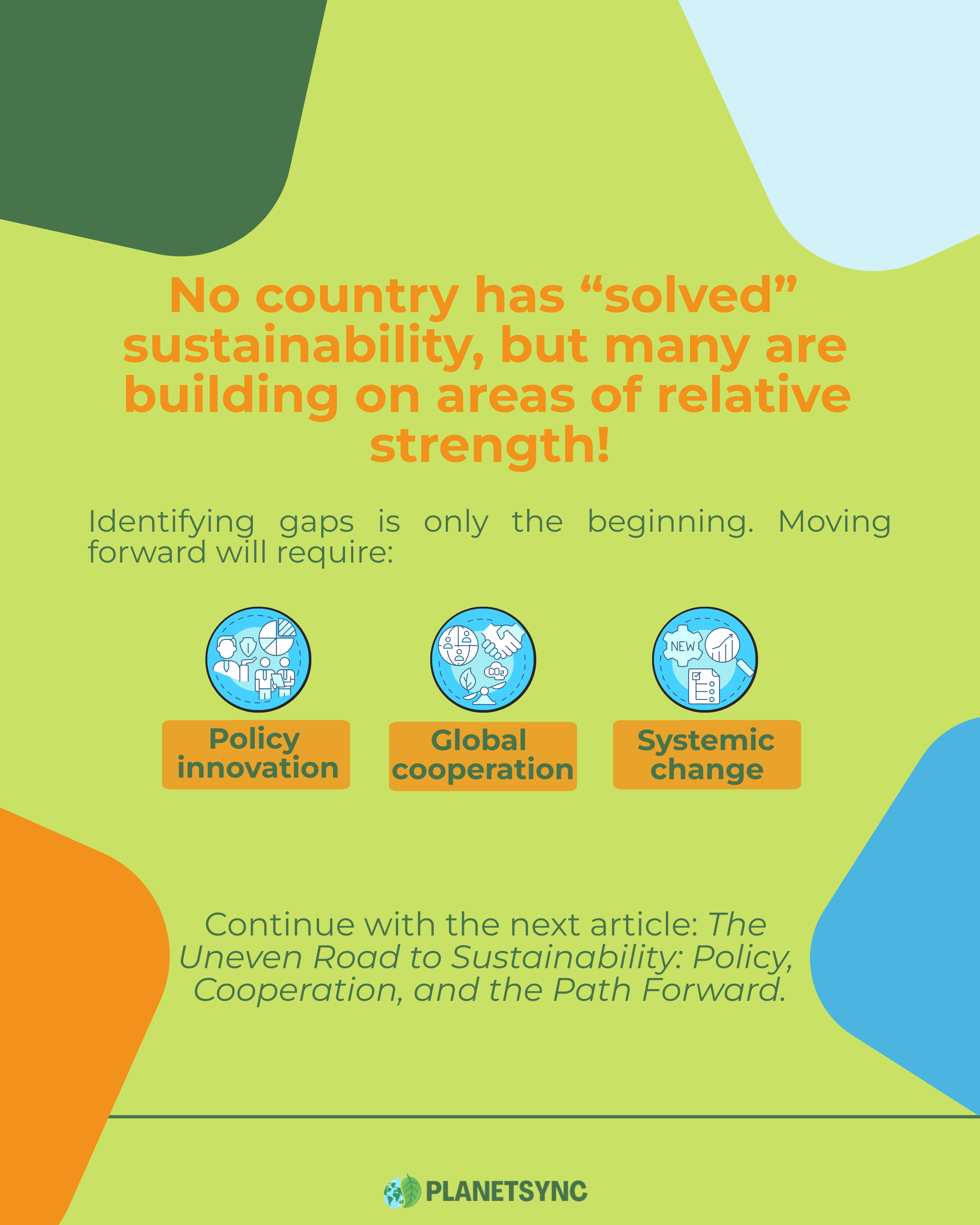
The study makes one thing clear: while no country has perfected the path to sustainability, many are carving out areas of relative strength, even amid broader struggles. By looking at both specialization and overall performance, we begin to see a fuller picture of progress, imbalance, and opportunity.
But understanding where countries stand is only the first step. What comes next is crucial: how can nations navigate these uneven pathways, correct courses where needed, and collaborate to ensure shared success? To explore the policies, partnerships, and systemic changes required to move forward, continue reading the next article: The Uneven Road to Sustainability: Policy, Cooperation, and the Path Forward.


 planetsync.blog
Leave a comment