


In the previous article, Beyond Policy: Examining the EU’s Progress on Climate Ambition Targets, we examined progress toward the EU’s 9 climate targets under the “Climate Ambition” pillar of the European Green Deal. The analysis revealed a mixed picture: while some targets are on track, others are unlikely to be met without additional measures.
This raises a critical question: what factors are limiting implementation?
The 2025 report by the Joint Research Centre (JRC), Delivering the EU Green Deal – Progress Towards Targets, identifies a range of systemic and structural challenges. These include misalignments between EU and national planning, delayed rollout of key policies, data and monitoring limitations, and gaps in investment and technological deployment.
This final article in the series offers a summary of those barriers. So, let’s take a look!
Need the Gist? Swipe through the visuals below for a quick summary!



Misalignment Between EU and National Plans
One of the most persistent challenges is the disconnect between EU-level climate objectives and national-level implementation strategies. While the European Climate Law and “Fit for 55” package lay out a coherent and legally binding roadmap, many EU Member States have adopted National Energy and Climate Plans (NECPs) that are misaligned in scope, timing, or ambition.
For example, some countries prioritize technologies or infrastructure investments that are less cost-effective or slower to deploy, creating bottlenecks in progress. In other cases, national transportation strategies lack consideration for cross-border emissions, undermining the cohesion needed to achieve Europe-wide decarbonization.
This fragmentation complicates the overall assessment of EU progress and weakens the effectiveness of collective action.
Incoherent Projections at EU Level
The JRC report underscores a key problem: the projections submitted by Member States are not mutually coherent when aggregated at the EU level. These projections often fail to capture the anticipated impact of EU-wide legal frameworks, such as the Emissions Trading System (ETS).
Without harmonized modelling or common methodological baselines, it becomes difficult to assess whether the EU as a whole is on track. The divergence between national assumptions and EU-level outcomes introduces uncertainty into the system, affecting both accountability and planning.
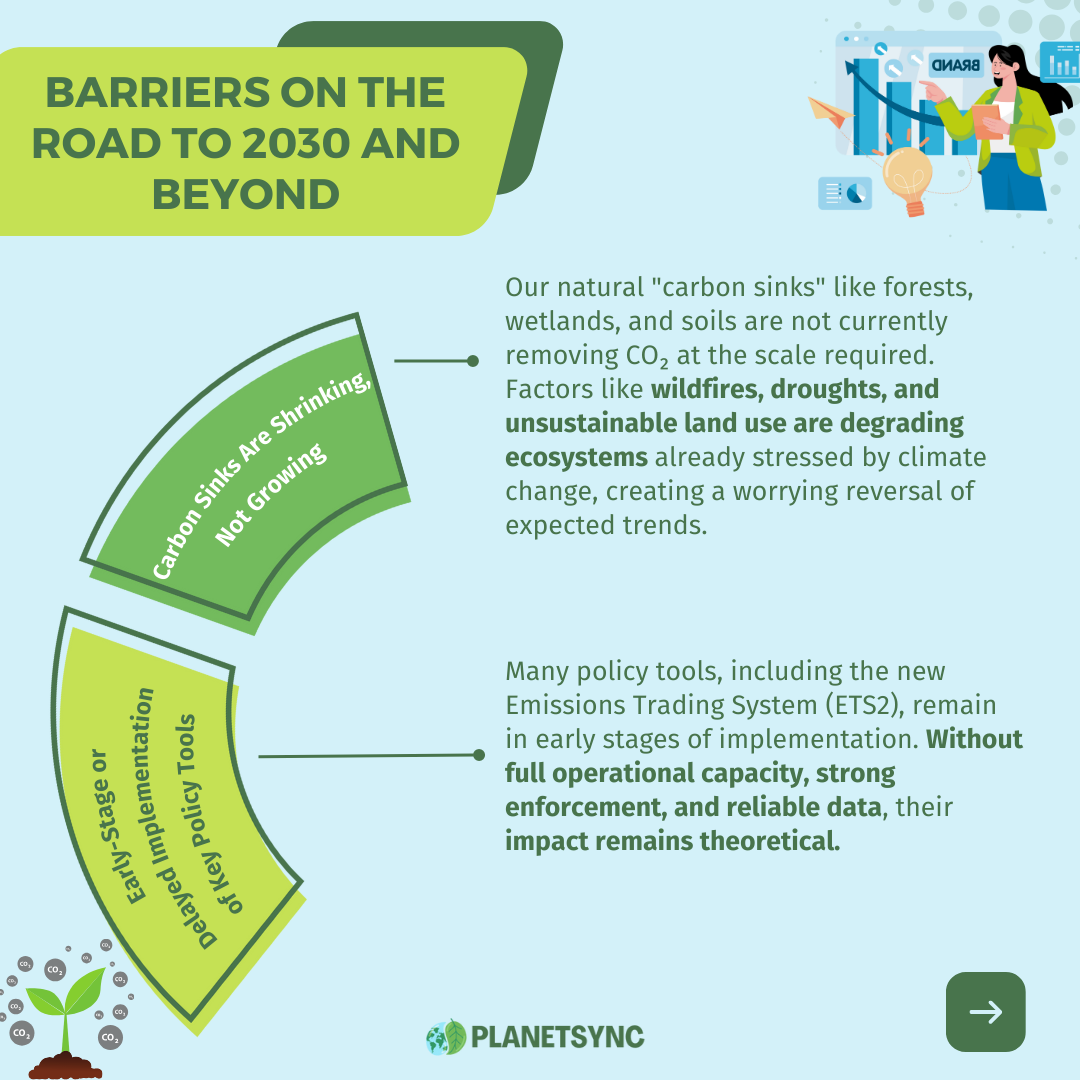
Carbon Sinks Are Shrinking, Not Growing
Our natural “carbon sinks” like forests, wetlands, and soils are not currently removing CO₂ at the scale required. Factors such as forest degradation, wildfires, droughts, and pest outbreaks (all worsened by climate change) are contributing to this regression.
Early-Stage or Delayed Implementation of Key Policy Tools
Several critical policy tools are still in early stages of implementation and have not yet produced measurable impacts. For example, the ETS2 will be fully operational in 2027, and current data is not yet available to assess its contribution. Until these systems are fully running and supported by comprehensive data and enforcement mechanisms, their contribution remains speculative. This lag time creates a window during which emissions may continue unchecked in sectors expected to deliver major reductions.
Persistent Challenges in Effort Sharing Regulation Sectors (ESR)
The sectors covered by the ESR account for roughly 60% of the EU’s emissions. Yet progress in these sectors is lagging behind. For example, renovating Europe’s ageing housing stock is complex, expensive, and often dependent on national subsidies or private investment decisions. Agriculture is another tough area, it continues to present difficulties as a hard-to-abate sector with significant methane and nitrous oxide emissions, limited technological alternatives, and the complexity of national implementation systems.
Monitoring and Data Gaps
Robust implementation depends on accurate and timely data. Yet in several cases, particularly methane emissions and carbon removals, key monitoring systems are either still under development or not yet producing reliable results.
For instance, a dedicated regulation for methane emissions in the energy sector was adopted in August 2024, but implementation is still at an early stage. Without consistent data on leaks, venting, and flaring, it is difficult to evaluate whether real-world reductions are occurring. Similarly, land-based carbon removals are subject to complex accounting methodologies, and gaps in satellite monitoring or land-use reporting remain. These limitations reduce transparency and slow the feedback loop necessary for policy adjustment.
Technology and Investment Gaps
Meeting the 2040 and 2050 climate targets will require the deployment of climate-neutral technologies at an unprecedented scale. While many of these technologies (such as renewable hydrogen, direct air capture, and negative emissions farming) are promising, they remain expensive or commercially immature.
In parallel, substantial public and private investment is needed to scale up existing solutions like clean energy grids and low-carbon transport infrastructure. But in many cases, investment levels fall short of what is required to meet the trajectory of the targets.
This investment gap risks locking in higher-emission pathways in the medium term and delaying the deployment of game-changing technologies in the long term.
We Need to Bridge the Gap
As the JRC report shows, there’s a big gap between having good plans and actually putting them into action. Problems like misaligned national plans, incoherent data, shrinking carbon sinks, and sector-specific hurdles all contribute to an implementation gap that threatens the credibility of the EU’s climate ambitions.
Reaching our 2030 goals and getting ready for the even tougher 2050 target demands consistent follow-through, smart investments, reliable ways to track progress, and most importantly, the political will to make it happen.
The EU has the tools. What it needs now is relentless execution.


 planetsync.blog
Leave a comment