


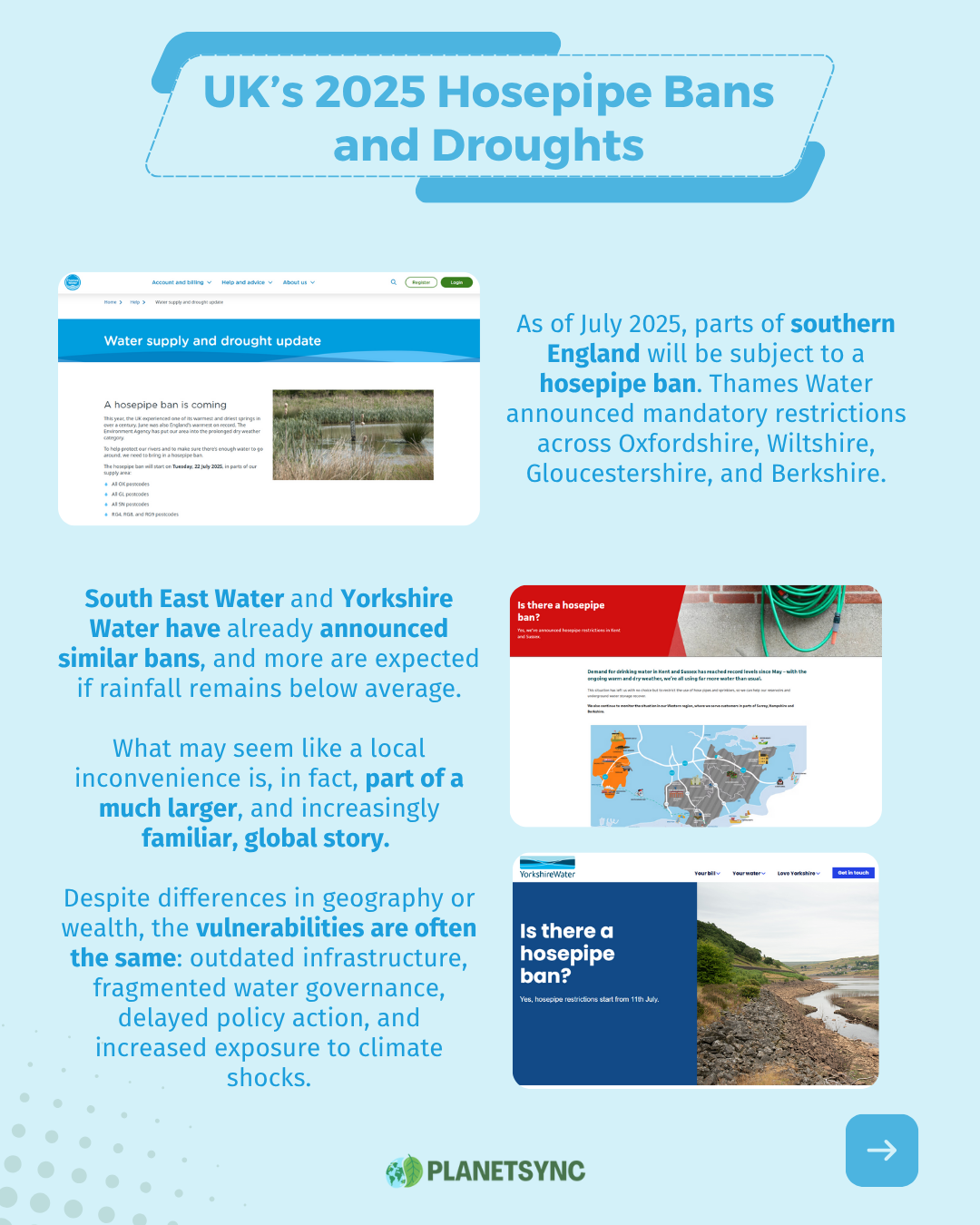
As of July 2025, parts of southern England will be subject to a hosepipe ban. Thames Water, Britain’s largest water supplier, announced mandatory restrictions across Oxfordshire, Wiltshire, Gloucestershire, and Berkshire following the driest spring in more than 130 years, combined with record-breaking temperatures in June. Similar bans have already been announced by South East Water and Yorkshire Water, and more are expected if rainfall remains below average.
What may seem like a local inconvenience is, in fact, part of a much larger, and increasingly familiar, global story. In many places, water systems were built for 20th-century climate norms that no longer exist. Now, they must contend with new extremes: prolonged drought, sudden floods, unpredictable rainfall, and intensifying heatwaves. Despite differences in geography or wealth, the vulnerabilities often remain the same: outdated infrastructure, fragmented water governance, delayed policy action, rising demands, and increased exposure to climate shocks.
While the UK’s situation has its own context, it is far from unique and represents a window into a global challenge, one that demands more adaptive, resilient, and forward-thinking approaches to water management in a rapidly changing climate.
Need the Gist? Swipe through the visuals below for a quick summary!


What’s Behind the Hosepipe Bans?
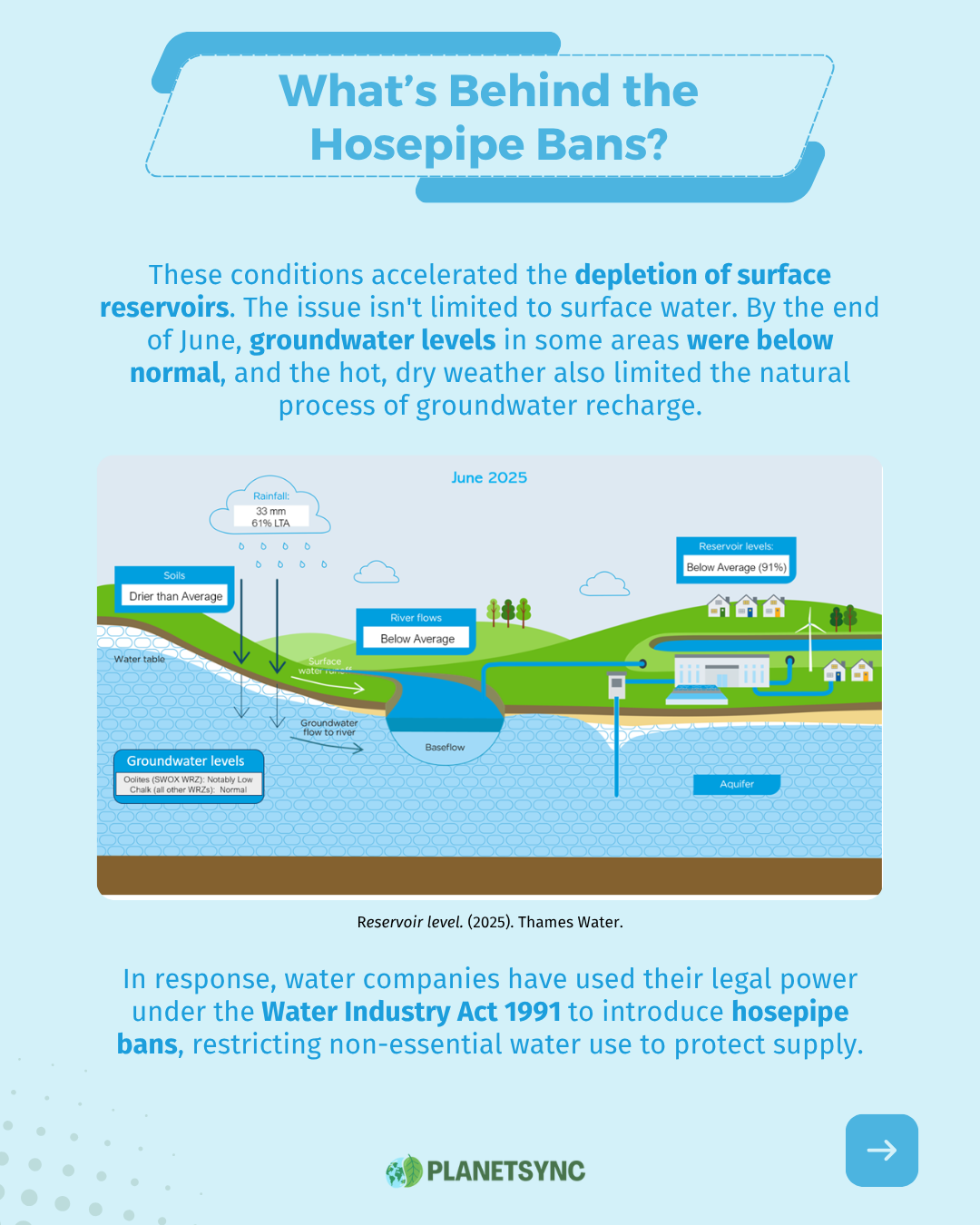
According to data from the UK Met Office, the spring months from March to May 2025 were exceptionally dry, marking the driest spring since 1893. Rainfall during this period was approximately 40% below the long-term seasonal average. This prolonged dry spell was followed by an unprecedented heatwave in June. It was the hottest June on record, with several consecutive days in which temperatures soared above 34°C in southern counties. These extreme conditions accelerated the depletion of surface reservoirs, which depend on consistent rainfall and moderate temperatures to maintain levels.
The issue isn’t limited to surface water. By the end of June, groundwater levels in areas such as Swindon and Oxfordshire were already below normal, and the hot, dry weather also limited the natural process of groundwater recharge, exacerbating the situation.
In response, water companies have invoked powers granted to them under the Water Industry Act 1991 to implement Temporary Use Bans (TUBs) to safeguard supply. Under the current ban, the use of hosepipes for non-essential activities is prohibited. This includes watering gardens or lawns, washing vehicles or outdoor surfaces, and filling swimming pools, paddling pools, or ornamental fountains. Violating these restrictions carries a financial penalty. Individuals who breach the ban can face fines of up to £1,000.
A Climate Signal, Not a One-Off
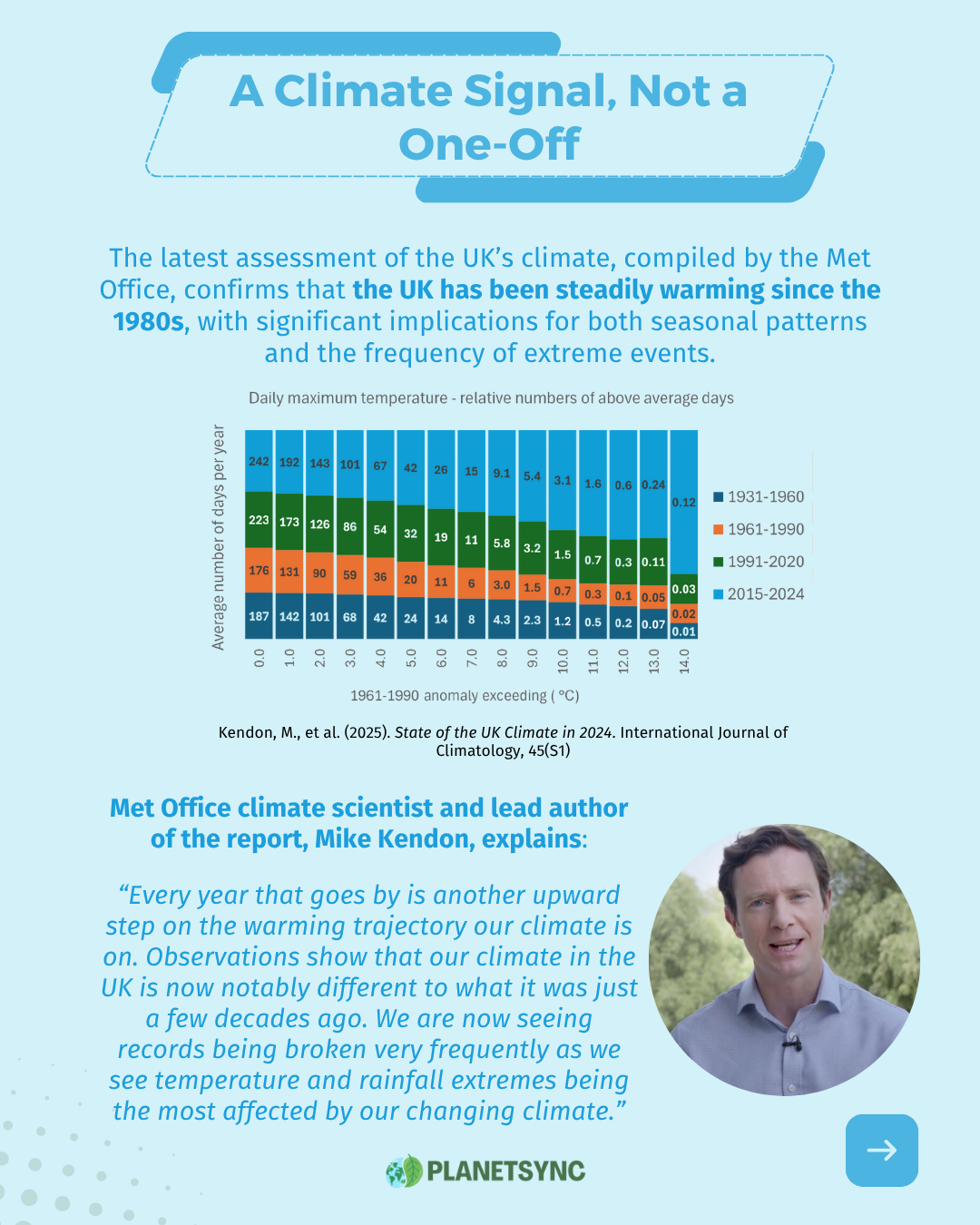
The latest assessment of the UK’s climate reveals a clear and accelerating shift: baselines are moving, records are falling more frequently, and extreme weather is becoming the norm. The report, compiled by the Met Office, confirms that the UK has been steadily warming since the 1980s, with significant implications for both seasonal patterns and the frequency of extreme events.
Since the 1980s, the UK has warmed at an average rate of approximately 0.25°C per decade. Notably, the last three years have all ranked among the five warmest ever recorded in the UK, highlighting the continued upward trend
Temperature extremes are at the forefront of this shift. According to the Met Office, the hottest summer days in parts of the UK have warmed roughly twice as much as average summer days when compared to the baseline period of 1961–1990. In effect, the most intense heat is becoming even more intense.
Met Office climate scientist and lead author of the report, Mike Kendon, explains:
“Every year that goes by is another upward step on the warming trajectory our climate is on. Observations show that our climate in the UK is now notably different to what it was just a few decades ago. We are now seeing records being broken very frequently as we see temperature and rainfall extremes being the most affected by our changing climate.”
Kendon emphasizes that this isn’t just natural variation in the climate. The pace of change and the clustering of back-to-back record-breaking years point clearly to human influence.
“Numerous studies have shown how human emissions of greenhouse gasses are warming the atmosphere and changing the weather we experience on the ground. Our climate in the UK is now different to what it was just a few decades ago, this is clear from our observations.”
Aging Infrastructure and Rising Demand
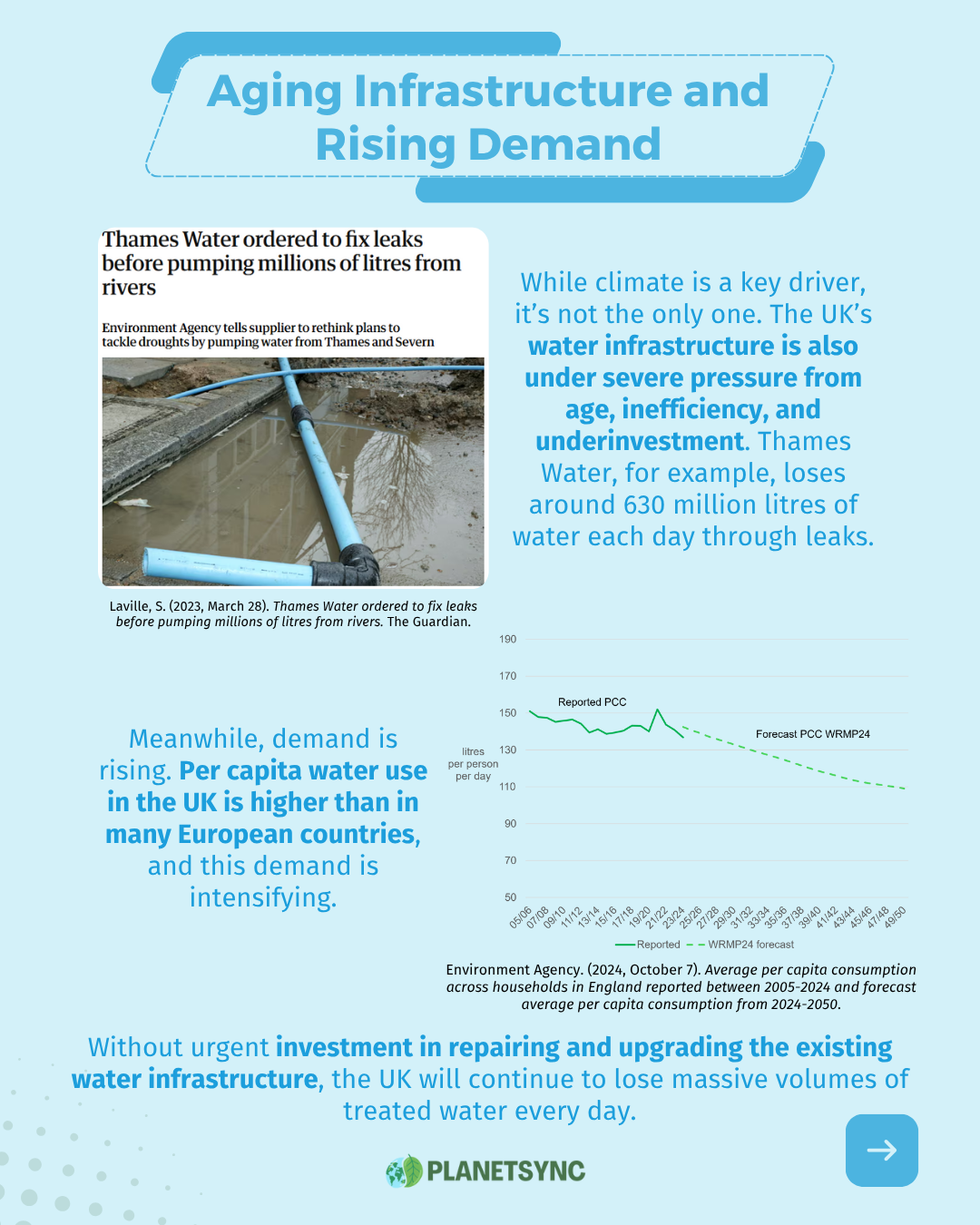
While climate is a key driver, it’s not the only one. The UK’s water infrastructure is also under severe pressure from age, inefficiency, and underinvestment. Thames Water, for example, loses around 630 million litres of water each day through leaks, enough to supply millions of households.
Meanwhile, demand is rising. Per capita water use in the UK is higher than in many European countries, and this demand is intensifying. Population growth in the southeast of England is outpacing national trends, increasing pressure on an already overstretched system.
In response, some regions are piloting surge pricing models, which charge higher rates for water used during peak periods to encourage conservation. Plans are also underway to accelerate the rollout of smart meters, allowing for more precise monitoring and early detection of leaks and excessive use. At a broader scale, officials are reviewing long-term strategies such as building new reservoirs, developing desalination facilities, and improving the infrastructure needed for inter-regional water transfers.
However, these measures, while important, fall short of addressing the vulnerabilities in the system. Without urgent investment in repairing and upgrading the existing water infrastructure, especially to reduce leakage, the UK will continue to lose massive volumes of treated water every day, undermining even the best-intentioned reforms. Fixing the future means first fixing what’s broken.
Why This Should Matter Everywhere
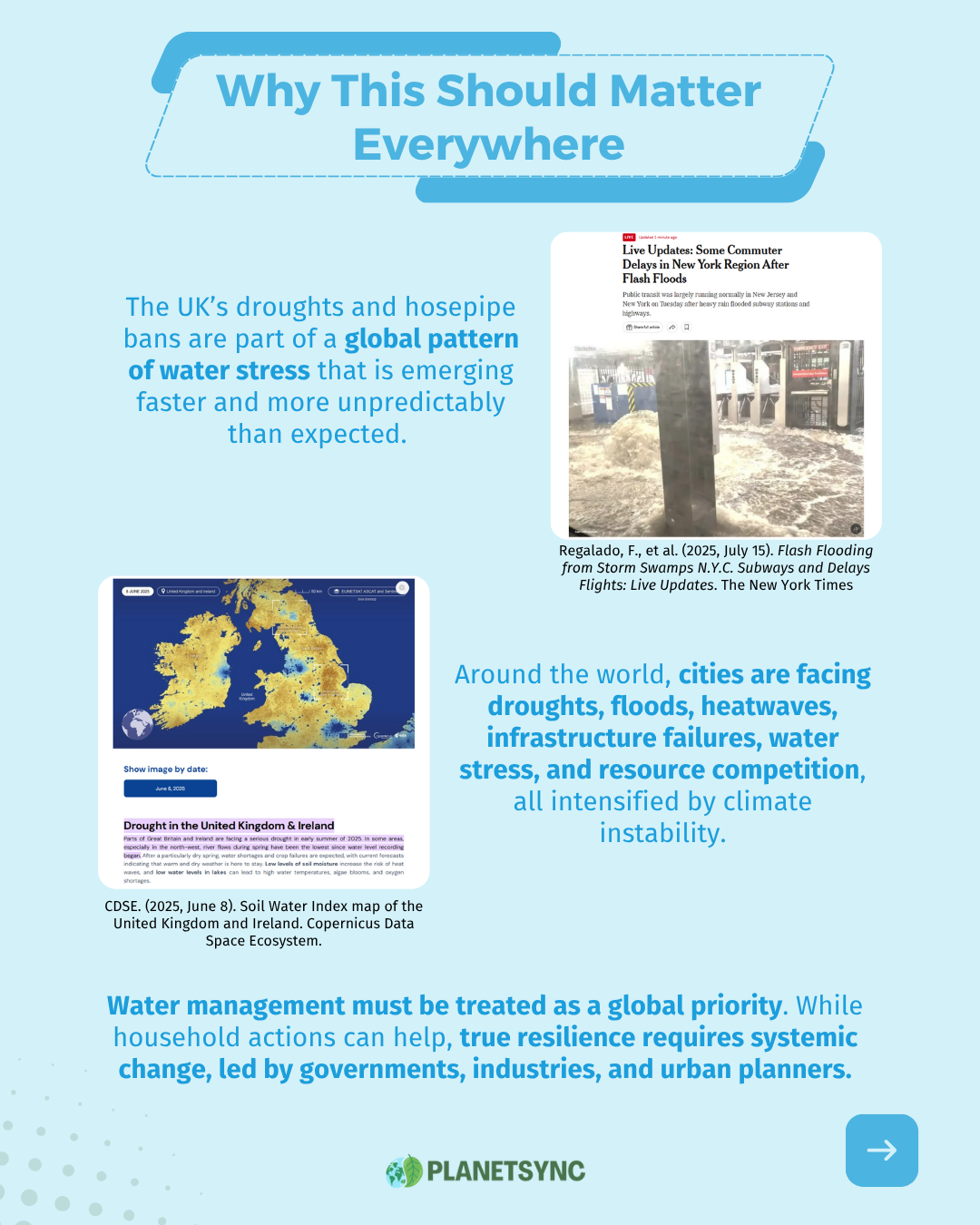
The UK’s droughts and hosepipe bans might seem like a regional problem, but they’re part of a global pattern of water stress that is emerging faster and more unpredictably than expected. Around the world, cities are facing droughts, floods, heatwaves, infrastructure failures, water stress, and resource competition, all intensified by climate instability.
This makes water management a global priority, not only during crises, but as part of everyday life. Simple actions at the household level, like turning off the tap while brushing your teeth, fixing leaks, collecting rainwater, or running dishwashers and washing machines only when full, can help ease demand (especially during periods of stress) when adopted at scale. But on their own, these efforts aren’t enough.
Real resilience depends on broader, systemic change. Governments, industries, and urban planners must lead with integrated, forward-looking strategies that strengthen water systems against increasingly unpredictable conditions. This includes investing in robust, climate-resilient infrastructure; accelerating smart water metering and leak detection; redesigning cities to manage both water scarcity and water overload; and diversifying sources through reuse, recycling, and nature-based solutions. Governance must also evolve, prioritizing flexibility, equity, and long-term sustainability in the face of climate volatility.
A Shared Responsibility
The UK’s water crisis offers a glimpse of what many regions are facing, regardless of wealth or geography. It reminds us that no water system is immune to climate disruption.
Whether you live in THE United Kingdom, the Netherlands, Spain, or the United States, securing our water future will require both everyday responsibility and ambitious, coordinated leadership. The goal shouldn’t be just to manage today’s disruptions, but to build systems that can absorb shocks, adapt in real time, and sustain communities through whatever climate future unfolds.
References & Resources
- Environment Agency. (n.d.). Water resources 2023-2024: Analysis of the water industry’s annual water resources performance. GOV.UK. https://www.gov.uk/government/publications/water-resources-2023-2024-analysis-of-the-water-industrys-annual-water-resources-performance/water-resources-2023-2024-analysis-of-the-water-industrys-annual-water-resources-performance
- Environment Agency. (2025, June 12). Why do we have hosepipe bans during a drought? https://environmentagency.blog.gov.uk/2025/06/12/why-do-we-have-hosepipe-bans-during-a-drought/
- GOV.UK. (n.d.-a). England faces 5 billion litre public water shortage by 2055 without urgent action. https://www.gov.uk/government/news/england-faces-5-billion-litre-public-water-shortage-by-2055-without-urgent-action
- GOV.UK. (n.d.-b). National Drought Group meets after driest spring in 132 years. https://www.gov.uk/government/news/national-drought-group-meets-after-driest-spring-in-132-years
- GOV.UK. (n.d.-c). South-east England water situation report: May 2025 summary. https://www.gov.uk/government/publications/water-situation-local-area-reports/south-east-england-water-situation-report-may-2025-summary
- GOV.UK. (n.d.-d). Water situation: June 2025 summary. https://www.gov.uk/government/publications/water-situation-national-monthly-reports-for-england-2025/water-situation-june-2025-summary
- IPCC Sixth Assessment Report. (n.d.). Chapter 11: Weather and Climate Extreme Events in a Changing Climate | Climate Change 2021: The Physical Science Basis. https://www.ipcc.ch/report/ar6/wg1/chapter/chapter-11/
- Kendon, M., Doherty, A., Hollis, D., Carlisle, E., Packman, S., Jevrejeva, S., Matthews, A., Williams, J., Garforth, J., & Sparks, T. (2025a). State of the UK Climate in 2024. International Journal of Climatology, 45(S1). https://doi.org/10.1002/joc.70010
- Kendon, M., Doherty, A., Hollis, D., Carlisle, E., Packman, S., Jevrejeva, S., Matthews, A., Williams, J., Garforth, J., & Sparks, T. (2025b). State of the UK Climate in 2024. International Journal of Climatology, 45(S1). https://doi.org/10.1002/joc.70010
- Laville, S., & correspondent, S. L. E. (2023, March 28). Thames Water ordered to fix leaks before pumping millions of litres from rivers. The Guardian. https://www.theguardian.com/environment/2023/mar/28/thames-water-ordered-to-fix-leaks-before-pumping-millions-of-litres-from-rivers
- Marshall, S. (2020, August 17). Water, water everywhere…or is it? South East Rivers Trust. https://www.southeastriverstrust.org/water-water-everywhere-or-is-it/
- Met Office. (n.d.-a). Annual climate stocktake shows weather records and extremes now the norm in UK Climate. Met Office. https://www.metoffice.gov.uk/about-us/news-and-media/media-centre/weather-and-climate-news/2025/annual-climate-stocktake-shows-weather-records-and-extremes-now-the-norm-in-uk-climate
- Met Office. (n.d.-b). Double record breaker: Spring 2025 is warmest and sunniest on UK record. https://www.metoffice.gov.uk/about-us/news-and-media/media-centre/weather-and-climate-news/2025/double-record-breaker-spring-2025-is-warmest-and-sunniest-on-uk-record
- Met Office. (n.d.-c). Weather and Climate summaries. Met Office. https://www.metoffice.gov.uk/research/climate/maps-and-data/summaries/index
- South East Water. (n.d.). South East Water’s hosepipe ban—FAQs. https://www.southeastwater.co.uk/about/updates/tubs-faq-25/,
- Thames Water. (n.d.-a). Groundwater levels and rain. Retrieved July 14, 2025, from https://www.thameswater.co.uk/about-us/environment/groundwater-levels
- Thames Water. (n.d.-b). Our leakage performance. Retrieved July 14, 2025, from https://www.thameswater.co.uk/about-us/performance/leakage-performance
- Thames Water. (n.d.-c). Reservoir levels. https://www.thameswater.co.uk/about-us/performance/reservoir-levels-and-rainfall-figures
- Thames Water. (n.d.-d). Water resources situation—June 2025. https://www.thameswater.co.uk/about-us/performance/reservoir-levels-and-rainfall-figures
- Thames Water. (n.d.-e). Water supply and drought update. https://www.thameswater.co.uk/help/water-supply-and-drought-update
- Water Industry Act 1991. (n.d.). Statute Law Database. https://www.legislation.gov.uk/ukpga/1991/56/contents
- Yorkshire Water. (n.d.-a). How the hosepipe ban affects your business. https://www.yorkshirewater.com/wwebsite-prd-fe.appsrvenv.appserviceenvironment.net
- Yorkshire Water. (n.d.-b). Is there a hosepipe ban? https://www.yorkshirewater.com/wwebsite-prd-fe.appsrvenv.appserviceenvironment.net


 planetsync.blog
Leave a comment